
 Ammar Sabilarrohman
 Laily UPN
 Evan Lee Salim
 Jia Lissa
 Pevita Pearce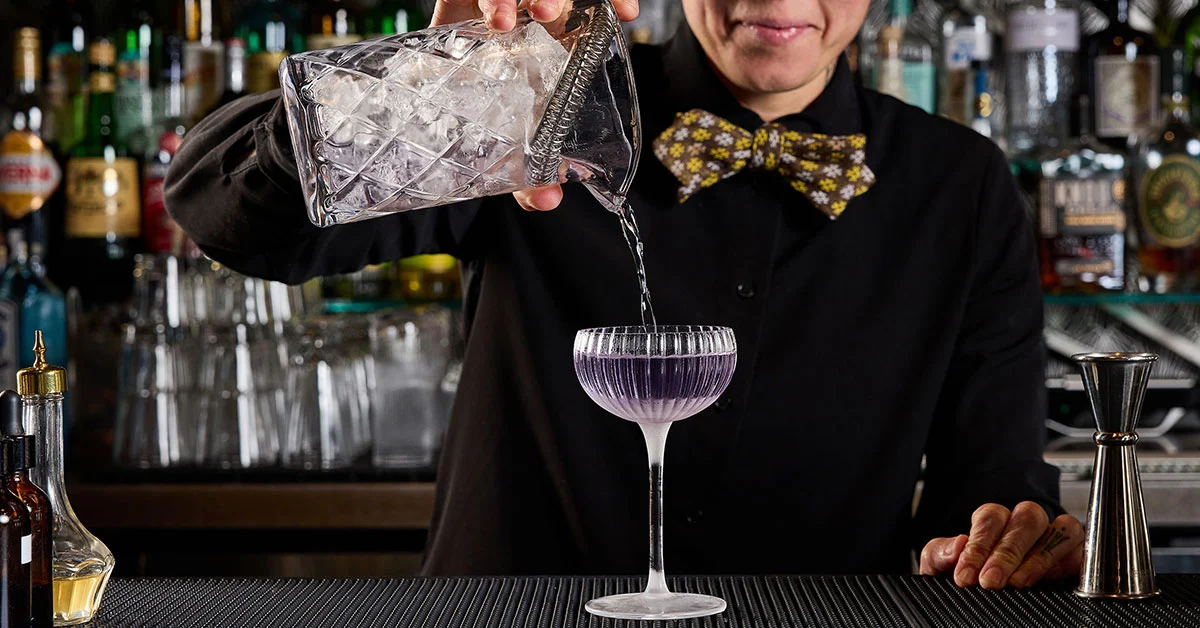
In the dim, velvet-clad glow of Denver’s Nocturne, where the brassy echoes of bebop and swing music cling to the rafters, Brandyn Shank is conducting a different kind of performance. He isn’t just pouring drinks; he is acting as an archaeologist of liquid history. At the center of his current repertoire is a cocktail that has been largely forgotten by the modern palate: the Arsenic and Old Lace.
It is a drink that rarely appears on a guest’s lips as a request. Unlike the ubiquitous Martini or the trendy Espresso Martini, the Arsenic and Old Lace—a 1940s-era Martini variation—has faded into the yellowed pages of mid-century cocktail manuals. Yet, for Shank, the beverage is not merely a relic. It is the perfect liquid shorthand for the swing and big band era, capturing the dark humor and sophisticated elegance of a time when the world was balancing precariously between glamour and chaos.
The Theatrical Roots of a Poisonous Potation
To understand the cocktail, one must understand the cultural zeitgeist of the 1940s. The drink shares its name with Joseph Kesselring’s 1939 hit play and Frank Capra’s 1944 cult-classic film, which starred Cary Grant. The narrative is a macabre comedy: two seemingly sweet, elderly aunts who take it upon themselves to "end the suffering" of lonely, aging bachelors by serving them elderberry wine spiked with arsenic, strychnine, and "just a pinch of cyanide."
The cocktail, first published in Broadway producer Crosby Gaige’s 1944 tome, Cocktail Guide and Ladies’ Companion, was clearly intended to mirror this dark whimsy. The inclusion of crème de violette gives the drink an unsettling, pale-purple hue, while the absinthe provides the "poison-adjacent" aromatic profile that ties it directly to the play’s deadly elderberry wine.
"When people see the purple, they think, Oh no, this is going to be too sweet," says Shank. "But that couldn’t be further from the truth. It is floral, bright, elegant, decadent, and very, very drinkable."
A Chronology of the Revival
The resurrection of this cocktail at Nocturne was not a spontaneous decision, but rather the result of a deliberate, iterative process led by Shank and his bar team. The catalyst was James Sporer, a former bartender at Nocturne and a self-described connoisseur of "dusty" Martini riffs.
Sporer introduced the idea to the team, triggering a period of extensive research. The staff began by sourcing the original 1944 recipe, which was significantly more aggressive than modern tastes might allow. The original spec called for three parts dry gin to one part absinthe, balanced with three dashes of dry vermouth and three dashes of crème de violette.
After several rounds of testing, the team realized that the 1944 ratio was, to put it mildly, volatile. The absinthe threatened to drown out the more delicate botanicals. Over several months, the team at Nocturne refined the formula, shifting toward a more balanced, "Martini-first" build:
- 2 oz Dry Gin (Citadelle Gin Original 88)
- 3/4 oz Dry Vermouth (Dolin Dry)
- 1/4 oz Crème de Violette (Rothman & Winter)
- Rinse of Absinthe (Leopold Brothers Absinthe Verte)
- 2 dashes of Orange Bitters
The addition of orange bitters was a calculated move. Many pre-Prohibition and early-century Martinis utilized bitters to bridge the gap between the sharpness of the gin and the herbal complexity of the vermouth. By integrating this step, the Nocturne team bridged the gap between a standard Martini and the floral complexity of the Arsenic and Old Lace.
Anatomy of the Drink: Ingredients and Methodology
The success of this revival hinges on the specificity of the ingredients. Shank argues that modern mixology often fails when it treats components as interchangeable.
The Gin Backbone
Shank selects Citadelle Gin Original 88 for its distinct floral nose. "It’s got such a floral backbone," he explains. "The juniper profile is there, but there are these green, herbaceous notes that converse quietly with the absinthe." This synergy is essential; the gin must be robust enough to hold its own against the anise-heavy absinthe while remaining light enough to allow the violette to shine.
The Vermouth Foundation
Dolin Dry was chosen for its neutrality. In a cocktail where violette and absinthe are present, a heavy, oxidized vermouth would turn the drink muddy. "Dolin creates such good structure," Shank notes. "It makes for a lovely, velvety texture that carries the flavors across the palate without overwhelming them."
The Violette and The Rinse
The choice of Rothman & Winter for the crème de violette is a nod to the craft cocktail renaissance. Many violette liqueurs are notoriously cloying, tasting more like artificial perfume than wildflowers. The Rothman & Winter label provides the necessary floral lift without the syrupy finish.
The use of Leopold Brothers Absinthe Verte—a local Denver product—is a point of pride for the team. While the distillery uses a pisco base, the extraction of wormwood, fennel, and anise is masterfully executed. By using it as a "rinse" rather than a measured ingredient, the team ensures the drink remains "spirit-forward" rather than becoming an absinthe bomb.
The Final Polish
The cocktail is finished with a lemon twist, a technique borrowed from the Aviation. The oils from the lemon peel interact with the violette on the nose, creating a bright, citrus-forward aroma that wafts toward the guest before the glass even reaches their lips.
The Implications of "Jazz History"
At Nocturne, the Arsenic and Old Lace is not served in a vacuum. It is a centerpiece of the "Jazz History Flight," a curated menu where each cocktail serves as a liquid biography of a specific era. Alongside the Sazerac (representing the birth of jazz in New Orleans) and the Between the Sheets (the debauchery of the 1920s), the Arsenic and Old Lace anchors the 1940s.
The implication for the industry is clear: there is a growing appetite for "lost" cocktails that provide a narrative experience. Guests are increasingly tired of the "standard" menu found in every craft cocktail bar from New York to Los Angeles. They want a drink that tells a story, a drink that requires an explanation from the bartender.
"It’s a bartender’s choice recipe," Shank admits. "We love introducing it because it forces a conversation. There’s that moment of trepidation when a guest hears ‘absinthe’ or ‘violette,’ but then they take a sip and realize it’s just a really, really well-made Martini with a secret."
Cultural Resonance and the Future of the Classic
The endurance of the Arsenic and Old Lace in the public consciousness—even if it is more associated with the film than the drink—speaks to our enduring love for the macabre. The idea of "poison" hidden within something beautiful is a trope as old as literature itself.
By reviving this drink, Nocturne is doing more than clearing out old inventory; they are participating in the ongoing evolution of the cocktail bar as a cultural institution. The goal at Nocturne is total immersion. When the live jazz ensemble starts into a Duke Ellington standard and a patron holds a cold, purple-hued, gin-forward cocktail, the boundary between 2024 and 1944 begins to blur.
"You know, you’re in a club, it’s the mid-forties, maybe it’s Prohibition-adjacent, maybe it’s the height of the war," Shank muses. "Wouldn’t you want one of these in your hand? It’s elegant, it’s a little dangerous, and it’s a hell of a lot of fun."
As the craft cocktail movement matures, the focus is shifting from "how can we make this drink as complex as possible?" to "how can we make this drink feel meaningful?" In the case of the Arsenic and Old Lace, the answer is simple: you honor the history, you respect the ingredients, and you never underestimate the power of a good story served in a chilled coupe. The arsenic, fortunately, remains purely metaphorical.

 Nana Wu
 Siti Muinah