

 Azzam Bilal Chamdy
 Neng Nana
 Nana Muazin
 Dwi Wanna
 Raul Delapena Setiawan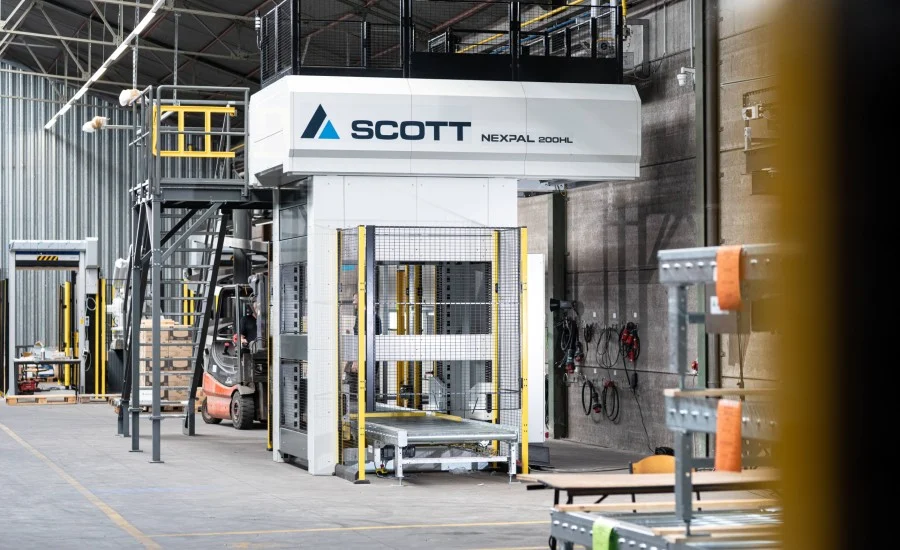
In the modern manufacturing landscape, space is more than just a physical constraint; it is a critical variable in the equation of operational profitability. As global supply chains face increasing pressure to accelerate output, the "end-of-line" bottleneck has emerged as a significant barrier to growth. Addressing this challenge, Scott Technology has officially launched the NexPAL 200HL, a high-capacity, compact palletizer engineered specifically for facilities where floor space is at a premium but throughput requirements are climbing.
The NexPAL 200HL represents a strategic evolution in materials handling. By condensing high-speed palletizing capabilities into a footprint 25% smaller than industry-standard alternatives, Scott Technology is providing manufacturers—particularly those in the mature markets of Europe and North America—with a path to expand production capacity without the need for costly facility expansions or structural redesigns.
The Core Innovation: Engineering for Efficiency
The NexPAL 200HL is designed to deliver a throughput of 35-plus cases per minute, a benchmark that remains highly competitive for its size class. The system’s primary value proposition lies in its unique architectural approach to row formation and pallet stacking.
Redefining the Footprint
Traditional palletizing units often rely on bulky overhead pusher mechanisms that require significant vertical and horizontal clearance. The NexPAL 200HL abandons this paradigm in favor of a side-mounted, rotating row pusher. This design choice serves two purposes: it facilitates simultaneous case infeed and row formation, and it removes the need for traditional overhead components, thereby reducing the machine’s vertical envelope and overall spatial requirement.
Flexibility as a Standard
In an era where consumer demand dictates rapid product diversification, the NexPAL 200HL is equipped with features designed for high-mix production environments. The system supports automatic changeovers, allowing for seamless transitions between different product formats and sizes. Furthermore, the unit’s flexible pattern execution software enables operators to adapt to varying pallet configurations with minimal downtime. For operations with specific needs, the platform offers modular application-specific options, including advanced label orientation, automated interlayer sheet handling, and integrated pallet dispensing.
Chronology of Development: A Response to Market Feedback
The development of the NexPAL 200HL was not an isolated engineering endeavor but rather a direct response to a longitudinal study of customer pain points.
- Q1–Q2 2022: Scott Technology conducted a series of consultative sessions with manufacturing leaders across Europe and North America. The consistent feedback centered on a "Floor Space Paradox": the need for higher throughput to meet market demand versus the physical limitations of legacy facility layouts.
- Q3 2022 – Q4 2023: Engineering teams commenced the design phase, focusing on "compression without compromise." The goal was to maintain the throughput performance of a standard-sized palletizer while integrating a smaller chassis.
- Q1 2024: Prototype testing was conducted in controlled environments to ensure that the side-mounted pusher design could sustain high-speed operation without inducing excessive wear or mechanical failure.
- Q3 2024: Official launch and rollout of the NexPAL 200HL to the global market, accompanied by live demonstrations at major industrial trade exhibitions.
Supporting Data: Why Compactness Matters
For plant managers, the transition from legacy manual or semi-automated systems to the NexPAL 200HL provides quantifiable gains.
Spatial Efficiency Metrics
The 25% reduction in footprint is not merely a cosmetic improvement; it translates to direct financial savings. In high-cost urban industrial hubs, square-footage rental rates are rising. By freeing up 25% of the space previously occupied by palletizing equipment, manufacturers can repurpose that area for:
- Additional upstream production lines: Increasing total factory output.
- Safety buffer zones: Enhancing floor safety and worker ergonomics.
- Storage and staging: Reducing the reliance on external warehousing for work-in-progress (WIP) materials.
Throughput Stability
The 35-plus cases per minute capacity is calibrated to meet the demands of high-volume consumer packaged goods (CPG) manufacturers. By ensuring that the end-of-line speed matches the output of high-speed filling and packaging lines, the NexPAL 200HL effectively eliminates the "choke point" effect where upstream production is forced to throttle down due to the inability of the palletizer to clear the line.
Official Perspective: The Human Factor in Automation
Aaron Vanwalleghem, President of Materials Handling and Logistics at Scott Technology, highlights that the machine’s design is as much about human-centric maintenance as it is about mechanical performance.
"In many established manufacturing facilities, floor space is at a premium and throughput is fundamental to the economics of the operation," says Vanwalleghem. "If end-of-line palletizing can’t keep pace with increased production upstream, it can become a bottleneck on the entire operation, hindering growth. Our customers are looking for ways to increase capacity with limited impact on their physical footprint."
Vanwalleghem emphasizes that the decision to prioritize the side-mounted pusher was not just for spatial savings, but for maintenance accessibility. "With the NexPAL 200HL, we focused on putting substantial palletizing capacity into a much smaller space without compromising performance. By removing the overhead structures, we’ve created a more open, accessible design that allows maintenance teams to perform cleaning and routine service faster and more safely than with traditional overhead systems."
Implications for the Manufacturing Industry
1. The Rise of "Brownfield" Modernization
Many manufacturers are currently focused on "brownfield" projects—the modernization of existing facilities—rather than "greenfield" construction. The NexPAL 200HL is an ideal candidate for these projects, as it allows for the integration of modern, high-speed robotics into tight, existing floor plans without requiring major facility renovation.
2. Labor and Ergonomics
By automating the palletizing process, the NexPAL 200HL reduces the need for manual lifting and repetitive motion, which are leading causes of workplace injury in end-of-line logistics. This improves not only safety but also employee retention, as personnel can be redeployed to higher-value roles that require cognitive oversight rather than physical labor.
3. Sustainability and Waste Reduction
Efficient palletizing reduces the risk of damage during transportation. By providing precise pattern execution and stable load formation, the system minimizes product waste—a key goal for manufacturers looking to improve their sustainability credentials. Furthermore, the compact design requires less material for the machine’s frame, aligning with broader industrial goals of reducing the carbon footprint of capital equipment.
4. Future-Proofing
The modular nature of the NexPAL 200HL allows it to grow with the business. As companies add new product lines or change packaging formats, the system’s flexibility ensures it remains relevant, protecting the initial capital investment against the volatility of consumer trends.
Conclusion
The launch of the NexPAL 200HL by Scott Technology marks a significant milestone in the evolution of materials handling. By recognizing that the future of manufacturing lies in the efficient use of existing spaces, the company has provided a solution that addresses both the immediate need for speed and the long-term need for operational flexibility.
As the industry continues to grapple with supply chain instability and the rising costs of industrial real estate, solutions like the NexPAL 200HL will become indispensable. By merging high-capacity performance with a minimalist footprint, Scott Technology has effectively bridged the gap between the constraints of the past and the productivity requirements of the future. For manufacturers, the path forward is no longer about finding more room; it is about making the room they already have work smarter.


 Laily UPN
 Rifan Muazin
