

 Raul Delapena Setiawan

 Ammar Sabilarrohman
 Lina Irawan
 Suro Senen
 Asep Darmawan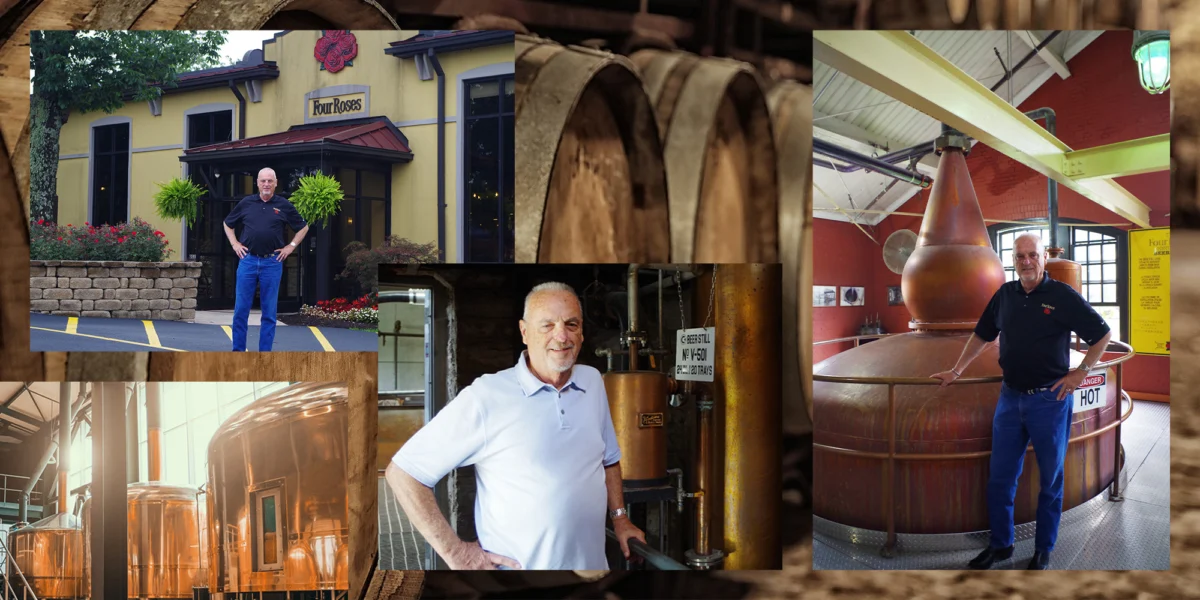
This month marks a monumental milestone in the history of American spirits: Jim Rutledge, a titan of the bourbon industry, celebrates 60 years of service. For many, Rutledge is the man who single-handedly rescued Four Roses from the brink of obscurity, transforming a forgotten brand into a global benchmark of quality. Yet, to categorize him merely as a "rescue artist" is to ignore the broader impact of a career that has spanned the transition from manual, ledger-based production to the high-tech, data-driven distilleries of the 21st century.
Even after his "retirement" from Four Roses in 2015, Rutledge has refused to exit the stage. Instead, he has pivoted to a role as a mentor, consultant, and master distiller for independent projects like Cream of Kentucky, Echoes of Oak, and the Jacob Spears brand. His career is not just a resume; it is a living history of the bourbon industry’s evolution.
The Chronology of a Distilling Life
1966: The Seagram’s Genesis
Rutledge’s journey began in 1966 at the Seagram’s Calvert Distillery on 7th Street Road in Louisville. Fresh out of the University of Louisville, he faced a fork in the road that sounds almost folkloric today: a job at a tobacco manufacturer that offered free cigarettes, or a position at Seagram’s. Seeking a career rather than a perk, he chose the latter.
In those early days, the job was a far cry from the romanticized image of the master distiller. Rutledge spent his time in research and development, case goods shipping, and bottling line planning. The production floor was a manual, often chaotic environment. "Back in those days," Rutledge recalls, "operators would use pencil marks on the valves to control the optimal temperature and flow on the stills." It was a tactile, imprecise science—one he was eager to master, though he found himself frequently pulled away to handle the holiday bottling rush.
1977-1990: The New York Interlude
In 1977, a twist of fate—and a poorly timed trip to the bowling alley—sent him to New York. While attempting to slip out early for a game, he was intercepted by a plant superintendent. He expected a reprimand for his early departure; instead, he received a "promotion" to the corporate office in New York.
"I went bowling," Rutledge laughs, "and I bowled the worst game I’d ever had in my life." For 15 years, he navigated the corporate bureaucracy of Seagram’s, holding titles like assistant manager of budgets and standards. It was a period of professional success but personal longing. He spent over a decade pining for the production floor, a desire that finally paid off in 1990 when his corporate reviewer asked if he was serious about returning to his roots.
1992-2015: Rescuing Four Roses
In 1992, the call finally came. Rutledge returned to Kentucky, initially tasked with overhauling the bottling and warehousing operations in Cox’s Creek. By 1994, he was slated to move to the Four Roses Distillery in Lawrenceburg. However, the situation was dire. Corporate leadership had deemed the distillate quality "so bad" for the previous three and a half years that they threatened a total plant shutdown by June 1995.
What followed was a masterclass in leadership. Rutledge didn’t just impose new rules; he embedded himself in the culture. He spent his off-hours on the production floor, earning the trust of union operators who had long been alienated by management. By the third week of January 1995, the quality of the distillate—rated on a scale of one to five—had achieved a "four" for the first time in years.
Once the brand was stable, he began his most ambitious campaign: bringing Four Roses back to the American consumer. Since 1959, the brand had been relegated to international markets, primarily Japan. Through sheer persistence—lobbying marketing teams and sales directors at every opportunity—he finally secured a foothold in the U.S. market in 1999, with a full-scale return following the 2002 acquisition by Kirin.
Supporting Data: The Impact of Quality Control
Rutledge’s career is defined by his obsession with consistency. At Seagram’s, the internal rating system for new-make distillate was the heartbeat of the distillery. For three years prior to his arrival at Four Roses, the average score was a "one"—the lowest possible mark.
Through his hands-on management style—arriving at 7:00 a.m., conducting three floor-walks daily, and empowering the operators—he shifted that average. The transition from a "one" to a "four" in just a few months was not merely a procedural victory; it saved jobs and prevented the permanent closure of the Lawrenceburg facility. This commitment to the "soul" of the distillate is why, today, Four Roses remains a top-tier name in the industry.
Official Perspectives and Industry Mentorship
The industry’s respect for Rutledge is palpable, not just in accolades but in the way he is sought out by the new guard. Ashley Barnes, a master blender and industry consultant who worked with Rutledge at Four Roses, notes that his influence goes beyond technical skill. "He was always ready to share his knowledge and teach me something," Barnes says. "He told me to go talk to the guy who’s been running the still for 20 years and see what you could learn. He valued the institutional knowledge of the floor."
This sentiment is echoed by Dixon Dedman, founder of 2XO Whiskey. For Dedman, Rutledge is a mentor in the truest sense. "We talked through the philosophy of blending—why things work, why they don’t, and the mystery of why some things that should work don’t," Dedman says. "He didn’t need to share his time or wisdom, but he did. I am eternally grateful."
Implications for the Future of Bourbon
The implications of Rutledge’s 60-year career are twofold: the preservation of craft and the importance of succession. As the industry currently faces a market correction and a downturn, many distilleries are pausing production. Rutledge views this with a seasoned, philosophical eye. He believes in the resilience of the industry, noting that despite the "hard jobs" and "heartaches," the passion for the craft remains the sector’s most valuable asset.
Rutledge’s current work with independent distilleries like Pennyroyal (producing Echoes of Oak) serves as a template for how legacy knowledge can be passed to the next generation. He is not a gatekeeper; he is an open door. By remaining active, he ensures that the techniques, standards, and, most importantly, the ethics of bourbon production continue to evolve rather than stagnate.
A Legacy in Motion
Jim Rutledge has seen the industry move from paper-and-pencil temperature tracking to fully automated, computer-monitored systems. He has seen the rise, fall, and resurrection of bourbon as a global commodity. Yet, his goal remains unchanged: "I’d like to end my life leaning over a fermenter, checking the quality, smelling it, tasting it."
As he looks toward the future, Rutledge continues to provide a blueprint for what it means to be a "master." He has demonstrated that the most important tool in a distillery isn’t the computer that controls the heat or the sensor that monitors the proof; it is the human element—the willingness to listen, to teach, and to put the product above the politics.
For the whiskey enthusiast, the name Jim Rutledge is a seal of quality. For the industry, he is the living bridge between the storied past of Seagram’s and the vibrant, craft-focused future of American whiskey. Whether he is blending a new release or mentoring a young distiller in a small warehouse in Kentucky, his influence continues to reverberate, ensuring that the legacy he built at Four Roses is only the beginning of his contribution to the spirit of America.

 Nana Wu
 Azzam Bilal Chamdy
