Azzam Bilal Chamdy
 Neng Nana
 Nana Muazin
 Dwi Wanna
 Raul Delapena Setiawan
 Layla Zulfa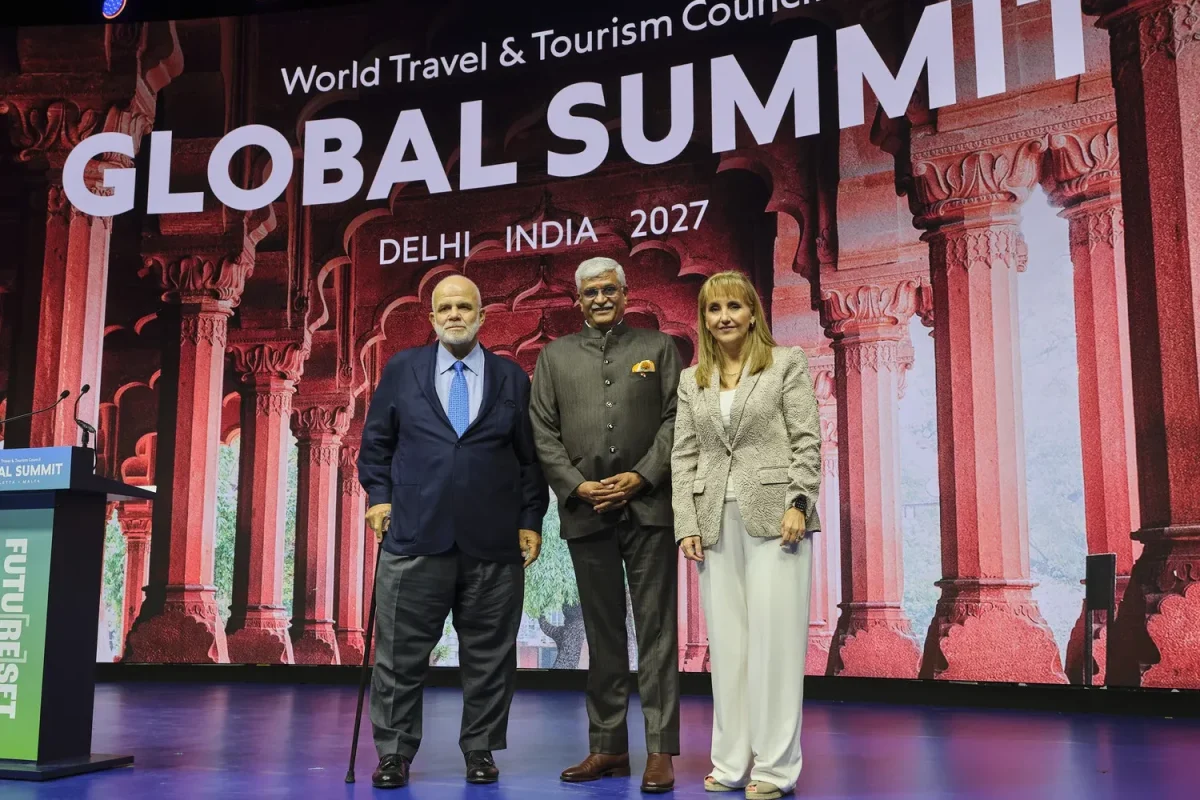
Introduction: The Great Indian Tourism Ambition
At the World Travel and Tourism Council (WTTC) summit in Malta, Indian Tourism Minister Gajendra Singh Shekhawat stood before a global audience of industry titans to articulate a vision that, while bordering on the Herculean, sets a new North Star for the nation’s economy. The goal is transformative: India, a country that saw a mere 9.2 million international arrivals in 2025, aims to welcome 100 million foreign tourists annually by 2047, the centenary of its independence.
To bridge the chasm between current realities and this ambitious future, Minister Shekhawat proposed a strategic framework defined by four "Ps": Political will, Public spending, Partnership, and People’s participation. Yet, as the industry digests these projections, the immediate landscape remains fraught with volatility, leaving analysts to question whether the roadmap accounts for the profound geopolitical and economic headwinds currently buffeting the global travel sector.
The Current Landscape: A Stagnant Arrival
To understand the gravity of the challenge, one must look at the sobering data. In 2025, India recorded 9.2 million foreign tourist arrivals, a figure that represents a 9.4% decline from 2024 and sits 17% below the pre-pandemic peak of 10.9 million reached in 2019.
This marks two consecutive years of decline, a trend that is not merely a statistical anomaly but a structural concern. The outlook for 2026 is similarly tempered. A recent report by the PHD Chamber of Commerce and Industry paints a grim picture, estimating that inbound tourism could contract by an additional 15–20% this year. The primary culprit? The ongoing Iran War, which has effectively severed critical air corridors used by long-haul travelers from Europe and North America. As airspace closures and safety concerns mount, the "Incredible India" narrative faces a temporary but severe logistical blockade.
Chronology: The Path from Peak to Present
- 2019: India hits its pre-pandemic zenith with 10.9 million international tourist arrivals, buoyed by robust global connectivity and a thriving visa-on-arrival scheme.
- 2020–2022: The COVID-19 pandemic effectively halts global travel. India’s tourism sector experiences a total collapse, leading to mass unemployment in the hospitality and aviation sectors.
- 2023: A cautious recovery begins, though international numbers struggle to return to pre-pandemic levels due to supply chain issues and high airfares.
- 2024: Geopolitical tensions begin to simmer. Despite domestic tourism growth, international arrivals falter, signaling a 9.4% year-over-year decline.
- 2025: The Iran War escalates. The closure of key transit routes leads to a significant decrease in long-haul visitors, bringing the annual arrival total to 9.2 million.
- 2026 (Current): Industry bodies forecast a 15–20% contraction. The government shifts focus to long-term structural reforms, unveiling the 2047 "100 Million" vision at the Malta WTTC summit.
The Mathematical Hurdle: Analyzing the 12% Growth Imperative
Reaching 100 million arrivals by 2047 is not merely an aspirational goal; it is a mathematical marathon. To achieve this, India would need to sustain a compound annual growth rate (CAGR) of approximately 12% or more for the next 21 years.
Historically, such growth is rare. For comparison, countries like France, the world’s most visited nation, see growth rates in the low single digits because their infrastructure is already saturated. India, conversely, possesses the landmass and the cultural assets to absorb such an influx, but it lacks the necessary "soft" and "hard" infrastructure.
Current infrastructure constraints—ranging from airport capacity in major metros to the quality of last-mile connectivity in secondary tourist circuits—pose the greatest risk to this growth target. The PHD Chamber of Commerce report highlights that without massive, sustained public spending on aviation hubs and visa facilitation, even a 5% growth rate will be difficult to maintain, let alone 12%.
The Four Ps: A Strategic Framework
Minister Shekhawat’s "Four Ps" strategy is designed to provide the institutional scaffolding for this growth.
1. Political Will
The Minister emphasized that tourism is no longer a peripheral department but a central plank of the national economic policy. This involves a shift toward "Tourism-as-an-Export," where the government prioritizes the ease of doing business for hotel chains and tourism operators.
2. Public Spending
The government has signaled an intent to increase budgetary allocations for tourism infrastructure. This includes the development of "Iconic Destinations," massive investment in regional connectivity through the UDAN (Ude Desh ka Aam Nagrik) scheme, and the modernization of heritage sites through public-private partnership models.
3. Partnership
Recognizing that the state cannot do it alone, the government is seeking deeper collaboration with the private sector. This includes incentivizing foreign investment in luxury hospitality and infrastructure, as well as fostering public-private partnerships (PPPs) to manage and maintain India’s thousands of archaeological and cultural landmarks.
4. People’s Participation
Perhaps the most crucial, and abstract, element is the integration of local communities. The government aims to promote "Homestay" models and community-led tourism. By decentralizing the benefits of tourism, the administration hopes to ensure that the 100-million-arrival goal leads to equitable economic development rather than just concentration in major urban centers.
Geopolitical Implications and the "Air Corridor" Problem
The most immediate barrier to the 100-million goal is the current regional instability. The conflict involving Iran has forced global carriers to reroute flights, leading to longer flight times and significantly higher ticket prices. For a long-haul destination like India, where price sensitivity is high among European and American tourists, this is a deterrent.
Furthermore, the "visa-as-a-service" model remains a friction point. While India has introduced e-visas, the complexity of the process compared to regional competitors like Thailand or Vietnam continues to frustrate international travelers. To reach 100 million, India must move toward a frictionless, "frictionless-travel" regime, perhaps by expanding visa-free entry to key source markets.
Supporting Data: Economic Potential
The potential upside of reaching this target is staggering. If India achieves 100 million arrivals, the multiplier effect on the economy would be transformative:
- GDP Contribution: Tourism’s current contribution to India’s GDP hovers around 6–7%. Reaching the 100 million target could potentially push this toward 10–12%.
- Job Creation: The hospitality sector is labor-intensive. A 10x increase in arrivals would necessitate millions of new roles in service, logistics, hospitality, and digital management, providing a massive boost to the country’s youth employment crisis.
- Infrastructure Synergy: The development of tourism infrastructure often acts as a catalyst for other sectors, such as real estate, telecommunications, and regional transportation, creating a "virtuous cycle" of investment.
Official Responses and Industry Skepticism
While the industry has lauded the Minister’s vision, the reaction is tempered with realism. During the Malta summit, several delegates noted that while the "4Ps" are excellent in theory, the execution in India is notoriously fragmented due to the state-center federal structure.
"Tourism is a state subject in India," noted an analyst from the World Travel and Tourism Council. "The Minister can set a national vision, but unless the states—which control land, police, and local infrastructure—are aligned with these four Ps, the bottlenecks will persist."
However, there is optimism regarding India’s digital transformation. The integration of the Unified Payments Interface (UPI) into the tourism sector has made India one of the easiest places in the world to make small-value payments, a trend that is already winning over international travelers who find the transition to cashless, transparent transactions refreshing.
Implications: The Long Road to 2047
The 100-million-arrival goal is a litmus test for India’s governance. It requires moving beyond the "incredible" marketing slogans of the past and into an era of "efficient" tourism.
If India manages to navigate the current geopolitical instability and successfully implements its infrastructure plans, it will cement itself as a global travel superpower. If, however, the target remains a top-down mandate without local reform, it risks becoming another missed economic milestone.
The next five years will be decisive. With the global travel industry shifting toward experiential and sustainable tourism, India’s diversity—from the Himalayas to the backwaters of Kerala—is an asset waiting to be unlocked. Whether the "Four Ps" are enough to turn the current downward trend into a historic ascent remains to be seen. One thing is certain: for the 1.4 billion people of India, tourism is no longer just a luxury; it is becoming a central pillar of the nation’s 2047 economic destiny.