
 Dwi Wanna
 Nana Wu
 Muslim
 Reynand Wu
 Ammar Sabilarrohman
 Pevita Pearce
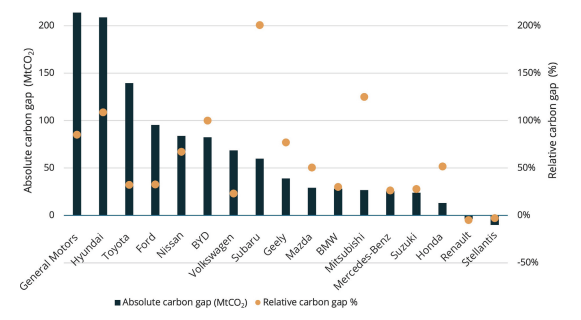
A profound discrepancy has emerged in the corporate sustainability landscape, casting a shadow over the transition to a low-carbon economy. According to a landmark report from the financial think tank Carbon Tracker, major global automakers are significantly understating the greenhouse gas emissions associated with the vehicles they sell. This systemic underreporting—dubbed the "Carbon Gap"—suggests that the automotive industry’s publicly disclosed climate footprints may be failing to capture the true scale of their environmental impact, posing significant financial and regulatory risks to investors.
The core of the issue lies in Scope 3, Category 11 emissions—a technical but critical accounting metric that tracks the emissions produced by products after they leave the factory floor. For automakers, this category typically accounts for roughly 80% of their total climate impact. Carbon Tracker argues that the current industry-standard models used to calculate these figures are built upon "unrealistic" assumptions, effectively masking the true carbon intensity of the modern automobile fleet.
The Anatomy of the Carbon Gap
The "Carbon Gap" is not merely an accounting error; it is a fundamental misalignment between corporate modeling and real-world behavior. The discrepancy arises primarily from how manufacturers calculate the lifetime emissions of their vehicles, a process rife with subjective assumptions regarding vehicle longevity, mileage, and driver behavior.
The Mileage Fallacy
One of the primary drivers of the Carbon Gap is the estimation of "lifetime miles driven." Automakers often employ standardized metrics that fail to account for geographical disparities in driving habits. A glaring example cited by Carbon Tracker is Subaru. While the company maintains a global footprint, it reportedly bases its lifetime emissions estimates on domestic Japanese driving patterns. This approach ignores the reality that nearly 70% of Subaru’s sales occur in the United States, where average annual vehicle mileage is significantly higher than in Japan. By applying a low-mileage assumption to a high-mileage market, the company’s reported emissions figures appear lower than the actual carbon output of its sold fleet.
The Plug-in Hybrid (PHEV) Illusion
Perhaps more contentious is the treatment of plug-in hybrid electric vehicles (PHEVs). Industry-standard tests often assume that these vehicles operate primarily on battery power, leading to optimistic emissions profiles. However, real-world data paints a starkly different picture. Researchers pointed to a comprehensive study of 800,000 vehicles in Europe, which revealed that PHEVs produce roughly five times the emissions suggested by industry laboratory tests. This suggests that the "green" credentials of many hybrid models are being grossly overstated, as the vehicles are rarely charged as frequently as manufacturer models anticipate.
A Chronology of Corporate Disclosure and Scrutiny
The tension between corporate reporting and climate reality has been brewing for years. Following the 2015 "Dieselgate" scandal, which exposed the industry’s willingness to manipulate emissions data for regulatory compliance, investors and environmental advocates have grown increasingly skeptical of self-reported corporate metrics.
- 2015–2018: The Post-Dieselgate Era: The automotive industry underwent a period of intense regulatory scrutiny, leading to stricter Euro 6 emissions standards and a shift in focus toward electrification. During this time, however, the focus remained largely on tailpipe emissions during the testing phase, leaving "lifetime" Scope 3 emissions largely unpoliced.
- 2020–2022: The Rise of ESG Investing: As Environmental, Social, and Governance (ESG) criteria became central to investment strategies, automakers began publishing detailed sustainability reports. These documents relied heavily on internal modeling to estimate the lifetime carbon footprint of their products.
- 2024: The Carbon Tracker Intervention: Carbon Tracker released its comprehensive analysis of the automotive sector, formally identifying the "Carbon Gap." This report marked the first time a major financial think tank systematically quantified how specific modeling assumptions were being used to suppress reported emissions data across the sector.
- Present Day: The debate has now shifted from whether the data is accurate to whether the current methods of disclosure constitute a "material financial risk." Institutional investors are now pressuring regulators, such as the SEC and the European Securities and Markets Authority, to standardize how lifetime emissions are calculated.
Supporting Data: Dissecting the Discrepancy
The Carbon Tracker report underscores that the gap is not a uniform issue; it varies by manufacturer based on their regional market dominance and their specific product mix.

The report highlights that when companies rely on standardized, static assumptions—such as a fixed number of years a vehicle is expected to remain on the road—they fail to account for market-specific variables. For instance, in developing markets, vehicles often have longer lifespans due to secondary-market longevity, whereas in mature markets, the churn rate is faster. By failing to segment these calculations, automakers produce a single, sanitized figure that obscures the reality of their carbon exposure.
Furthermore, the "relative" Carbon Gap—the ratio of the reported vs. estimated emissions—serves as a warning sign for investors. High-growth markets where infrastructure is lacking, or regions where gasoline remains cheap, tend to see higher usage rates than the models predict. When researchers recalculated the emissions using more realistic, locally-adjusted data, the "gap" in some instances widened by double digits, representing millions of tons of uncounted CO2.
Official Responses and Industry Defense
The reaction from the automotive sector has been largely defensive, with most companies standing by their current reporting methodologies.
A spokesperson for Ford Motor Company addressed the findings by stating that their assumptions are "consistent with best practices for Scope 3, Category 11 reporting." Ford emphasized that their data is publicly disclosed and follows existing industry frameworks, suggesting that the "gap" is a matter of interpretation rather than a deliberate attempt to deceive. The company maintained that as long as they follow the established global protocols, they are fulfilling their fiduciary and environmental reporting duties.
Conversely, other industry giants—including Subaru, General Motors, and Toyota—opted not to comment on the findings. This silence has been interpreted by some analysts as an acknowledgment of the complexity of the issue; changing their methodology would force a recalculation of their entire climate transition strategy, potentially exposing them to criticism regarding their progress toward net-zero goals.
Implications: The Financial Risk of "Carbon Gaps"
The researchers at Carbon Tracker were explicit in their warning to the financial community: "For the investor, absolute Scope 3 Category 11 totals cannot be taken at face value."
The implications of this are twofold:
1. Regulatory and Legal Exposure
As carbon pricing mechanisms—such as carbon taxes and cap-and-trade schemes—expand globally, the "hidden" emissions represent a significant financial liability. If an automaker reports 10 million tons of emissions but is actually responsible for 15 million, they are significantly underestimating their exposure to future carbon levies. Investors who base their holdings on the company’s reported progress toward a low-carbon economy could face sudden losses if regulators decide to "true up" these figures.
2. The Mispricing of Transition Risk
The automotive industry is in the midst of a multi-billion-dollar transition to electrification. If the emissions from the internal combustion engine (ICE) vehicles still being produced are higher than reported, the "payback period" for these investments changes. Investors are currently pricing in a gradual decline in carbon intensity; however, if the current fleet is "dirtier" than expected, the transition period required to reach net-zero becomes much steeper and more expensive. This constitutes a systematic mispricing of long-term risk.
3. Reputational and Strategic Risk
In an era where "greenwashing" is a significant legal and reputational hazard, the Carbon Gap poses a threat to brand equity. Should consumer advocacy groups or government bodies successfully challenge these reporting methods, automakers could face a wave of litigation similar to the tobacco or fossil fuel lawsuits of the past. The gap is not just an accounting nuance; it is a signal of a strategic disconnect between the industry’s public narrative of decarbonization and its operational reality.
Conclusion: The Need for Standardized Reality
The Carbon Tracker report serves as a clarion call for a more rigorous, standardized approach to climate accounting. If the automotive sector is to be a credible partner in the global effort to limit climate change, the "Carbon Gap" must be closed. This requires a transition away from flexible, manufacturer-defined modeling toward transparent, third-party verified metrics that reflect the realities of regional driving habits and the actual performance of hybrid technologies.
For investors, the message is clear: the era of accepting corporate emissions data at face value is over. The financial markets are increasingly demanding a higher degree of granularity. Until the industry adopts a more realistic accounting framework, the "Carbon Gap" will remain a hidden, yet potentially explosive, risk in the portfolios of those betting on a cleaner automotive future.


 Laily UPN