 Layla Zulfa
 Laily UPN
 Neng Nana
 Sagoh
Sagoh
 Raul Delapena Setiawan
 Basiran
By Industry Desk | July 7, 2026
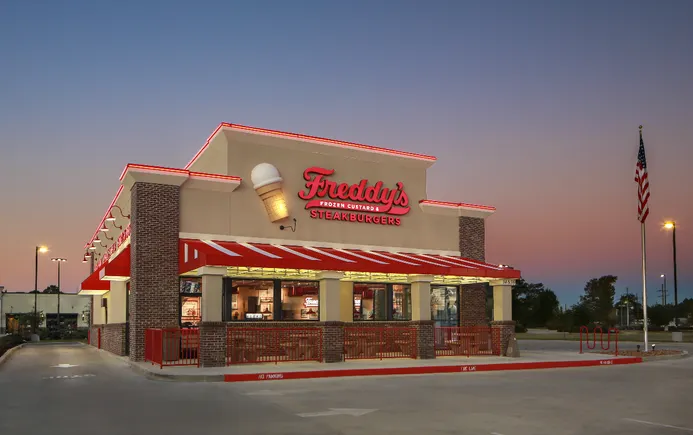
Freddy’s Frozen Custard & Steakburgers, the fast-casual staple known for its cooked-to-order steakburgers and signature frozen custard, has unveiled an ambitious growth strategy for 2026. As the brand eyes a significant milestone—surpassing the 600-unit threshold—it is pivoting its development focus toward increased real estate flexibility. By prioritizing in-line and end-cap locations, the company aims to lower the barrier to entry for its franchisee network, ensuring sustainable growth in an increasingly competitive QSR (Quick Service Restaurant) landscape.
The Strategy: Rethinking Real Estate Economics
The cornerstone of Freddy’s 2026 development plan is a strategic shift in how it approaches site selection. For years, the industry standard for fast-casual chains has been the standalone, ground-up restaurant. However, Freddy’s is aggressively pivoting toward in-line and end-cap units, which offer a significantly more attractive capital expenditure profile for its franchisees.
According to the latest internal data, the cost to develop an in-line restaurant averages approximately $854,834. This is a stark contrast to the $1.5 million-plus required for a traditional standalone unit. By reducing the initial capital investment, Freddy’s is effectively opening new, previously inaccessible pathways for growth in high-density urban markets and suburban shopping corridors.
"A strong franchise system is built on operators who see long-term opportunity within the brand," said Andrew Thengvall, Chief Development Officer of Freddy’s. "As Freddy’s continues to grow, we remain focused on supporting our franchisees through new restaurant prototypes, greater real estate flexibility, and development strategies that help position the brand for sustainable growth."
Chronology of Growth: A Trajectory of Success
Freddy’s ascent has been marked by methodical, consistent expansion rather than the "growth at any cost" mentality seen in some of its peers.
- 2021–2022: Under the ownership of Thompson Street Capital Partners, the brand focused on operational excellence and system-wide modernization, laying the groundwork for the accelerated expansion seen in subsequent years.
- 2023: The chain entered the year with a footprint of 456 units. This period marked a transition toward diversifying real estate footprints to capture different market demographics.
- 2025: By the close of 2025, the brand had successfully scaled to 580 units, demonstrating its resilience in the face of rising construction costs and interest rates.
- 2026 (Current): With the projected opening of 60 new units this year, the brand is on track to eclipse the 600-unit mark, signaling a mature but still rapidly scaling business model.
Supporting Data: Understanding Unit Economics
The viability of this expansion strategy is backed by strong unit economics. Freddy’s has consistently demonstrated that its brand identity remains intact across various store formats.
The Average Unit Volume (AUV) for standalone drive-thru franchised restaurants remains the "gold standard" at nearly $1.9 million. While the shift toward in-line and end-cap units represents a lower top-line revenue—with end-cap drive-thru units averaging $1.8 million and in-line units averaging $1.4 million—the higher margins achieved through reduced build-out costs and lower lease expenses present a compelling return on investment (ROI) for operators.
This economic versatility is a key driver for existing franchisees, roughly one-third of whom are currently expanding into new territories. This high internal "buy-in" rate is a vital indicator of franchisee health and brand confidence.
Strategic Leadership and Private Equity Backing
The aggressive push for 2026 is supported by a strengthened leadership team. In April 2026, the company bolstered its development department with two key executive appointments: Rafik Farouk as Vice President of Business Development and Jackie Lobdell as Vice President of Franchise Sales. Their mandates are clear: to streamline the site-selection process and recruit high-quality operators who align with the brand’s long-term vision.

Furthermore, the brand is operating under a new ownership structure. In September 2025, global private equity firm Rhône Group acquired Freddy’s. This transition from Thompson Street Capital Partners to Rhône represents a vote of confidence in the brand’s scalability. Private equity backing provides the capital and operational rigor necessary to scale a national chain, providing a safety net for franchisees as they navigate the complexities of 2026’s economic environment.
Implications for the QSR Landscape
Freddy’s shift in strategy carries broader implications for the fast-casual industry.
1. The Death of the "One Size Fits All" Model
For decades, many chains were tethered to the "standalone drive-thru" model. Freddy’s is proving that by offering a tiered approach to real estate—standalone, end-cap, and in-line—brands can penetrate diverse markets. Whether it’s a high-traffic strip mall or a bustling downtown street, Freddy’s is adapting its architecture to fit the space, rather than forcing the space to fit its architecture.
2. Prioritizing Franchisee Health
The emphasis on lowering the cost of entry is a prudent move. As interest rates remain a concern for developers, the ability to build a profitable store for under $900,000 rather than over $1.5 million makes the franchise opportunity significantly more attractive to multi-unit operators looking to diversify their portfolios.
3. Sustainable vs. Explosive Growth
Freddy’s is not attempting to open hundreds of stores overnight. By keeping the growth target to 60 units in 2026, the company is prioritizing operational consistency. A rapid influx of new, inexperienced franchisees can often lead to a dilution of brand standards; by relying heavily on existing, proven operators, Freddy’s minimizes the risk of operational drift.

Looking Ahead: The Challenges and Opportunities
As the brand pushes toward 600 units and beyond, it will face the typical headwinds of a growing national chain: supply chain management, regional labor shortages, and the challenge of maintaining brand loyalty in markets where competition is fierce.
However, the combination of strong AUVs, a diversified real estate strategy, and the backing of a private equity powerhouse positions Freddy’s as one of the most stable growth stories in the restaurant sector. The brand’s ability to remain "top of mind" while focusing on the granular details of its real estate footprint suggests that the "Freddy’s way"—focusing on quality steakburgers and custard served with a side of Midwestern hospitality—is a model that translates well across the country.
For potential franchisees and industry observers alike, the 2026 calendar will be defined by how effectively Freddy’s can integrate these new in-line and end-cap formats into its existing ecosystem. If the early data is any indication, the brand has found the right recipe for sustained, profitable expansion.
This report was synthesized from the company’s recent press releases, franchise disclosure documentation, and industry executive updates. All financial figures are based on the latest available internal reports.

 Lina Irawan
 Evan Lee Salim