
 Rifan Muazin
 Layla Zulfa
 Nana
Nana
 Asro
Asro
 Nana Wu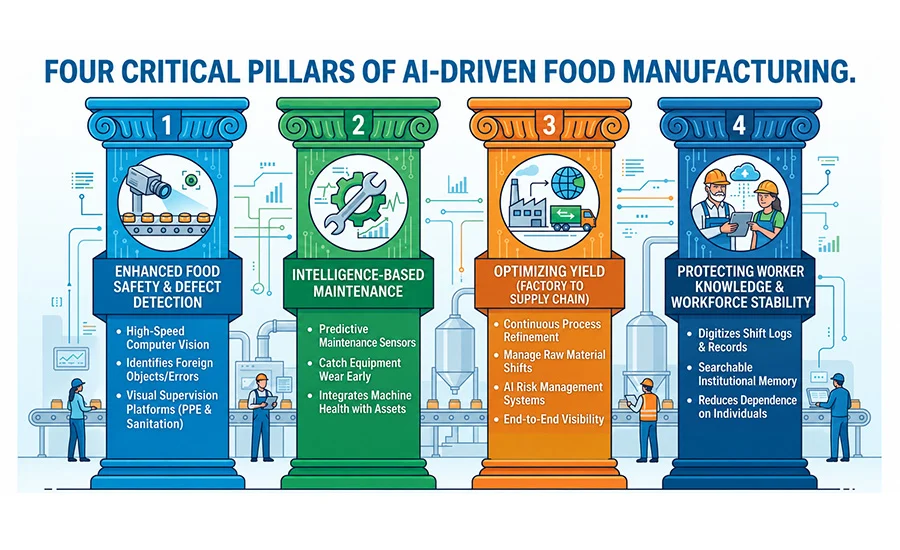
The global food manufacturing industry stands at a technological crossroads. Faced with razor-thin profit margins, a volatile supply chain, and the ever-present threat of high-stakes product recalls, manufacturers are increasingly turning to Artificial Intelligence (AI) to stabilize operations. However, the transition from legacy systems to AI-driven production is not merely a matter of software acquisition; it is a fundamental architectural shift that requires a robust data foundation, strategic governance, and a workforce prepared for a digital-first environment.
Main Facts: The AI Imperative in Food Production
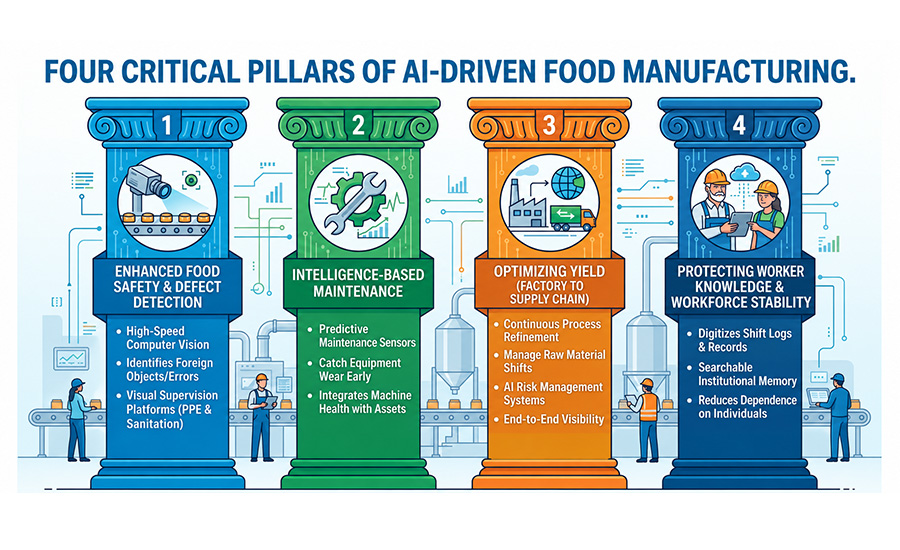
Artificial Intelligence in food manufacturing is no longer a futuristic concept; it is an active tool for risk mitigation and performance optimization. Currently, the integration of AI is concentrated in four critical pillars:
- Enhanced Food Safety and Defect Detection: Using computer vision, X-ray, and spectral imaging, manufacturers can inspect products at unprecedented speeds. These systems often achieve detection accuracy rates exceeding 95 percent, significantly reducing the risk of contaminated products reaching the market.
- Predictive Maintenance: By utilizing IoT sensors, manufacturers can anticipate equipment failure before it occurs. This transition from reactive to proactive maintenance minimizes unplanned downtime—an issue that costs the broader industrial sector an estimated $50 billion annually.
- Optimizing Yield and Supply Chain Performance: AI models analyze the interplay between raw material quality, ambient environmental conditions, and machine settings to maximize output and minimize food loss.
- Preserving Institutional Knowledge: As the industry faces high turnover, AI-enabled knowledge management systems are being deployed to capture the tacit expertise of veteran staff, ensuring that decades of troubleshooting experience remain accessible to the next generation of employees.
Chronology: The Road to Modernization and Compliance
The trajectory of AI adoption in food safety is closely linked to the legislative landscape. The Food Safety Modernization Act (FSMA), specifically Section 204, represents the primary driver for digital record-keeping.
- Pre-2020: The industry relies largely on manual logging and disparate, siloed data systems, leading to slow response times during traceback investigations.
- 2022–2025: Rapid adoption of cloud-based computer vision for PPE compliance and early-stage predictive maintenance trials begins among large-scale manufacturers.
- January 2026: The original compliance deadline for the FDA’s Food Traceability Rule.
- Late 2026: The FDA formally proposes a 30-month extension for FSMA Section 204 compliance, moving the effective date to July 20, 2028.
- Present Day: Manufacturers are utilizing this extended window to overhaul their data infrastructures, moving away from fragmented, paper-based records toward centralized, AI-ready data environments.
Supporting Data: Quantifying the Impact
The economic case for AI in food production is supported by significant performance metrics. In heavy industries, which share similar operational profiles with food processing, digital maintenance transformations have yielded impressive results:
- Asset Availability: Implementation of advanced predictive maintenance has been shown to increase asset availability by 5 to 15 percent.
- Maintenance Cost Reduction: Strategic use of AI-driven reliability tools has reduced maintenance overhead by 18 to 25 percent.
- Food Loss Mitigation: Globally, 13.2 percent of food is lost post-harvest but pre-retail. AI-driven process optimization provides a direct pathway to reclaiming a portion of this loss by identifying inefficiencies in real-time.
These figures underscore the reality that while AI is an investment, the cost of inaction—measured in downtime, food waste, and potential regulatory non-compliance—far exceeds the cost of implementation.

Official Responses and Regulatory Perspective
The regulatory environment, led by the FDA and guided by the National Institute of Standards and Technology (NIST), emphasizes a "safety-first" approach to AI. The consensus among regulators is that AI must be transparent.
The NIST AI Risk Management Framework has become the gold standard for companies seeking to implement AI responsibly. The framework stresses that AI should not function as an inscrutable "black box," especially in sectors where public health is at stake. Instead, regulators and industry leaders are advocating for "white box" or explainable AI (XAI). This ensures that if a system flags a batch for contamination or suggests a change in production speed, the logic behind that decision is traceable, auditable, and verifiable by human oversight.
The FDA’s extension of the FSMA 204 deadline reflects an understanding that true traceability is impossible without the digital infrastructure to support it. The regulator is effectively signaling that it prefers a slower, more deliberate transition to high-quality, digitized systems over a rushed, haphazard implementation of immature technologies.
Implications for the Future of Manufacturing
The shift toward an AI-integrated facility carries profound implications for the industry.
The Human-AI Partnership
One of the most persistent myths regarding AI is that it serves as a total replacement for human labor. On the contrary, in the food industry, AI acts as an augmentation tool. By automating routine monitoring, the technology frees human operators to focus on complex decision-making and quality control. Furthermore, AI-enabled knowledge management ensures that the "tribal knowledge" of senior technicians—often the most valuable asset in a facility—is preserved in a searchable, digital format.
The Blueprint for Readiness
For manufacturers looking to navigate this transition, the path forward requires four specific strategic actions:
- Digitize and Centralize: Data is the fuel for AI. Without a centralized "data backbone" that integrates MES, ERP, and sensor data, AI applications will fail to gain the necessary context to make accurate predictions.
- Define the Problem: Avoid the trap of "AI for the sake of AI." Start with a high-impact, low-complexity problem—such as a specific bottleneck in the packaging line or a recurring maintenance issue—and build from there.
- Engage the Workforce: Technology is only as good as its adoption. Employees must be trained to understand the limitations of AI. When a machine learning model provides a recommendation, the human operator must remain the final arbiter of truth, particularly regarding safety.
- Establish Governance: Every AI project requires an oversight structure. This includes clear documentation of model performance, regular validation of algorithms, and strict adherence to the "white box" principle for any process affecting food safety or regulatory compliance.
Long-Term Resilience
The ultimate goal of AI in food manufacturing is not just immediate efficiency; it is long-term resilience. A facility that can predict its own maintenance needs, trace its own products with precision, and optimize its own yield is a facility that can withstand supply chain shocks and regulatory shifts.
As we move toward the 2028 FSMA deadline, the divide between manufacturers who have successfully integrated these technologies and those who remain tethered to legacy systems will likely widen. The winners will be those who view AI not as a product to be purchased, but as a strategic capability to be nurtured. By treating data as a vital asset and fostering a culture of continuous improvement, food manufacturers can build a safer, more sustainable, and more efficient future for the global food supply chain.
In conclusion, while AI provides the tools to address the industry’s most persistent challenges, its success rests on a foundation of human expertise and rigorous data management. The technology is ready, the data is available, and the regulatory environment is providing the necessary time to prepare. The question for manufacturers is no longer if they should adopt AI, but how effectively they can integrate it into the heartbeat of their operations.


 Ali Ikhwan
 Iffa Jayyana