Azzam Bilal Chamdy
 Neng Nana
 Nana Muazin
 Dwi Wanna
 Raul Delapena Setiawan
 Siti Muinah
It is 9 p.m. The kitchen is finally quiet, the dishwasher is humming, and the day’s chaos has settled into a rhythmic hum. You find yourself scrolling through your phone, hovering over the browser tab for a culinary school application—a tab you’ve kept open for two weeks.
For many, this is the definitive moment of decision. The internal conflict is palpable: you are balancing the "now" of school drop-offs, grocery runs, and bedtime stories with the "what if" of a professional culinary career. While the logistics of adding rigorous coursework to an already packed parenting schedule can feel daunting, it is a path successfully navigated by countless graduates. Pursuing a culinary degree while raising a family is not about achieving perfect balance; it is about strategic planning, leveraging support systems, and refusing to let your personal aspirations gather dust.
The Reality of the Culinary Path: A Chronological Framework
Embarking on a culinary education is a multi-stage process that requires a shift in household dynamics. Success begins long before the first knife skill lecture.
Phase 1: The Pre-Enrollment Alignment
The journey starts with transparency. Before you sign an enrollment agreement, your household must be a unified front. This means sitting down with your partner and, depending on their age, your children, to discuss the "why." When family members understand that your education is an investment in the family’s future, they are often more willing to take on additional household responsibilities.
Ask your family about their specific anxieties. A child might fear you will miss their soccer games; a partner might worry about the financial shift or the loss of "down time." By addressing these concerns early, you can create a tactical plan. Perhaps you trade off evening chores to ensure you are present for those crucial extracurricular events.
Phase 2: Building the Infrastructure
Once the decision is made, you must build the logistical framework. This is the stage where you identify your "pressure points"—the specific times of day when childcare or meal prep might falter. Whether you are attending an on-campus program in cities like Boulder or Austin, or participating in an online curriculum, your infrastructure must be robust enough to handle the inevitable curveballs of parenthood, such as a sick child or a last-minute school closure.
Phase 3: The Academic Sprint
Once classes begin, the rhythm changes. Whether you are in a professional teaching kitchen or your home kitchen, the focus shifts to "batching" your attention. This means complete immersion during study hours and complete presence during family hours. The goal is to eliminate the gray area where you are physically present with your children but mentally stressed about an assignment.
Supporting Data: Why Parents Succeed in Culinary Education
Data suggests that mature students—often parents—bring a level of discipline and professional urgency to the kitchen that younger students may lack. According to student success metrics at the Auguste Escoffier School of Culinary Arts, parents who treat their education as a "non-negotiable appointment" often experience higher rates of retention and satisfaction.
The flexibility of modern culinary education is a key driver. For instance, online programs allow for a "weekly window" of completion (typically Wednesday to Tuesday), which accommodates the unpredictability of parenting. Conversely, on-campus programs provide a rigid structure that can be beneficial for parents who need a "hard" boundary between their roles as students and their roles as caregivers.
Research into student outcomes indicates that those who utilize their school’s "Success Coaches" or "Student Success Managers" are significantly more likely to complete their programs. These professionals act as intermediaries, helping students navigate everything from financial aid to emergency leave requests.

Official Perspectives: Expert Guidance for the Culinary Parent
Industry experts and educators emphasize that culinary schools are not designed to be "all or nothing." The pedagogy is built to be modular.
"In the time I was in school, I had a baby," says Mary Weischedel, an Escoffier online baking and pastry graduate. Her experience reflects a growing reality in higher education: institutions are evolving to support the "non-traditional" student. Chef instructors are trained to provide guidance that extends beyond the curriculum, often offering flexible deadlines or extra credit when family emergencies arise.
Katie Sualog, a mother of two who attended the Austin campus, echoes this sentiment. When her son was hospitalized, she didn’t drop out; she communicated. "Do not hesitate to ask for help," she advises. By maintaining open lines of communication with administrative staff and instructors, she successfully balanced a crisis with her academic progress.
The message from the academic side is clear: institutions want you to succeed. They understand that a parent’s life is complex, and they provide the resources—such as counseling, peer support groups, and tutoring—to ensure that a temporary setback does not become a permanent exit.
The Implications: Resilience and Long-Term Gains
The implications of going back to school as a parent are far-reaching. While the immediate effect is a tighter schedule and less personal time, the long-term implications are profound.
Modeling Resilience
Children are observant. When they watch a parent work toward a difficult, long-term goal, they are learning a masterclass in resilience. You are teaching them that dreams require effort, that failures are learning opportunities, and that it is never too late to pivot toward a passion.
Career Transformation
Culinary arts is a broad field. By obtaining credentials, you are not just learning how to cook; you are gaining access to a professional network, business management skills, and the potential for a career that could significantly alter your family’s financial trajectory. From starting a private catering business to working in food research or restaurant management, the opportunities are vast.
The Myth of Guilt
Perhaps the greatest obstacle is not the scheduling of chores, but the weight of parental guilt. Many parents fear that by chasing their own ambitions, they are neglecting their children. However, studies on parental fulfillment suggest that parents who pursue their passions often exhibit higher levels of patience and engagement with their children. A fulfilled parent is, by definition, a better parent.
Strategic Tips for the Culinary Parent
To ensure you stay on track, consider these time-tested strategies:
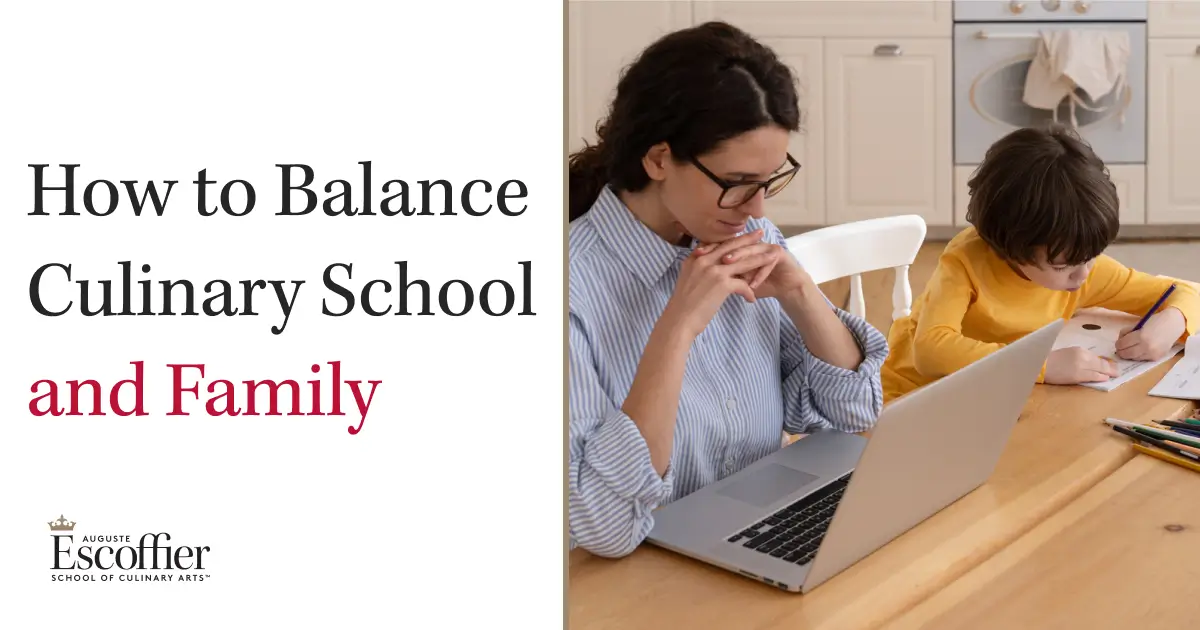
- The "Parallel Play" Method: If your children are doing homework, do yours at the same time. This turns study time into a communal activity, modeling the importance of education.
- Child-Involved Cooking: If you are an online student completing assignments at home, involve your children in the prep work. It is an excellent way to spend quality time together while simultaneously completing your required coursework.
- Prioritize, Don’t Maximize: You do not need to be the perfect parent, the perfect student, and the perfect employee simultaneously. Identify which tasks can be "good enough"—such as a simpler dinner or a slightly messier house—to reclaim the energy needed for your studies.
- Delegate Without Apology: Your family is a team. When older children take on chores like setting the table or feeding the pets, they aren’t just helping you; they are gaining independence.
Choosing Your Path: Online vs. In-Person
| Feature | Online Programs | On-Campus Programs |
|---|---|---|
| Schedule | Weekly deadlines; flexible daily hours | Fixed, structured daily sessions |
| Location | Your own kitchen | Professional campus kitchens |
| Childcare | Best for irregular schedules | Requires reliable, fixed coverage |
| Support | Remote Success Coaches | On-site Student Success Managers |
Conclusion: Starting the Journey
You don’t need a perfectly cleared calendar to begin your culinary journey. You need a decision and a support structure. The "logistics" that currently keep you from clicking "apply" are merely puzzles to be solved, not barriers to be feared.
Whether you opt for the flexibility of an online program that allows you to cook alongside your children or the immersive environment of a physical campus that provides a dedicated "away" space, your goal is achievable. By communicating with your family, leaning on your instructors, and framing your education as a vital step in your personal and professional evolution, you can close the browser tab and finally start the path toward the chef’s hat.
The dishes will always be waiting, but your dream doesn’t have to. Reach out to an admissions representative today to discuss which program fits your life, and take the first step toward a future that tastes exactly the way you imagined it.


 Evan Lee Salim