

 Ali Ikhwan

 Iffa Jayyana

 Muslim

 Nana

 Dwi Wanna
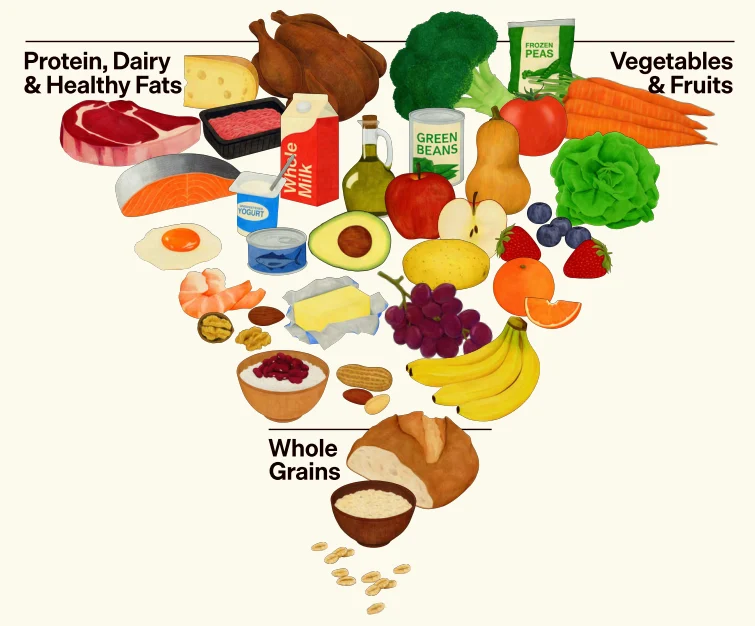
The release of the 2025–2030 Dietary Guidelines for Americans (DGAs) this week was met with both anticipation and skepticism. Framed by the catchy, consumer-friendly tagline "eat real food," the document aims to provide a definitive roadmap for nutritional health in the United States. While the Guidelines take an undeniably stronger stance against the consumption of added sugars and highly processed foods, they have simultaneously ignited a firestorm of controversy. The reintroduction of a pyramid-style graphic—this time inverted to prioritize animal products—has left nutrition scientists, public health advocates, and the general public questioning whether the government’s latest advice is rooted in rigorous science or influenced by industry pressures.
Main Facts: A Shift in Tone and Strategy
The 2025–2030 DGAs mark a departure from the dense, policy-heavy documents of the past. The current edition is notably shorter, more accessible, and accompanied by an interactive website and modernized graphics. Central to the guidelines is a bold, long-overdue critique of "highly processed" foods. For the first time, the DGA text explicitly recommends limiting not just specific nutrients like sugar and sodium, but an entire category of manufactured items, including ready-to-eat snacks and sugar-sweetened beverages.
However, the headline-grabbing feature is the "New Food Pyramid." Unlike the classic iterations of the past, this graphic has been flipped on its head. It features a prominent visual hierarchy that emphasizes steak, full-fat milk, and butter—a choice that seems at odds with the written text. While the Guidelines officially maintain the long-standing scientific consensus that saturated fat intake should remain below 10% of total daily calories, the visual prominence of animal-based fats in the pyramid creates a jarring contradiction.
Chronology: The Road to the 2025 Guidelines
To understand the current friction, one must look at the process behind the publication. Every five years, the U.S. Departments of Agriculture (USDA) and Health and Human Services (HHS) are tasked with updating the DGAs. Traditionally, this involves an independent Dietary Guidelines Advisory Committee (DGAC)—a group of nutrition experts vetted for conflicts of interest—who synthesize current science into a public report.
The 2025 cycle followed a different, more contentious path. After the initial Advisory Committee completed their rigorous two-year evidence review, their findings were rejected by the administration. In an unprecedented move, the government turned to a separate "supplemental scientific analysis" conducted by a panel of individuals selected through a federal contracting process rather than the traditional committee structure.
This pivot has drawn sharp criticism from experts. Deirdre Tobias, a professor in the Department of Nutrition who served on the 2025–2030 DGAC, has publicly noted a lack of transparency regarding the methodology used in the supplemental review. "The reviews themselves, as well as their overall presentation and integration, deviate significantly from the rigorous process that the HHS developed," Tobias stated. Furthermore, investigative reports have surfaced highlighting that several members of this supplemental review panel held disclosed financial ties to the beef and dairy industries, raising immediate red flags regarding the impartiality of the resulting "New Food Pyramid."
Supporting Data: The Saturated Fat and Protein Paradox
The internal logic of the new guidelines is frequently undermined by the math of daily consumption. Consider a standard 2,000-calorie diet. With a 10% cap on saturated fat, an individual is limited to roughly 22 grams of saturated fat per day.
If a consumer follows the DGA’s recommended three daily servings of dairy—specifically choosing the full-fat versions highlighted in the pyramid (e.g., 8 ounces of whole milk, 3/4 cup of full-fat Greek yogurt, and 1 ounce of cheddar cheese)—they have already reached 17 grams of saturated fat. Adding a single tablespoon of butter or beef tallow, both suggested in the guidelines as cooking fats, pushes the consumer over the 22-gram limit before they have even accounted for the fat present in their primary protein sources or other meals.
Furthermore, the guidelines suggest a significant increase in protein intake, recommending 1.2 to 1.6 grams per kilogram of body weight. This is a 50–100% increase over previous minimum intake recommendations. While protein is vital, the guidelines fail to distinguish between protein "packages." As Frank Hu, chair of the Department of Nutrition at the Harvard T.H. Chan School of Public Health, points out, "Substantially raising overall protein intake without distinguishing between different protein sources may have unintended long-term health implications." Diets heavy in red meat are linked to different health outcomes than those reliant on fish or plant-based proteins, yet the guidelines group these sources together without clear instruction on which to prioritize for heart health.
Official Responses and Expert Critique
The disconnect between the government’s rhetoric and the practical advice has not gone unnoticed. Dr. Frank Hu notes that while the guidelines move in the right direction by tackling refined grains and sugars, the "mixed messages" regarding saturated fats are dangerous. "The visual prominence of red meat, butter, and beef tallow may lead to confusion and potentially higher intake of saturated fat and increased LDL cholesterol and cardiovascular risk," Hu warns.
The government maintains that the new guidelines are designed to be "consumer-friendly." By simplifying the language and providing a visual "food map," they hope to reach a broader audience than previous, more academic reports. However, critics argue that "simple" should not come at the expense of "accurate." By failing to provide clear guidance on the difference between healthy unsaturated fats (like olive oil) and saturated animal fats, the guidelines essentially leave the average consumer to guess—often opting for the products most heavily marketed in the new, government-endorsed imagery.
Implications: A Crisis of Public Trust
The implications of these mixed messages are profound. Historically, Americans have struggled to follow dietary guidelines, and the current, confusing rollout is unlikely to improve compliance. When government advice is perceived as being influenced by industry lobbyists rather than independent, peer-reviewed science, the credibility of the entire public health apparatus suffers.
Moreover, the omission of environmental and socioeconomic factors remains a glaring oversight. Food production and consumption are inextricably linked to climate change and the cost-of-living crisis. By ignoring the environmental impact of animal-heavy diets and the reality that healthy, whole foods are often inaccessible in "food deserts," the 2025–2030 DGAs feel disconnected from the modern reality of American life.
Moving Forward
For the average consumer, the current situation highlights the importance of nutritional literacy. While the DGAs offer some helpful guardrails—particularly regarding the need to reduce added sugars and ultra-processed carbohydrates—the "New Food Pyramid" should be treated with caution.
Health professionals, including registered dietitians and nutrition scientists, suggest that the most reliable dietary frameworks are those that have been vetted by non-partisan, independent institutions. Resources such as the Healthy Eating Plate and the Healthy Eating Pyramid—developed by nutrition researchers at the Harvard T.H. Chan School of Public Health—remain evidence-based alternatives for those looking to cut through the confusion.
Ultimately, the 2025–2030 guidelines serve as a reminder that health policy is never created in a vacuum. As the debate over these guidelines continues, the public must demand greater transparency in how nutritional science is synthesized, ensuring that the food on our plates is dictated by human health, not the interests of special groups. Until then, the "New Food Pyramid" stands as a cautionary tale of what happens when scientific rigor is sidelined by political and industry influence.


 Nana Muazin

 Evan Lee Salim

