 Dwi Wanna
 Nana Wu
 Muslim
 Reynand Wu
 Ammar Sabilarrohman
 Iffa Jayyana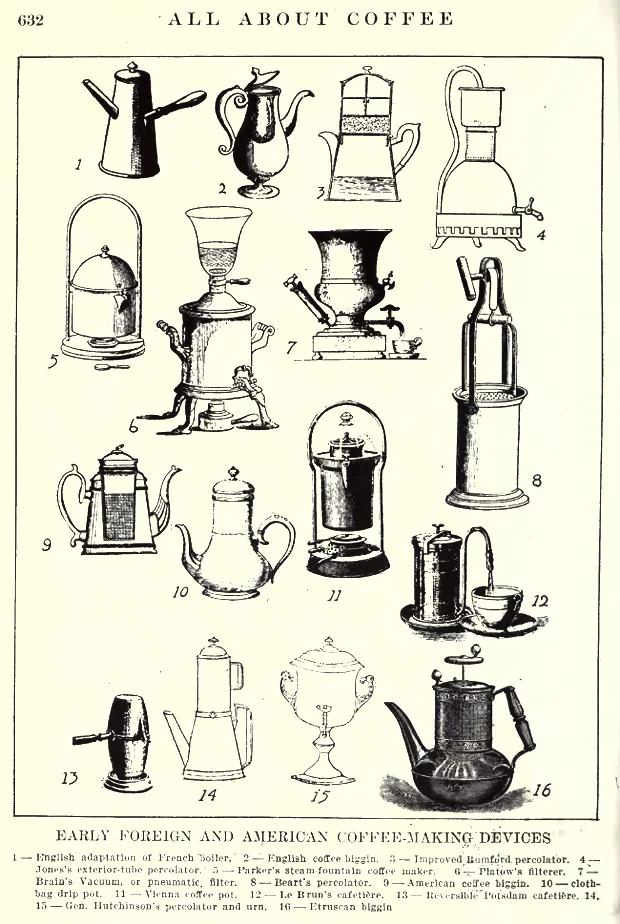
For many, the morning ritual of brewing coffee is a simple, automated process. However, beneath the surface of the humble V60 or French press lies a complex laboratory of fluid dynamics, thermal physics, and organic chemistry. While the average consumer might view coffee as a binary state of "strong" or "weak," the reality is a multi-dimensional spectrum of nine orders of magnitude in chemical concentration. Achieving the "perfect" cup is not a matter of luck, but a mastery of selective extraction.
The Chemistry of Selective Extraction
To understand coffee, one must first accept that a roasted coffee bean is not a monolithic entity. It is a dense matrix of cellulose, oils, carbohydrates, and volatile aromatic compounds, all of which possess different solubility profiles and extraction rates.
If one were to grind coffee to a fine dust and steep it for an extended period in boiling water—the methodology of a traditional Turkish coffee—the extraction yield would approach 30%. While this yields a robust, high-intensity cup, it is rarely the most nuanced. The goal of the modern home barista is not total extraction, but selective extraction. We are not looking to pull every last molecule from the bean; we are looking to curate a profile of flavor compounds while leaving behind the bitter, astringent, or undesirable elements.
Contrary to the popular goal of "even extraction," a chemical analysis suggests that the target should actually be a controlled, uneven extraction. By manipulating variables such as contact time, grind size distribution, and water temperature, we can ensure that desirable acids and sugars reach the cup while potentially harsh compounds remain trapped in the spent grounds.
A Chronology of Coffee Innovation
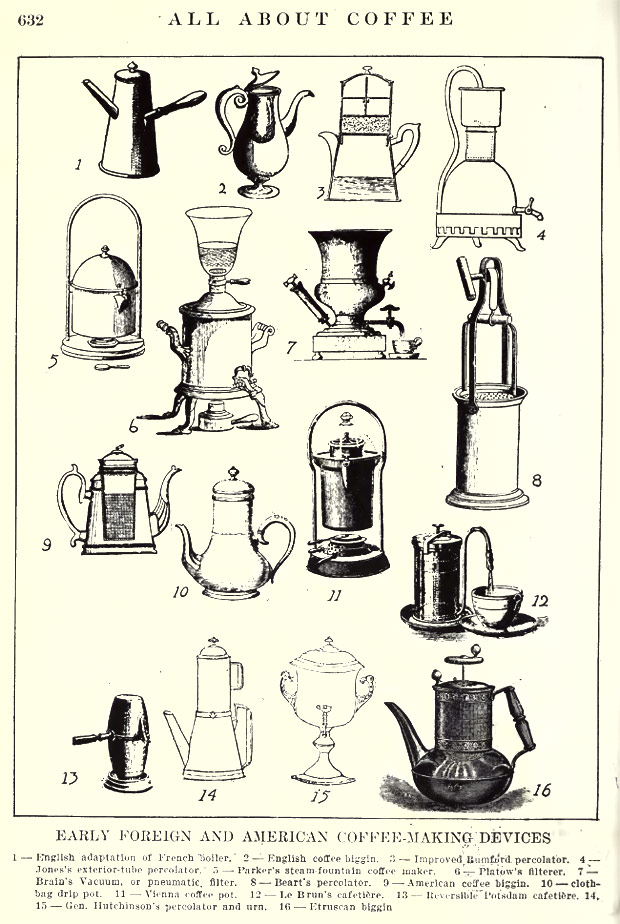
The quest for the perfect extraction method is not a modern trend. It is a two-century-old pursuit of engineering perfection.
The Early Era: From Percolation to Gravity
The mid-19th century saw the birth of the "percolator," a device that relied on convection to circulate heated water through a coffee bed. While revolutionary for its time, it often suffered from over-extraction due to the repeated boiling of the liquid. By the 1970s, the design had been refined, yet the fundamental issues of temperature instability remained.
The Rise of the Pour-Over
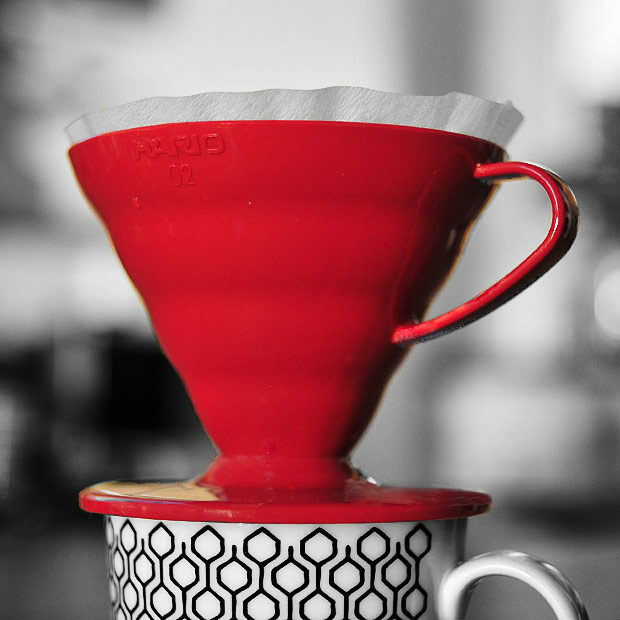
As the specialty coffee movement gained momentum, the focus shifted back to manual pour-over techniques. These methods rely on gravity-fed percolation, where water travels once through the coffee bed. This transition allowed for greater control over the "bypass"—the water that flows around the coffee rather than through it—and ushered in the era of the modern dripper, from the iconic Hario V60 to the flat-bottomed Kalita Wave.
The Modern Quest for Repeatability
Today, the field is flooded with specialized gear, from the Gabi Dripmaster to the Tricolate. These innovations represent a concerted effort by engineers and baristas alike to "untie the coffee knot." The current frontier involves minimizing bypass entirely, ensuring that the only factor restricting water flow is the coffee bed itself, rather than the geometry of the filter holder or the paper’s permeability.
Technical Parameters and Supporting Data
The variables involved in brewing are vast and deeply correlated. A change in one, such as grind size, inevitably triggers a cascade of effects on flow rate, contact time, and, consequently, the final flavor profile.
The Correlation Table: A Barista’s Map
Understanding how these variables interact is critical. As noted in the analysis of modern brewing equipment:
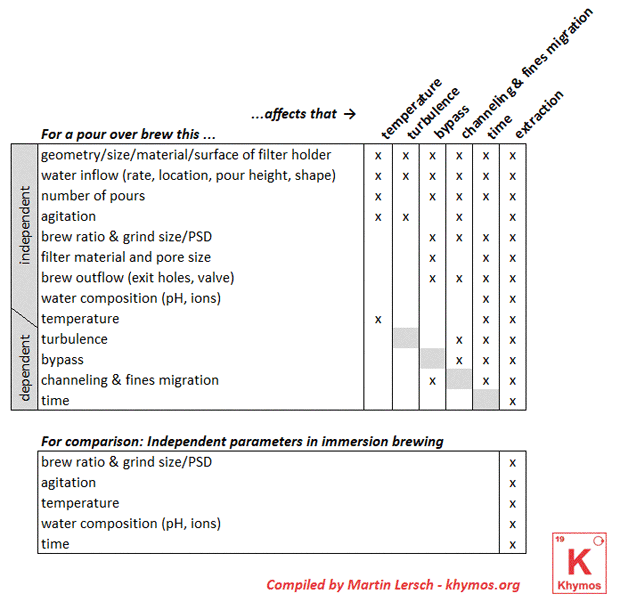
- Grind Size & PSD: Finer grinds increase surface area, improving extraction, but also slow flow and increase the risk of channel formation.
- Geometry: A tall, narrow coffee bed encourages deep contact but risks slow drainage. A wide, flat bed promotes faster, more uniform flow but requires precise water distribution to prevent "channeling," where water bypasses the bulk of the grounds.
- Bypass Control: The "laziness" of water means it will always seek the path of least resistance. Equipment that allows water to run down the sides of the filter without passing through the coffee bed effectively dilutes the cup, leading to a loss of complexity.
| Device Type | Primary Material | Bypass Risk | Control Mechanism |
|---|---|---|---|
| Hario V60 | Plastic/Ceramic | High | Manual Pouring |
| Aeropress | Plastic | None | Pressure/Steeping |
| Kalita Wave | Metal/Glass | Moderate | Geometry/Filter |
| Tricolate | Plastic | None | Geometry |
The Immersion Alternative
While pour-over methods offer the highest ceiling for complexity and clarity, they are inherently prone to human error. This is where immersion brewing—such as the French press or the Aeropress—finds its strength.
Immersion brewing is the "robust" cousin of the pour-over. By steeping grounds in a fixed volume of water for a set duration, the system reaches a state of equilibrium. This minimizes the impact of pouring technique and water distribution, making the recipe highly repeatable. The trade-off is often a heavier body, due to the migration of coffee fines into the cup, and a potential for muted flavor notes compared to the crystalline clarity of a well-executed paper-filtered pour-over.
Implications for the Modern Barista
The modern coffee industry is currently navigating a tension between two philosophies: the precision of the laboratory and the art of the craft.
The Myth of the "Perfect" Recipe
The proliferation of conflicting brewing advice on social media platforms often stems from a lack of control over the variables mentioned above. When a recipe fails to specify the filter type, the water temperature, or the pouring rate, the result becomes random. The implication for the home enthusiast is that "better" coffee is not necessarily found in a more expensive brewer, but in a deeper understanding of the physics governing the interaction between water and ground coffee.
The Future of Brewing
As researchers and innovators like Jonathan Gagné and various equipment designers continue to iterate, we are seeing a shift toward "total immersion" and "high-extraction" drippers. These devices aim to eliminate the uncontrolled variables of traditional pour-overs. The industry is moving toward a standard where the barista—or the home user—can act more as a technician, adjusting variables with the confidence that the equipment will respond predictably.
Conclusion: The Essence of the Search
Ultimately, the obsession with brewing equipment—the search for the "perfect" dripper or the ideal filter paper—is a testament to our desire for the optimal cup. Whether one chooses the delicate, nuanced clarity of a pour-over or the robust, consistent body of an immersion brew, the goal remains the same: to capture the most desirable soluble compounds of the bean.
As demonstrated by the enduring popularity of iconic setups, from the humble French press to the sophisticated build seen in popular media like Breaking Bad, the pursuit of the "perfect" cup is a journey through chemistry. The next generation of coffee makers will likely focus on removing the guesswork, allowing the unique character of the origin to shine through with unprecedented clarity. Until then, the secret to the perfect cup remains where it has always been: in the mastery of the variables, the patience of the pour, and the rigorous application of the scientific method to our daily caffeine intake.


 Sagoh
Sagoh