
 Dwi Wanna
 Nana Wu
 Muslim
 Reynand Wu
 Ammar Sabilarrohman
 Siti Muinah
To the average consumer, a cup of coffee is a simple morning ritual—a dark, invigorating elixir born from hot water and roasted beans. However, for the chemist and the dedicated barista, that same cup represents a complex, multi-dimensional chemical landscape. While we often focus on the mechanics of brewing—grind size, water temperature, and extraction ratios—the true mystery lies in the liquid itself. What exactly constitutes the 1.5% of "stuff" that transforms 98.5% water into the world’s most nuanced beverage?
Main Facts: The Composition of Complexity
A standard cup of black coffee is, by volume, more than 98.5% water. The remaining 1.2% to 1.5% consists of Total Dissolved Solids (TDS). When you brew a liter of coffee using roughly 60 grams of grounds, you are effectively extracting about 12 to 15 grams of solids. These solids are not a monolithic substance; they are a chaotic, beautiful mixture of hundreds, potentially thousands, of individual molecules.
These extracted compounds are responsible for every aspect of the coffee experience: the deep brown color, the sharp acidity, the velvety body, and the intoxicating aroma. Despite decades of study, coffee chemistry remains an active field of exploration. Advanced chromatographic techniques have allowed scientists to isolate these components, yet a significant portion of the coffee profile remains "dark matter"—compounds that are either present in such minute quantities that they defy isolation or are so structurally complex that they remain unmapped.
Chronology: A History of Chemical Inquiry
The scientific pursuit of coffee’s "flavor code" has evolved significantly over the last three decades:
- 1996: A landmark study by Semmelroch and Grosch established a baseline for synthetic coffee. Researchers successfully synthesized "model" coffees based on 22 key volatile compounds. While assessors described the results as "clearly coffee-like," they lacked the depth and complexity of the real thing. This proved that the sensory experience of coffee is far greater than the sum of its most prominent parts.
- 2002: An Aroma Extract Dilution Analysis (AEDA) provided a humbling revelation: of the 40 key odorants identified in coffee, 13 were entirely unknown. This highlighted the limitations of existing technology, as these elusive molecules often exist at concentrations too low for standard structural elucidation.
- 2020 and Beyond: Recent research, including studies by Batali et al., continues to bridge the gap between volatile aromatics and the sensory perception of the consumer. As analytical tools like mass spectrometry become more sensitive, the "unknown" fraction of the cup is slowly shrinking, revealing a world of flavor hidden in the parts-per-trillion range.
Supporting Data: The Power of the Minute
One of the most persistent misconceptions in food science is the idea that concentration equates to impact. In the world of coffee, this is fundamentally false.
The Logarithmic Scale of Flavor
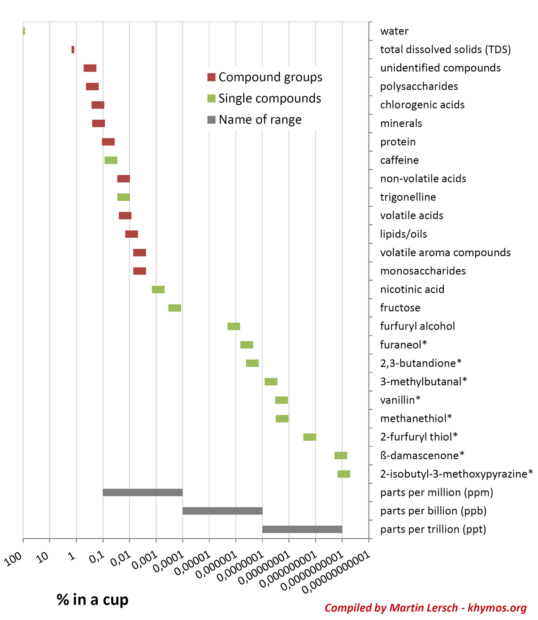
When plotting the concentration of coffee compounds, scientists use a logarithmic scale because the variation in concentration spans over nine orders of magnitude. We categorize these into:
- Major Components: Carbohydrates, acids, and proteins, which define the "strength" and mouthfeel.
- Minor Components: Specific volatiles that define the "notes" of the coffee—floral, fruity, or nutty aromas.
The Odor Activity Value (OAV) is the metric that matters most. OAV is defined as the concentration of a compound divided by its odor threshold. A compound present at 0.01% may be less influential than a compound present at 0.0000000001% if the human nose is hypersensitive to the latter.
The Case of Beta-Damascenone
Consider $beta$-damascenone, a "rose ketone" found in coffee. Despite being present in concentrations as low as 1 part per trillion (ppt), it is considered one of the top five most impactful odorants in a brew. Historically famous for its role in luxury perfumes like Dior’s Poison, its presence in coffee explains the floral, honey-like complexity that distinguishes high-quality Arabica from lower-grade beans.
Official Perspectives: The Limits of TDS
In the specialty coffee industry, TDS meters have become the gold standard for measuring extraction. However, experts warn against relying on these devices as a comprehensive measure of quality.
"TDS is an excellent measure of strength, but a poor predictor of flavor," note leading coffee chemists. Because coffee contains both polar and non-polar compounds, the extraction rate is not uniform.
- Polar Compounds: Acids, minerals, and proteins are highly water-soluble. Water, being a polar solvent, extracts these quite easily—often capturing over 75% of the available polar solids.
- Non-Polar Compounds: Many of the essential oils and volatile aroma compounds are hydrophobic. Water struggles to extract these, typically managing only 10-30% of the available non-polar material.
This disparity is why a high TDS reading does not guarantee a delicious cup. You can have a high-strength coffee that is entirely unbalanced because the extraction process failed to pull the right ratio of volatiles to non-volatiles.
Implications: The Future of Extraction
What does this mean for the future of coffee brewing? If we are currently only extracting a fraction of the non-polar flavor compounds, the industry may be leaving significant potential on the table.
Beyond Water
The industry is beginning to look at the chemistry of solvents. While water is the universal medium for coffee, researchers are investigating whether alternative, food-safe solvents—or perhaps specific pH-adjusted waters—could unlock the "hidden" aroma compounds that currently remain trapped in the spent grounds.
The Sensory Frontier
As we continue to map the chemical composition of coffee, the role of the "human analytical detector"—our own olfactory system—remains vital. Science can quantify the parts-per-trillion of a rose ketone, but it cannot yet fully simulate the synergistic effect of these hundreds of compounds interacting with the human brain.
The "perfect cup" is therefore not merely a product of following a recipe. It is a balancing act of polar and non-polar extraction, a dance of volatile aromatics, and a testament to the fact that even in a substance as ubiquitous as coffee, there is still much to discover. Whether you are a home enthusiast or a professional roaster, the next time you pour a cup, remember: you are holding a chemical solution of staggering complexity, one that continues to defy our ability to perfectly replicate it.
The mystery of the cup is, perhaps, exactly why we keep coming back for more.


 Sagoh
Sagoh