 Dwi Wanna
 Nana Wu
 Muslim
 Reynand Wu
 Ammar Sabilarrohman
 Jia Lissa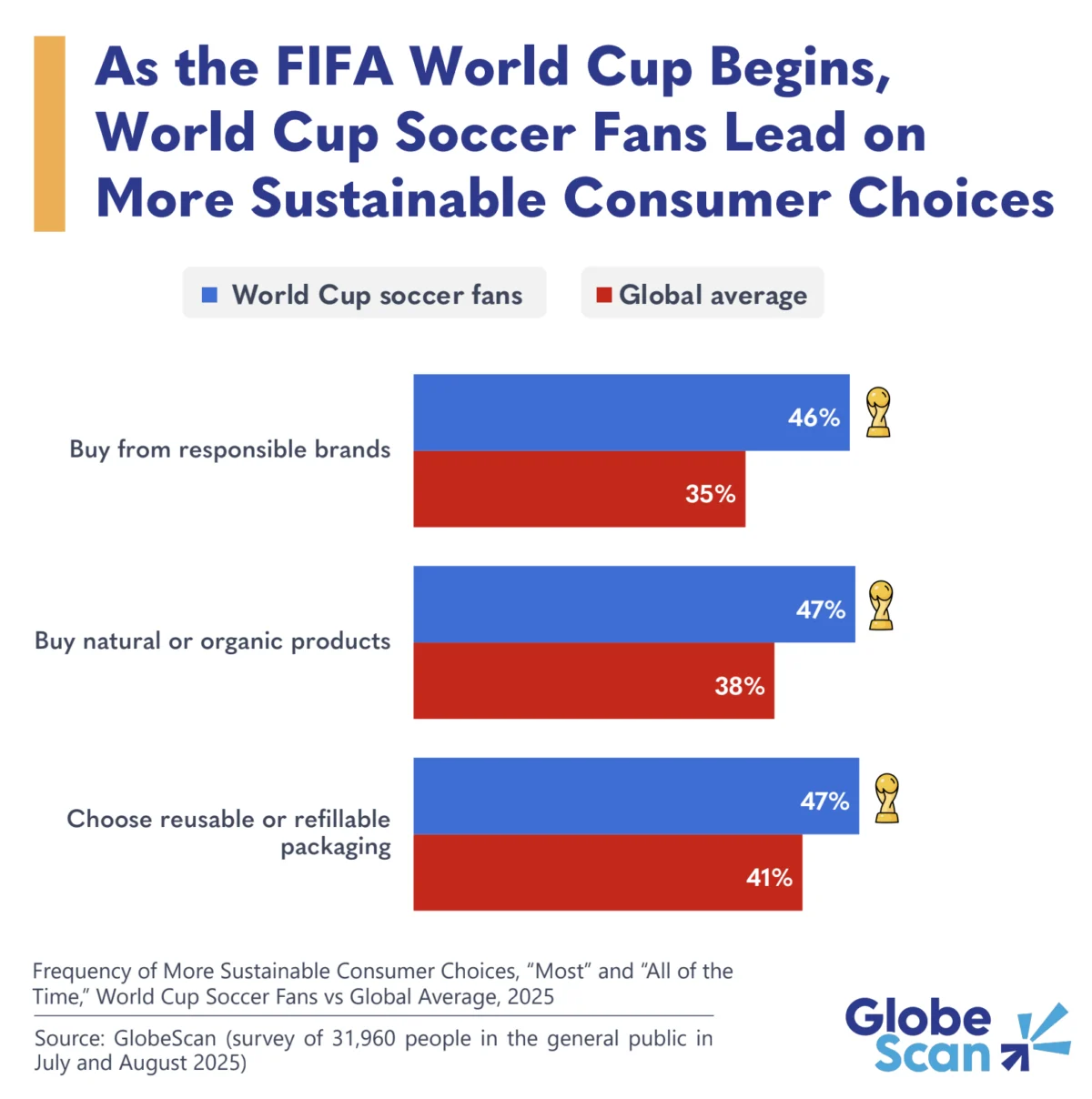
As the global spotlight pivots toward the 2026 FIFA World Cup, brands are scrambling to secure their slice of the most significant cultural event of the decade. While traditional marketing playbooks emphasize visibility, celebrity endorsements, and massive media buys, a new, data-driven narrative is emerging: the fan of 2026 is not merely a passive spectator. They are an active, conscious consumer with a strong propensity for sustainable choices.
According to groundbreaking research from GlobeScan, the soccer fan base represents a unique strategic opportunity. These individuals are not only highly engaged in the tournament but are also significantly more inclined than the general public to adopt sustainable shopping behaviors. This creates a critical intersection where brand activation, retail strategy, and fan experience collide with the growing global mandate for environmental responsibility.
Main Facts: The Intersection of Sport and Sustainability
The fundamental shift identified by GlobeScan is that sustainability is no longer a peripheral "add-on" for the soccer-watching demographic. Instead, it is becoming a core component of their consumer identity. Globally, self-identified FIFA World Cup fans are outperforming the average consumer in nearly every category of sustainable behavior.
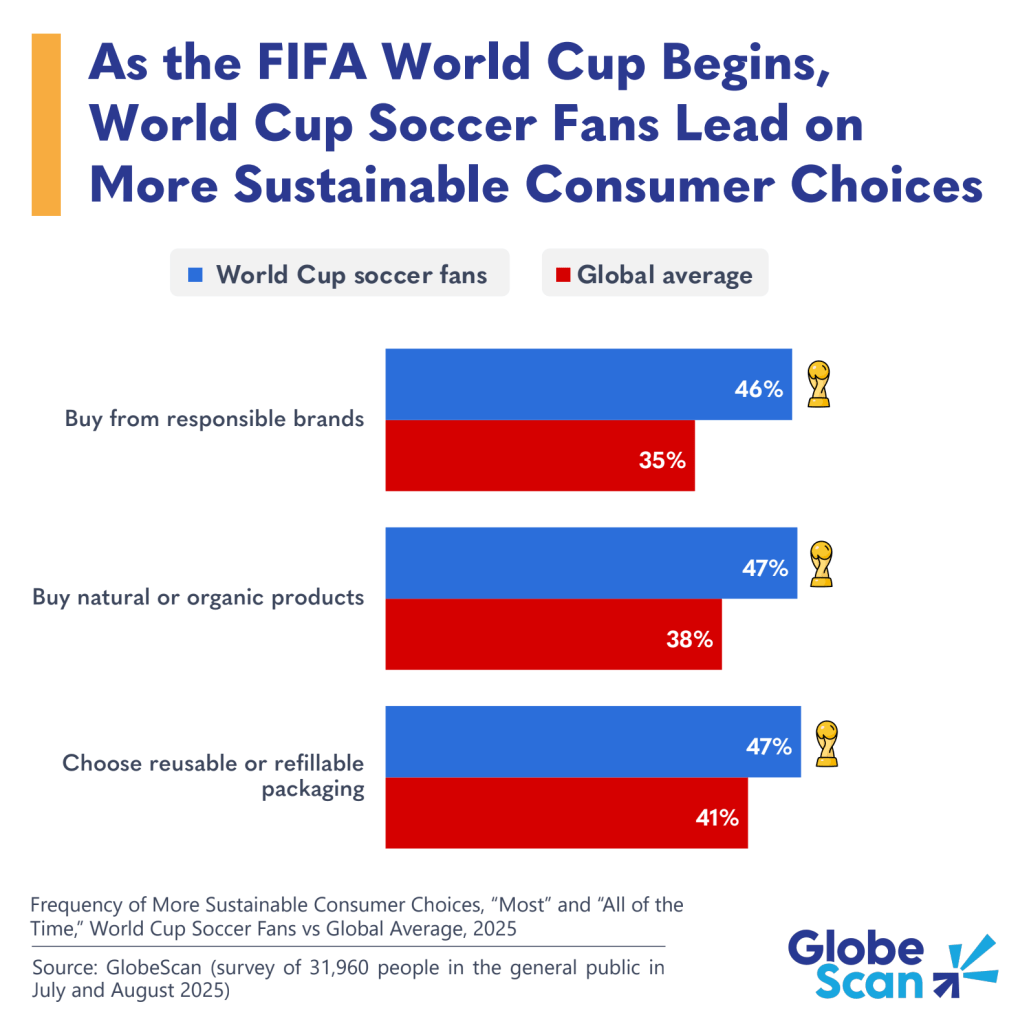
The data reveals a striking trend: 47 percent of soccer fans report purchasing products in returnable, reusable, or refillable containers most or all of the time, compared to a global average of 41 percent. Similarly, 47 percent of fans prioritize natural or organic products, whereas the general public sits at 38 percent. Perhaps most tellingly, 46 percent of fans actively seek out responsible brands—a ten-point lead over the 35 percent average among the general public.
These statistics suggest that soccer fans are not merely "attentive" to sustainability messaging; they are behaviorally primed to act upon it. For sponsors and venue operators, this means the barrier to entry for sustainable consumption is lower among this demographic than with the general population, offering a high-ROI environment for green initiatives.
A Chronology of Changing Consumer Values
The evolution of the "sustainable fan" did not happen overnight. It is the culmination of years of shifting consumer sentiment, tracked meticulously by research bodies like GlobeScan.
- 2019: The Foundation: GlobeScan launches its "Healthy and Sustainable Living" research program. At this stage, the focus was on understanding the systemic barriers preventing consumers from making sustainable choices. It established the baseline for how values translate into daily action.
- 2023–2024: The Rise of the Conscious Fan: As post-pandemic life returned to normal, researchers noted a spike in interest regarding the ethics of large-scale event sponsorships. Fans began to vocalize a preference for brands that displayed environmental stewardship.
- 2025: The Evidence Base: In July and August of 2025, GlobeScan conducted an extensive online survey of more than 31,000 people. This comprehensive dataset provided the empirical weight needed to prove that the "conscious consumer" was not just a niche demographic, but a growing majority among sports enthusiasts.
- 2026: The World Cup Inflection Point: As the tournament kicks off, the confluence of high-intensity commercial engagement and personal values creates a unique "moment of truth." Brands that successfully tap into this sentiment are poised to define the next era of sports marketing.
Supporting Data: The U.S. Context
While the global numbers are compelling, the data regarding the United States—the primary host of the 2026 tournament—is even more dramatic. In a country often criticized for its slower adoption of sustainable habits, soccer fans are defying the trend.

The contrast is stark: American soccer fans are nearly twice as likely as the general public to prioritize shopping with responsible companies (61 percent vs. 32 percent). In terms of specific product choices, 55 percent of American soccer fans favor natural or organic products, compared to just 30 percent of the general public. Furthermore, 50 percent of these fans seek out reusable or refillable packaging, significantly outpacing the 33 percent of the general public who do the same.
This "over-indexing" of sustainable behavior suggests that the U.S. World Cup activations have the potential to normalize green consumption habits on a massive scale. By aligning brand messaging with the values already held by this subset of the population, sponsors can bypass the traditional friction associated with eco-friendly marketing.
Official Perspectives: The Expert View
Tove Malmqvist, a lead researcher at GlobeScan and a core architect of the Healthy and Sustainable Living research program, argues that the World Cup provides a rare convergence of identity and action.
"The implication for brands is not simply that soccer fans care more," Malmqvist explains. "It is that the World Cup creates a rare convergence of attention, identity, and action. In this environment, sustainable options are not just visible; they are highly relevant. They feel like a natural part of the event experience."
Malmqvist emphasizes that her work focuses on the "how" of behavior change. By understanding the motivations and barriers of the consumer, brands can design product assortments and fan experiences that remove the ‘trade-off’ mentality. "We are looking at how to make these choices easier, more attractive, and more normal," she adds. Her research underscores that when sustainability is integrated into the ‘fan journey’—from the stadium concessions to the retail aisle—it ceases to be a chore and becomes an aspirational act of participation.
Implications for Brands and Venue Operators
The evidence suggests that the "sustainability as a communications layer" strategy is outdated. If brands want to leverage the 2026 World Cup effectively, they must move toward "sustainability as a service."
1. The Power of the Fan Journey
Brands should look at the entire arc of the fan experience. Whether it is a refillable water station at the stadium, QR codes that display the carbon footprint of a retail product, or responsible sourcing transparency for food and beverage, these interventions should be baked into the event itself.
2. Normalizing the Choice
The World Cup is a powerful social occasion. When fans see their peers engaging in sustainable behaviors—like using a refillable cup or choosing a brand with clear ethical certifications—those behaviors become part of the shared event culture. Brands have the power to curate these social norms.
3. Moving Beyond Messaging
Messaging is easy; infrastructure is hard. The findings suggest that the audience is ready for action. Brands that invest in physical infrastructure—such as reusable packaging loops or clearly marked organic product assortments—will be rewarded with deeper brand loyalty than those who simply rely on "green" slogans in their advertisements.
4. Sustainability as Aspirational
The ultimate goal for brands is to make sustainability feel like a badge of honor. By positioning green choices as part of the excitement and prestige of the World Cup, brands can move sustainability from a "necessary evil" or a "trade-off" to a hallmark of the modern, sophisticated sports fan.
Conclusion: A Turning Point for Global Consumption
The 2026 FIFA World Cup represents more than just a month of matches; it is a global experiment in behavioral influence. With the data confirming that soccer fans are uniquely receptive to sustainable choices, the tournament serves as a testing ground for how mainstream, high-visibility events can accelerate the transition toward more responsible living.
For the organizations, sponsors, and retailers involved, the message is clear: the fans are ready. They are looking for brands that reflect their values, and they are willing to reward those who facilitate their desire to live more sustainably. By shifting the focus from mere marketing to meaningful, experiential change, the 2026 World Cup could leave a legacy that extends far beyond the final whistle—a legacy of normalized, sustainable consumption that sets a new standard for the industry.

 Azzam Bilal Chamdy
 Ali Ikhwan