

 Azzam Bilal Chamdy
 Neng Nana
 Nana Muazin
 Dwi Wanna
 Raul Delapena Setiawan
 Layla Zulfa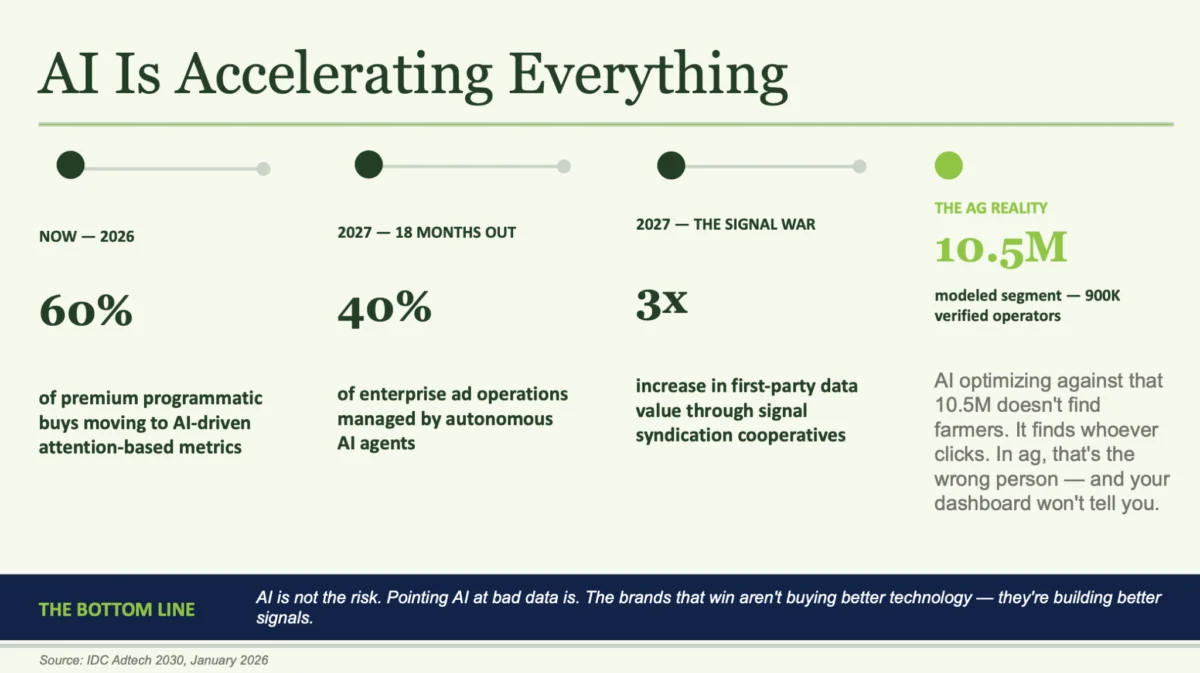
The agricultural sector is currently navigating a period of unprecedented economic pressure. With U.S. farm sector debt projected to hit a staggering $624.7 billion by 2026, and the compounding strain of soft commodity prices and rising input costs, the margin for error in business operations has narrowed to a razor’s edge. For agricultural marketers, this macro-economic shift has triggered a fundamental crisis of confidence: the old playbook—built on broad reach, vanity metrics, and questionable third-party audience modeling—is no longer delivering the returns that finance teams demand.
In this new reality, the efficacy of a marketing campaign is no longer defined by how many eyes see an ad, but by the quality of the signals that drive every decision. As the industry grapples with the transition from traditional digital marketing to a data-first approach, the core thesis is clear: the market has changed, and marketing must fundamentally change with it.
The Market Reality: Convergence of Constraint and Complexity
To understand why traditional marketing tactics are faltering, one must look at the convergence of three primary forces: economic volatility, the erosion of digital privacy, and the deceptive promise of Artificial Intelligence.
The Financial Squeeze
Ag marketers are under scrutiny from internal leadership teams that are increasingly acting like private equity auditors. When farm budgets are tightened, marketing spend is often the first line item to be questioned. The industry is moving away from “brand awareness at any cost” toward a requirement for demonstrable pipeline contribution and revenue impact.
The Privacy Reckoning
For years, marketers relied on third-party cookies as the bedrock of digital targeting. That foundation is crumbling. Despite Google’s recent decision to delay the total phase-out of third-party cookies in Chrome, the regulatory and technical shift toward consumer privacy is irreversible. Nearly 90% of marketers have already pivoted toward first-party and zero-party data strategies. The delay in cookie deprecation is not a stay of execution; it is merely a reprieve that savvy marketers are using to build more sustainable, data-resilient infrastructures.
The AI Paradox
Artificial Intelligence has become the primary tool for campaign optimization, yet it is often misunderstood. AI is not a magic wand that fixes bad data; it is a high-speed engine that scales whatever information it is fed. If a campaign is built on flawed, modeled audiences, AI will simply find more people who fit that flawed model at an accelerated rate. This leads to a dangerous illusion of efficiency, where campaigns appear "optimized" based on the wrong signals.

The Signal Problem: Why Your Campaigns Are Broken
The most startling revelation in modern ag-marketing analysis is that many campaigns are effectively dead on arrival. The disconnect between "perceived reach" and "actual audience" is not just a nuisance—it is a structural failure.
The Illusion of Scale
The reliance on third-party modeled audiences has created a disconnect between digital targeting and physical reality. An analysis by Farm Journal illustrated this vividly: when comparing a modeled third-party crop producer audience to a verified operator database, the third-party list claimed approximately 12.6 million individuals. However, the verified, real-world operator count was closer to 983,000.
This is not necessarily a failure of vendors, but a failure of methodology. Modeled data is a probabilistic estimation, not an observation. In some cases, the inaccuracy is even more alarming; one comparison found zero overlap between a 10.5-million-record third-party agricultural segment and a verified list of 592,000 in-market machinery buyers. Relying on such data is akin to building a house on quicksand.
The Trap of the "Vanity Metric"
Perhaps the most damaging habit in the industry is the continued reliance on Click-Through Rate (CTR). Nielsen research has consistently shown that CTR correlates with less than 1% of actual brand awareness or purchase intent. In agriculture, where buying cycles for equipment, chemicals, or seed are long and complex, a click is rarely a proxy for a sale.
When marketers optimize for clicks, they are training their AI models to find “click-happy” users rather than “buyer-ready” operators. This leads to high traffic numbers that fail to move the needle on revenue, leaving leadership teams to wonder why digital "engagement" never translates to physical sales.
A Chronology of the Shift: From Cookies to Context
- The Era of Mass Reach (2010–2018): Marketers prioritized scale. Third-party cookies allowed for affordable, broad-spectrum digital advertising across the open web.
- The Privacy Pivot (2019–2023): GDPR, CCPA, and Apple’s App Tracking Transparency (ATT) framework began the long process of stripping away anonymous tracking. Marketers scrambled to adapt as the effectiveness of third-party audiences plummeted.
- The AI Acceleration (2024–2025): AI-powered bidding and programmatic media buying became the standard. The focus shifted from how to target to how fast to scale, creating a new problem: the rapid amplification of bad data.
- The Quality Mandate (2026–Present): We are now in the age of "Signal Integrity." The focus has shifted toward first-party data, verified operator identities, and omnichannel measurement that correlates marketing effort to actual business outcomes.
Supporting Data: Why Quality Outperforms Scale
The argument for verified, high-quality data is not just philosophical; it is supported by clear performance metrics. In head-to-head testing where spend and creative were held constant, the only variable being manipulated was audience quality.

- User Engagement: The verified audience generated 106% more unique users and 341% more total site visits than the modeled audience.
- Contextual Superiority: Contextually targeted display campaigns, which place ads within relevant agricultural content, delivered a 79% higher CTR than run-of-network placements.
- Actionable Outreach: Targeted, action-triggered emails sent to verified operators achieved a 35.65% open rate—significantly higher than the industry average for cold-outreach campaigns.
These numbers suggest that when a marketer moves away from the “spray and pray” approach of broad third-party targeting, the result is a massive increase in engagement quality and, ultimately, conversion probability.
Implications: Building a Resilient Strategy
For the CMOs and marketing directors of today, the path forward requires a shift in how they question their vendors and their internal dashboards. Before launching a campaign, marketers must demand answers to four critical questions:
- Is the audience verified or modeled? Understanding the provenance of your data is the first step toward reducing waste.
- When was the data refreshed? In agriculture, where commodity prices and weather patterns dictate buying intent, 18-month-old data is functionally useless.
- Does the creative match the audience? Messaging must align with the operation type and the specific stage of the buying journey.
- Are we measuring buyer behavior or dashboard behavior? Move beyond clicks. Pay attention to site quality, depth of engagement, and view-through metrics that reflect genuine intent.
Conclusion: The Path to Better Results
The era of easy digital marketing is over. As agricultural budgets face continued scrutiny and the digital landscape becomes increasingly fragmented, the "size" of an audience has become a vanity metric that no longer correlates with success.
The marketers who will thrive in the coming years are those who reject the siren song of massive, unverified datasets. They will be the ones who treat their data as a strategic asset, demand transparency in how that data is collected, and measure success through the lens of genuine business impact rather than simple digital noise.
Ultimately, the goal of marketing has not changed: it is still about reaching the right person with the right message at the right time. But in an age of AI and privacy constraints, the method to achieve that goal has been transformed. Better signals lead to better decisions, and better decisions remain the only reliable path to superior results in the modern agricultural market.



 Siti Muinah
