
 Rifan Muazin
 Layla Zulfa
 Nana
Nana
 Asro
Asro
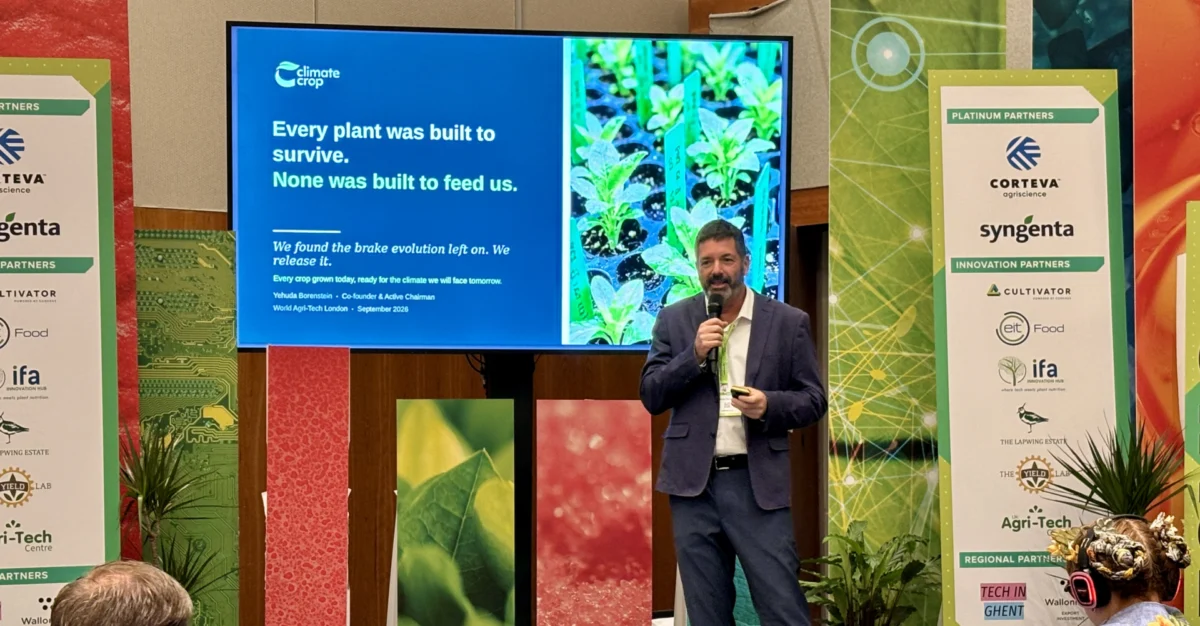
In the high-stakes world of global food security, the quest for the "holy grail" of agriculture—higher yields coupled with climate resilience—has long been hampered by the fundamental biological trade-offs of plant life. Plants, having evolved over millennia to survive rather than to maximize harvest, are governed by internal regulatory mechanisms that prioritize immediate survival over biomass accumulation.
However, an Israeli startup, ClimateCrop, is challenging these evolutionary constraints. By targeting a specific "off-switch" in the starch production cycle, the company claims it can unlock a 10–15% increase in daily starch accumulation across a diverse array of crops. This breakthrough, rooted in fundamental research from the Weizmann Institute of Science, offers a potential paradigm shift in how we approach food, feed, and fuel production in an era of accelerating climate volatility.
The Science of Starch: Neutralizing the Biological Brake
To understand the innovation, one must look at the mechanics of photosynthesis. During the daylight hours, plants perform a complex chemical dance, converting sunlight, water, and carbon dioxide into sugars. A significant portion of this fixed carbon is stored within the leaves as starch—a biological energy reserve that the plant breaks down at night to fuel growth.
However, plants have evolved a regulatory mechanism to govern this process. As light levels shift, specific signaling proteins act as a "brake," throttling starch production to ensure the plant doesn’t overreach its own resource capacity.
"We identified a very specific command that goes to one of the signaling proteins that tells the plant to stop producing starch," explains Yehuda Borenstein, co-founder and CEO of ClimateCrop. "Once we neutralize that command, the plant makes 10–15% more starch."
This extra starch is not merely a surplus; it is a catalyst for a more robust growth cycle. By having more energy available, the plant can accelerate root development, reaching nutrients deeper in the soil faster, and recover from environmental stressors—such as drought or heat waves—with significantly more vigor. Because this effect compounds daily, the long-term impact on biomass and eventual yield can be transformative.
Chronology: From Academic Discovery to Field-Ready Tech
The journey of ClimateCrop began in 2021, though the intellectual foundations were laid years prior within the laboratories of Israel’s prestigious Weizmann Institute.
- Pre-2021: Researchers at the Weizmann Institute uncover a group of proteins governing the daily starch storage mechanism in plants. This discovery provides the crucial "target" for what would eventually become the ClimateCrop platform.
- 2021: ClimateCrop is formally founded by Yehuda Borenstein, Erez Eliyahu, and Vivekanand Tiwari. The company secures an exclusive license to the Weizmann Institute’s research, setting the stage for commercialization.
- 2022–2024: The company transitions from theoretical validation to experimental proof-of-concept. The team begins testing the gene-editing mechanism across a wide variety of crops, including potatoes, tomatoes, canola, and sorghum.
- 2025: ClimateCrop begins demonstrating successful starch accumulation in diverse species, including high-value crops like bananas. The focus shifts toward partnership-driven commercialization, teaming up with seed companies and breeders to integrate the technology into elite varieties.
Supporting Data: Why "Survival Mode" is the Bottleneck
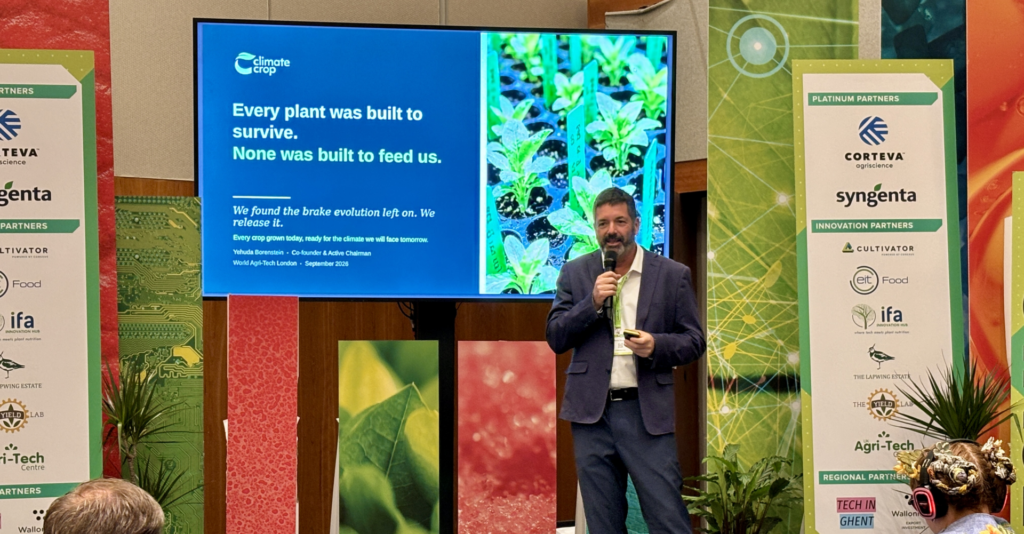
One of the most profound insights offered by Borenstein during his discussion at the World Agri-Tech Innovation Summit in London is the difference between an agricultural crop and a wild plant.
"Plants are not here for us," Borenstein notes. "Their job is not to feed us. They just want to survive."
He points out that 10,000 years of human selection have already drastically altered the morphology of crops, moving them away from their wild, low-yield ancestors. However, even these modern varieties retain the archaic, conservative regulatory "brakes" that served their ancestors in the wild.
ClimateCrop’s data suggests that these brakes are not actually necessary in a managed agricultural environment. In testing, the company has seen no negative tradeoffs in plant health or structural integrity. Because photosynthesis is rarely working at its theoretical maximum capacity in the field, the removal of this internal constraint does not appear to overtax the plant’s systems.
Furthermore, the technology appears to be universal. Because the genetic target is highly conserved across vascular plants, the approach is theoretically applicable to thousands of species. While C4 plants (like maize and sugarcane) may show different response profiles compared to C3 plants (like wheat and soy), the fundamental mechanism of "releasing the brake" is expected to yield positive results across the board.
Official Perspectives: Navigating the Market and Regulatory Landscape
Borenstein is candid about the challenges of bringing a new trait to market. In agriculture, yield is not an absolute; it is a variable influenced by soil quality, weather patterns, and regional geography.
"On yield, you never win on the knockout. You win on points," he admits.
This creates a nuanced narrative for investors and partners. ClimateCrop does not promise a static, guaranteed percentage increase in yield regardless of circumstance. Instead, they position the technology as a form of "biological insurance." In an era of climate change, where the frequency and severity of environmental stress are increasing, a plant that can manage its internal energy more efficiently is inherently more resilient.
The Business Model
ClimateCrop’s route to market is defined by flexibility. Rather than attempting to become a massive, vertically integrated seed company, they act as a "technology provider." They work with:
- Breeders: To backcross the edit into existing, high-performing commercial varieties.
- Seed Companies: To integrate the trait directly into their R&D pipelines.
- Growers: To demonstrate the value of the trait in specific high-value crops.
Regarding the method of implementation, the company is technology-agnostic. While they utilize advanced gene-editing techniques (such as CRISPR) to implement the change, they have also identified naturally occurring mutations in some crop libraries that achieve the same result. This dual-path approach—using both precise editing and traditional marker-assisted breeding—allows them to navigate the varying regulatory environments of different global markets.
Implications: A New Era for Global Food Security
The potential implications of ClimateCrop’s technology are vast. If a company can reliably increase starch production by 10–15% across major staples, the ripple effects on global food prices, land-use efficiency, and agricultural carbon footprints would be substantial.
Increased Efficiency and Land Use
If a plant produces more yield on the same amount of land, the pressure to convert wild forests or grasslands into farmland diminishes. This is a critical component of sustainable agriculture, particularly in developing nations where agricultural expansion is a leading driver of deforestation.
Climate Adaptation
As climate change shifts growing seasons and intensifies droughts, the ability of a crop to recover from stress is becoming more valuable than absolute peak yield. By providing plants with a larger "energy buffer" to draw upon during periods of environmental stress, ClimateCrop is directly addressing the primary pain points of the 21st-century farmer.
A New Tool for Breeders
For decades, plant breeding has been a game of slow, incremental gains. By providing a targeted, well-understood mechanism for increasing energy production, ClimateCrop is handing breeders a new, high-precision tool. This does not replace traditional breeding but rather accelerates it, allowing breeders to focus on other essential traits—such as disease resistance or taste—while ClimateCrop ensures the plant has the underlying energy to thrive.
Conclusion
As ClimateCrop moves from the laboratory to the field, the industry will be watching closely. The company’s success will be measured not just by the data they produce, but by their ability to scale their partnerships and navigate the complexities of global agricultural regulations.
If they can successfully translate their findings from the petri dish to the field-scale acreage, they will have achieved something rare: a fundamental improvement in the efficiency of the most basic biological process on Earth. By turning off the evolutionary "brakes" that keep plants in survival mode, ClimateCrop is helping to ensure that the crops of the future are not just surviving, but thriving, in an increasingly challenging world.


 Sagoh
Sagoh
 Siti Muinah