

 Azzam Bilal Chamdy
 Neng Nana
 Nana Muazin
 Dwi Wanna
 Raul Delapena Setiawan
To the casual observer, a cup of coffee is a simple infusion: hot water poured over roasted, ground beans. However, for the chemist and the dedicated barista, that same vessel holds a chaotic, sophisticated, and largely mysterious chemical landscape. While we often obsess over grind size, water temperature, and brew ratios, we rarely stop to consider the sheer molecular complexity of the liquid we consume.
Beyond the 98.5% water content that forms the base of every brew, the remaining 1.5%—the Total Dissolved Solids (TDS)—is where the real magic happens. Within that tiny fraction lies a chemical profile composed of hundreds, if not thousands, of distinct molecules that define the color, body, acidity, and aromatic profile of the coffee.
The Anatomy of Extraction: Beyond Total Dissolved Solids
When we measure TDS, we are essentially taking a census of the "solids" extracted from our coffee grounds. In a standard brew, roughly 12 to 15 grams of material are pulled from 60 grams of grounds into every liter of water. But TDS is a blunt instrument. It tells us the "strength" of the coffee, but it is notoriously poor at predicting the nuance of the flavor.
The compounds within these solids fall into two broad categories: volatile and non-volatile. The non-volatiles—sugars, acids, minerals, proteins, and lipids—are what we perceive on our tongues as sweetness, bitterness, acidity, and astringency. They provide the body and texture, the "mouthfeel" that makes a cup feel rich or thin. Conversely, the volatile compounds are the ones that take flight, wafting into our nasal passages to create the complex aroma profile that defines the coffee experience.
The challenge, as researchers have discovered, is that the human nose does not perceive these compounds linearly. A compound present at a concentration of 0.01% might have the same sensory impact as one present at a concentration of 0.0000000001%. This is due to the unique "odor threshold" of every individual molecule.
Chronology of Discovery: Mapping the Aroma
The quest to decode the scent of coffee has been a decades-long pursuit of analytical chemistry. In 1996, a landmark study attempted to synthesize "model" coffees using only 22 key volatile compounds. While the resulting brew was described by tasters as "clearly coffee-like," it lacked the depth and soul of a true, complex brew. This failure proved that while we can identify the primary building blocks of coffee, the "perfect" replica remains elusive.
By 2002, Aroma Extract Dilution Analysis (AEDA) pushed the boundaries further, revealing that of the 40 key odorants identified in coffee, 13 remained completely unknown to science. The difficulty in identifying these molecules is twofold: many exist in concentrations so minute that capturing a sample large enough for structural analysis is nearly impossible, and others possess molecular structures so large and convoluted that they defy traditional characterization.
This timeline of research suggests that the "true" flavor of coffee is not a singular phenomenon, but a symphony of trace elements, many of which we are only just beginning to name.
Supporting Data: The Case of the Rose Ketones
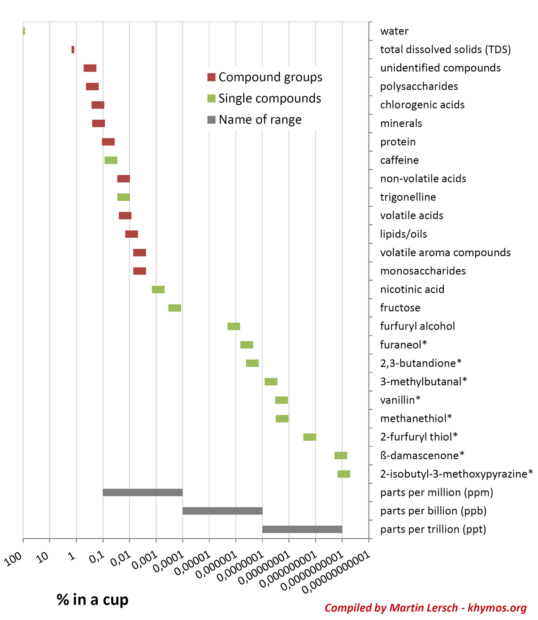
Perhaps the most compelling evidence of coffee’s complexity lies in the role of β-damascenone. A member of the "rose ketone" family, this compound is so potent that our noses can detect it at concentrations as low as one part per trillion (ppt).
Though its concentration in coffee is infinitesimal, it consistently ranks among the top five most influential odorants in a cup. Interestingly, these same rose ketones were the secret weapon behind the iconic 1980s Dior fragrance, Poison. That the same chemical compound can define the scent of a luxury perfume and the nuanced notes of a specialty-grade Arabica coffee highlights the extraordinary sensitivity of human olfaction.
When we look at the concentration ranges of these compounds—spanning over nine orders of magnitude—the disparity between concentration and impact becomes clear. A compound present in the parts-per-trillion range can "play first violin" in the flavor profile, while a compound present at 10,000 times that concentration might be relegated to the background.
The Polar Divide: Solubility and Brewing Implications
A critical, often overlooked aspect of coffee chemistry is the solubility of these compounds. We are dealing with two distinct chemical worlds: polar and non-polar compounds.
- Polar Compounds: These include the acids, minerals, proteins, and carbohydrates. Because water is a polar solvent, it is exceptionally efficient at extracting these elements, successfully pulling more than 75% of available polar compounds into your cup.
- Non-Polar Compounds: These include the volatile aromatics and many of the lipids. Water, being polar, struggles to extract these; typically, only 10% to 30% of these non-polar components make it into the brew.
This chemical reality is why extraction time and solvent choice matter so much. If we only use water, we are essentially getting a biased sample of the coffee bean’s potential. Future experiments in coffee brewing may well move toward alternative, less polar solvents—such as ethanol—to unlock the "hidden" flavors that water simply cannot reach.
Implications for the Modern Barista
What does this mean for the person behind the bar? First, it necessitates a shift in how we view quality control. If a TDS meter is incapable of capturing the nuances of aroma, then our sensory apparatus—the human nose and palate—must remain our primary analytical tool.
Second, the "unknown" nature of many coffee compounds suggests that the coffee industry is still in its infancy regarding technical understanding. We are brewing with ingredients that we don’t fully comprehend, using extraction methods that favor certain chemical groups while ignoring others.
The pursuit of the perfect cup is not just a culinary endeavor; it is an exercise in applied chemistry. As we continue to identify new key odorants and understand the thresholds of human perception, the bridge between the science lab and the coffee shop will continue to narrow.
For now, the next time you take a sip of coffee, remember: you are not just drinking a beverage. You are sampling a volatile, unstable, and incredibly dense chemical solution. You are interacting with rose ketones that define high-fashion perfumes, and you are extracting only a fraction of the total potential of the bean. You are participating in a microscopic, invisible alchemy that is, in every sense of the word, a wonder of nature.
References
- [1] Sanz, C.; Czerny, M.; Cid, C.; Schieberle, P. Eur. Food. Res. Technol., 2002, 214, 299.
- [2] Semmelroch, P.; Grosch, W. J. Agric. Food Chem. 1996, 44, 537.
- [3] Belitz, H.-D.; Grosch, W.; Schieberle, P. (ed.), 2004, Food Chemistry (3rd edition) Springer.
- [4] Amanpour, A.; Selli, S. J. Food Proc. Pres. 2016, 40, 1116.
- [5] Batali, M. E.; Frost, S. C.; Lebrilla, C. B.; Ristenpart, W. D.; Guinard, J.-X. J. Sci. Food Agric. 2020, 7, 2953.

 Pevita Pearce
 Layla Zulfa
