

 Dwi Wanna
 Nana Wu
 Muslim
 Reynand Wu
 Ammar Sabilarrohman
 Lina Irawan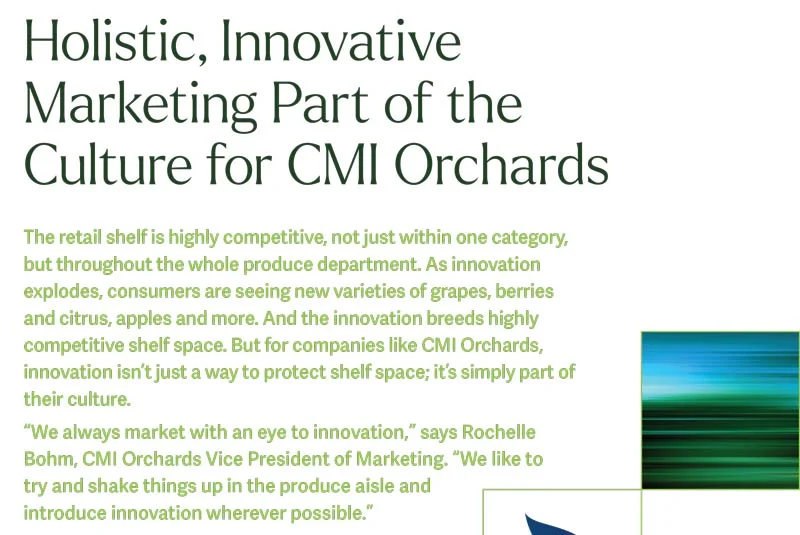
In an industry traditionally dominated by commodity-based pricing and standardized retail displays, CMI Orchards is carving out a reputation as a digital-first innovator. By bridging the gap between centuries-old orchard practices and the high-tech demands of Gen Z and Millennial consumers, the company is proving that produce marketing can be as dynamic as the tech or beauty industries.
Under the guidance of Rochelle Bohm, Vice President of Marketing, CMI Orchards has adopted a philosophy centered on "calculated risk" and "programmatic innovation." Rather than relying on outdated mass-market strategies, the company is leveraging gamification, holistic media integration, and data-driven storytelling to turn the humble apple, pear, and cherry into lifestyle brands.
The Strategic Pivot: Meeting the Digital-First Consumer
The demographic landscape of the modern grocery shopper has shifted dramatically. With Millennials and Gen Z now representing more than half of the population, the expectation for brand interaction has moved away from static signage toward personalized, interactive digital experiences.
The Rise of Gamified Produce
One of the most striking examples of CMI’s pivot is the launch of "Apple Crush," a gamified, dating-app-inspired tool designed to help consumers find their perfect apple variety. By injecting humor and interactivity into the selection process, CMI lowers the barrier to entry for shoppers who might otherwise default to the "standard" red delicious or granny smith.
"We always market with an eye to innovation," explains Rochelle Bohm. "We like to try and shake things up in the produce aisle and introduce innovation wherever possible. We’re not afraid to take some calculated risks on different approaches, and we pull a lot of cues from other departments across the store, too."
Borrowing from CPG Playbooks
CMI Orchards recognizes that while produce budgets are often dwarfed by those of major Consumer Packaged Goods (CPG) giants in the beverage or cosmetic sectors, the tactics used by those industries are scalable. By observing how high-end fragrance or wine brands build anticipation and exclusivity, CMI adapts these strategies for the produce section, ensuring that their marketing remains fresh, relevant, and visually compelling.
The Programmatic Approach: Simplifying Retail Integration
Innovation in marketing is meaningless if it creates friction at the retail level. Retailers, often constrained by limited shelf space and labor shortages, are frequently hesitant to overhaul their displays. CMI Orchards addresses this through an "intentional program approach."
Streamlining the Retail Experience
Rather than presenting retailers with a dizzying array of individual products, CMI provides cohesive programs—such as American Dream® and Flavors of the World®—that offer a flexible framework.
"We understand that it’s tough for retailers to switch things out," Bohm notes. "It’s an easier sell if we can come to them with a program that says, ‘Just take this program, and we’ll slot in different varieties.’ They can sign on to the umbrella brand, and then we push different varieties based on seasonality or the specific flavor preferences of that local market."
This approach turns the retail display into a "plug-and-play" module, minimizing the logistical burden on grocers while maximizing the variety available to the consumer.
Holistic Media Integration: A Multi-Channel Strategy
CMI Orchards’ marketing strategy does not end at the store exit. Their media strategy is designed to create a "surround-sound" effect, ensuring that the brand is present at every stage of the customer—and the retailer—journey.
The "West Coast Produce Expo" Model
For CMI, industry events like the West Coast Produce Expo (WCPE) are not merely networking opportunities; they are hubs for testing new marketing hooks. Through a long-standing partnership with The Packer, CMI has integrated their event presence with digital and print campaigns.
"By the time we land at the show, we’re ready to have our customers swing by and check out what’s new," Bohm explains. "Having that holistic approach, where they’re seeing us ahead of time in their inboxes, on their desks when the print publications drop, and then in person at the show, gives us a multi-prong approach to making sure we hit our targets."
This strategy often involves creative experimentation—such as installing Ferris wheels or music-based interactive games at trade shows—to foster genuine, informal connections. "We love being the guinea pig," Bohm says. "It’s about creating an environment where you don’t feel like you’re working, but you’re still building meaningful networks."
Data, Metrics, and the Power of Anecdotal Intelligence
In an era of big data, CMI Orchards remains committed to a "grassroots" philosophy. While the company utilizes sophisticated digital metrics to track campaign performance, they place equal importance on anecdotal feedback—the "word of mouth" that occurs in the aisles and at industry conferences.
The Value of Human Feedback
CMI trains its team to actively listen and report back on how shoppers are reacting to new varieties or marketing tactics. This qualitative data is just as critical as the quantitative metrics provided by digital tools. It allows the company to pivot quickly if a marketing hook isn’t resonating or if a specific apple variety is gaining unexpected traction in a particular region.
"We take advantage of a range of tools so we can hit a wide range of customers at one time," says Bohm. "We don’t want to apply just a single tactic, because each one speaks to a different audience member."
Implications for the Future of Produce Marketing
The success of CMI Orchards serves as a case study for the agricultural sector at large. As smaller companies in the produce space navigate an increasingly competitive environment, the ability to cultivate a culture of curiosity and calculated risk-taking becomes a primary competitive advantage.
Key Takeaways for the Industry:
- Cultural Intentionality: Innovation does not happen by accident; it requires a corporate culture that encourages employees to ask, "How can we adapt this from another industry?"
- Strategic Partnerships: Leveraging media partners as collaborators, rather than just advertising outlets, allows for more sophisticated, multi-channel storytelling.
- Flexible Frameworks: By creating "umbrella" brands for retailers, produce companies can overcome the "paradox of choice" and make it easier for stores to showcase variety.
- Embracing Disruption: Whether it is a gamified dating app for apples or a Ferris wheel at a trade show, the willingness to be the "guinea pig" allows for breakthroughs that standard marketing simply cannot achieve.
Final Thoughts
CMI Orchards is not just selling fruit; they are selling an experience. By treating their marketing as an evolving program rather than a series of one-off ads, they are setting a new standard for how the agricultural industry communicates with the modern consumer.
"We’re just curious people trying to keep abreast of trends any way we can," Bohm concludes. This curiosity, backed by a robust and multi-faceted marketing architecture, ensures that CMI will remain at the forefront of the produce aisle for years to come. In a world where attention is the scarcest resource, CMI is finding that the most effective way to grab it is by refusing to settle for the status quo.
As the industry continues to evolve, the CMI Orchards model provides a blueprint for any company—regardless of size—that is ready to turn its marketing into a catalyst for growth. By being bold, staying nimble, and always keeping the consumer’s digital habits at the heart of their strategy, they have successfully transformed from a traditional orchard into a modern, lifestyle-focused powerhouse.


 Sagoh
Sagoh