 Dwi Wanna
 Nana Wu
 Muslim
 Reynand Wu
 Ammar Sabilarrohman
 Pevita Pearce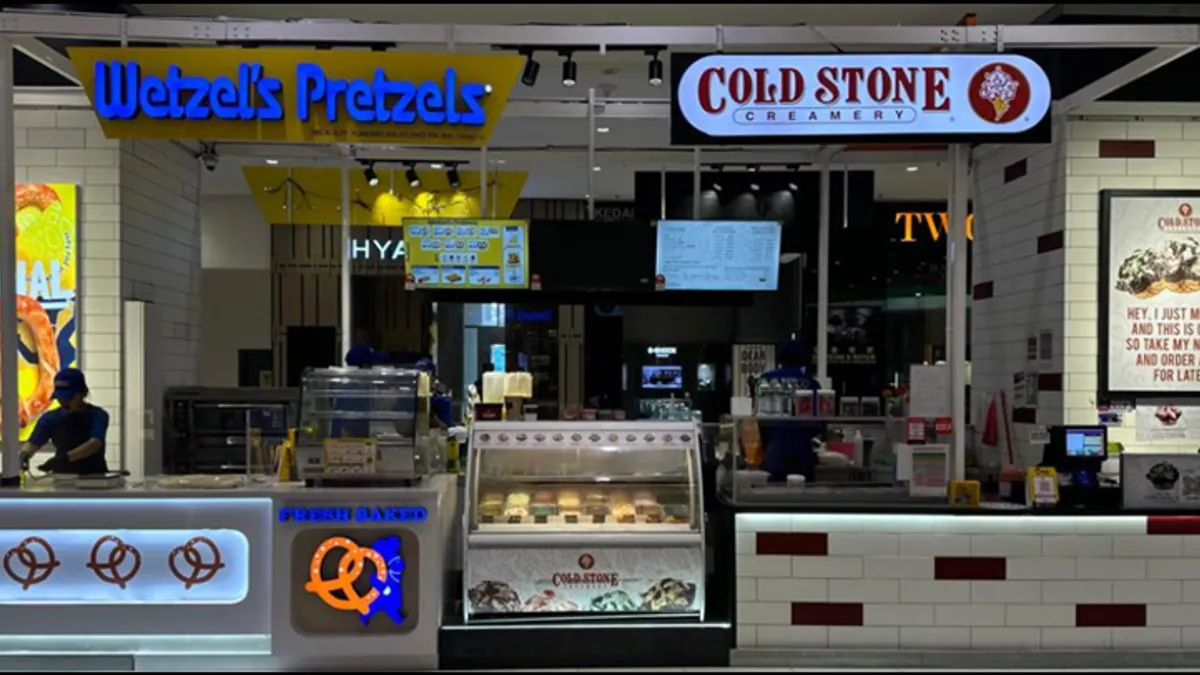
By Julie Littman | Published May 14, 2026
In an era where real estate costs are climbing and consumer attention is increasingly fragmented, the restaurant industry is witnessing a seismic shift toward "co-branding" or "dual-concept" storefronts. The latest major play in this space comes from an unlikely but highly complementary duo: Wetzel’s Pretzels and Cold Stone Creamery. The two iconic snack and dessert chains have announced an aggressive expansion plan, targeting 17 new co-branded locations across the United States in 2026. This move represents a strategic pivot designed to maximize store efficiency, extend daypart relevance, and capitalize on the combined brand equity of two industry staples.
Main Facts: A Dual-Concept Strategy
The initiative seeks to consolidate two distinct, high-traffic consumer experiences—savory, soft-baked pretzels and premium, customizable ice cream—under a single roof. By sharing operational costs, labor, and overhead, franchisees are positioned to capture a broader segment of the market.
The strategy is built on the premise of "craveability." Wetzel’s Pretzels, with its roughly 500-unit footprint, brings a strong savory snack presence, while Cold Stone Creamery, a global titan with approximately 1,500 locations across 30 countries, provides a robust dessert platform. By merging these two, the operators aim to solve a common retail challenge: the "slow time" of the day. A location that might see heavy traffic during lunch for pretzels can now leverage the evening dessert surge inherent to the ice cream model, ensuring a more consistent flow of revenue from morning through late night.
A Chronology of the Co-Branding Trend
Co-branding is far from a new concept, but its application has evolved from experimental food court kiosks to highly integrated, standalone, or lifestyle-center models.
- The Early 2000s: The fast-casual and quick-service restaurant (QSR) sectors experimented with multi-brand concepts, mostly limited to internal portfolios, such as Yum! Brands’ early KFC/Taco Bell combinations.
- The 2020s Acceleration: As the COVID-19 pandemic reshaped retail habits, the need for efficient, high-volume footprints became paramount. Operators began looking for ways to maximize the "square-foot yield" of their real estate.
- 2024-2025: GoTo Foods (formerly Focus Brands) aggressively leaned into the model, launching the Cinnabon Swirl concept and further integrating Auntie Anne’s with Cinnabon, proving that snack-based synergies drive foot traffic.
- May 2026: The formal announcement of the 17-unit Wetzel’s/Cold Stone expansion marks a maturation of this strategy, moving beyond pilot testing into a nationwide rollout phase.
Supporting Data: The Economics of Integration
The financial appeal of co-branding is rooted in the "one plus one equals three" philosophy. However, the reality of these units is nuanced.
According to recent franchise disclosure documents, individual Cold Stone outlets report average gross sales of approximately $604,392. Wetzel’s Pretzels, meanwhile, boasts higher average gross revenues at $813,125. On paper, a simple merger of these two entities suggests a potential unit volume of $1.4 million.
Industry analysts, however, caution that the reality of operational costs and customer flow means these numbers are rarely purely additive. For instance, looking at the GoTo Foods portfolio, Auntie Anne’s mall locations generate roughly $792,000, while Cinnabon’s mall units average $665,000. While a simple sum would imply a $1.45 million unit, the reality is that these co-branded stores typically settle into an Average Unit Volume (AUV) of roughly $1.2 million.
Dine Brands, the parent company of Applebee’s and IHOP, offers perhaps the most successful benchmark for this model. Their dual-branded units are currently seeing sales 1.5 to 2.5 times higher than their single-branded counterparts. The success of this model is largely attributed to the "daypart expansion" effect—IHOP captures the breakfast and early morning crowd, while Applebee’s anchors the lunch, dinner, and late-night lounge segments.
Official Responses: Leadership Perspectives
The leadership teams at both Wetzel’s and Cold Stone believe that this partnership is a blueprint for the future of their respective brands.

"The co-brand model allows us to deliver two highly complementary, craveable experiences under one roof while creating a more impactful and efficient opportunity for our franchisees," said Eric Weigel, brand leader of Wetzel’s Pretzels.
Weigel emphasized that this is not merely a partnership for the sake of novelty; it is a data-driven response to current market conditions. "As we look ahead, this partnership will build on the momentum we’ve seen across recent openings and position us for accelerated growth with a robust pipeline of co-brand locations set to debut in markets nationwide."
For franchisees, the value proposition is clear: one lease, one set of utility bills, and one management team overseeing two revenue streams. This efficiency is increasingly vital in a market defined by rising labor costs and the ongoing pressure to maintain margins in the face of inflation.
Implications for the Industry
The success of the Wetzel’s and Cold Stone rollout will likely serve as a litmus test for the industry. Several key implications emerge from this development:
1. Real Estate Optimization
As prime retail space becomes increasingly expensive and difficult to secure, brands that can demonstrate they are "high-utility" tenants will win. A co-branded store is more attractive to landlords because it guarantees a wider demographic reach and, presumably, a more stable cash flow, which reduces the risk of franchise default.

2. The Death of the Single-Purpose Store?
While there will always be a place for the flagship, standalone unit, the "multi-hyphenate" store is becoming the standard. If a consumer can satisfy their craving for a salty snack and a sweet treat in one transaction, the "stickiness" of the store increases. This reduces the likelihood of the consumer visiting a competitor for a second purchase.
3. Operational Complexity vs. Reward
The challenge, of course, lies in the back-of-house operations. Training staff to handle two distinct menus, inventory systems, and health safety protocols can be daunting. The success of this 17-unit rollout will depend heavily on whether the brands can streamline their training and technology to ensure that the complexity of two menus does not lead to a decline in service speed or product quality.
4. A Template for Future Consolidation
We are likely to see more cross-company partnerships. Historically, co-branding was confined to companies under the same holding group. The Wetzel’s/Cold Stone deal suggests that brands may be more willing to cross-pollinate with external partners if the strategic fit is strong enough. This could lead to a wave of "strategic alliances" across the restaurant landscape, where brands swap real estate or enter joint ventures to combat the dominance of larger conglomerate-owned chains.
Conclusion: A Cautiously Optimistic Horizon
The move to open 17 co-branded locations in 2026 is a calculated risk. While the potential for increased unit volume is significant, the brands must carefully manage the integration to ensure that they don’t cannibalize their own sales or overwhelm their operators.
As the retail landscape continues to favor those who can provide "convenience at scale," the Wetzel’s-Cold Stone alliance represents a savvy evolution. By pairing a snack-time favorite with a dessert staple, these companies are not just opening new stores; they are re-engineering the economics of the casual dining experience. If the 2026 expansion proves successful, it will likely provide a blueprint for a wave of similar partnerships, potentially changing the face of the modern shopping mall and neighborhood retail center for years to come.


 Azzam Bilal Chamdy