Asro
 Pevita Pearce

 Lina Hope

 Jia Lissa

By Industry Analysis Desk
The landscape of American fast-casual dining has undergone a radical transformation over the last twenty years. Amidst the rise of massive global conglomerates and the churn of short-lived culinary trends, a select few brands have managed to scale with precision, maintaining brand identity while aggressively expanding their geographic footprint. Few stories are as illustrative of this controlled, steady climb as that of Freddy’s Frozen Custard & Steakburgers.
New research provided by RestaurantData.com offers an unprecedented look at the evolution of the chain, tracing its trajectory from a singular 2003 storefront in Wichita, Kansas, to its current status as a formidable national player. By analyzing development records, site-selection trends, and market entry strategies through 2026, industry experts have mapped the blueprint of a brand that has successfully bridged the gap between nostalgic Americana and modern, data-driven franchising.
The Genesis: Establishing the Foundation (2003–2010)
In January 2003, the first Freddy’s Frozen Custard & Steakburgers opened its doors in Wichita, Kansas. Named in honor of Freddy Simon, the father of the company’s founders, the brand was built on a simple, albeit difficult-to-execute, premise: high-quality, cooked-to-order steakburgers paired with premium frozen custard.
Unlike many competitors who prioritized speed above all else, Freddy’s carved out a niche by emphasizing the "cooked-to-order" aspect of their menu. This operational choice created a unique challenge for scaling: it required a specific, consistent kitchen workflow that could be replicated in diverse markets without losing the "mom-and-pop" feel that defined the original location.
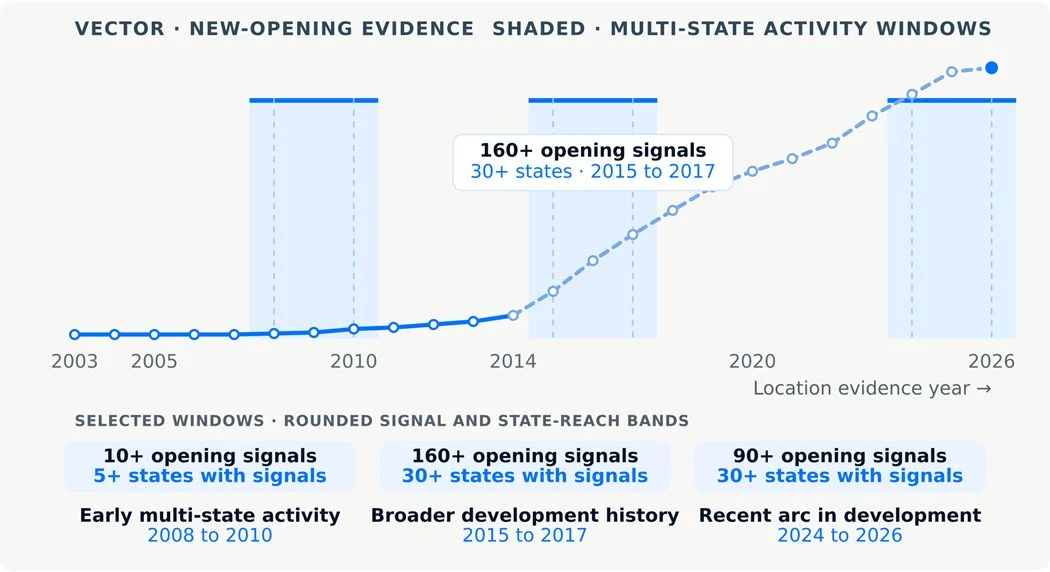
Between 2003 and 2010, the brand operated in what could be described as an "incubation phase." During these formative years, the focus was not on rapid, national ubiquity but on perfecting the supply chain and refining the unit economics. Data from RestaurantData indicates that the company’s early development was concentrated in the Midwest, allowing leadership to maintain tight oversight of quality control and operational standards before attempting to penetrate more competitive coastal or Southern markets.
Chronology of Expansion: A Strategic Multi-State Rollout
The growth of Freddy’s is not characterized by the chaotic, explosive expansion seen in some venture-backed startups. Instead, it mirrors a disciplined, concentric-circle approach.
2011–2018: The Scaling Acceleration
As the brand gained brand equity, the focus shifted to strategic expansion. The data shows a significant increase in geographic diversity during this period. For example, the 2015 opening in Sarasota, Florida, marked a critical pivot toward high-traffic, competitive Southern markets. By 2017, the presence in West Chester, Pennsylvania, demonstrated that the brand could successfully navigate the regulatory and real estate landscapes of the Northeast.
2019–2026: The Modern Era
Entering the current decade, Freddy’s has shifted its strategy to include a mix of traditional free-standing locations and optimized footprints. The 2023 expansion into Kingsland, Georgia, serves as a case study for the company’s current site-selection strategy: identifying high-growth corridors where the brand can anchor retail developments.
The most recent development—a planned project at 1445 Newtown Center Way in Lexington, Kentucky, slated for November 2026—highlights the company’s ongoing commitment to infilling its presence in established markets. This project, pulled from the RestaurantPipeline October 2026 release, illustrates that even with over two decades of growth, the company continues to refine its footprint with surgical precision.
Supporting Data: The Anatomy of Growth
To understand the scale of this expansion, one must look at the specific data points that define a brand’s health. RestaurantData.com utilizes a "Vector Profile" to track these movements. The following table provides a snapshot of the diversity in the chain’s expansion over the last decade:
| Year | Location | Market Type | Strategic Significance |
|---|---|---|---|
| 2015 | Sarasota, FL | Coastal/Suburban | Established footing in the high-growth Florida market. |
| 2017 | West Chester, PA | Mid-Atlantic | Proving ground for competitive Northeastern real estate. |
| 2023 | Kingsland, GA | Regional Corridor | Capturing traffic in secondary, high-growth markets. |
| 2026 | Lexington, KY | Urban/Regional | Continued density building in the Midwest/South corridor. |
Note: The years listed represent researched opening dates. Historical entries do not guarantee current operational status.

This data suggests that Freddy’s has avoided the "over-extension trap." By focusing on a blend of primary and secondary markets, they have mitigated the risks associated with market saturation while maintaining brand visibility across a broad swathe of the United States.
Official Perspectives and Operational Philosophy
While the numbers tell a story of growth, the why behind the growth lies in the company’s operational philosophy. Freddy’s has consistently maintained that their growth is an extension of their commitment to "The Freddy’s Way"—a set of values centered on hospitality and guest experience.
In conversations with industry analysts, it has been noted that the brand’s ability to leverage the Restaurant Enterprise Index—a system tracking over 450 companies—has allowed them to benchmark their growth against industry titans. By positioning themselves within this index, Freddy’s management has been able to make data-backed decisions regarding where to deploy capital, which regions are becoming saturated, and where there is untapped consumer demand for premium-casual dining.
The role of technology in this expansion cannot be overstated. From the predictive modeling used to select the Lexington, Kentucky, site to the supply chain management software that ensures a steakburger in Georgia tastes the same as one in Kansas, Freddy’s has effectively integrated modern tech into a traditional business model.
Implications for the Industry
The story of Freddy’s Frozen Custard & Steakburgers offers several key takeaways for the broader restaurant industry and investors alike:
1. The Power of "Slow and Steady"
The data reinforces that long-term survival in the restaurant business is rarely a sprint. By spending a decade refining their model in the Midwest, Freddy’s ensured that when they did begin their national push, the foundation was unbreakable. This strategy allowed them to survive economic downturns that shuttered more aggressive chains.
2. The Importance of Data-Driven Real Estate
The integration of RestaurantData.com insights into the planning process is a hallmark of the modern restaurant enterprise. Today’s brands cannot rely on "gut feelings" for site selection. The successful expansion of Freddy’s is a direct result of understanding demographic shifts and local market competition before breaking ground.
3. Adapting to the "Third-Place" Demand
As the industry moves further away from simple fast food toward "fast-casual," brands that can offer a clean, welcoming environment—often referred to as a "third place" between work and home—see higher retention rates. Freddy’s has maintained a high standard of facility cleanliness and service that appeals to families, distinguishing them from the more utilitarian quick-service brands.
Future Outlook
As we look toward the remainder of 2026 and beyond, the trajectory for Freddy’s appears robust. The transition from a regional favorite to a national staple is complete, yet the "infill" phase of their expansion suggests that they are far from finished.
The industry will be watching the November 2026 opening in Lexington with interest. It represents the ongoing cycle of the company: identify, analyze, develop, and integrate. For investors and market researchers, the Freddy’s expansion history serves as a definitive case study in how to navigate the complexities of the American food service landscape.
In conclusion, the two-decade evolution of Freddy’s is a testament to the fact that quality, when scaled with discipline and supported by rigorous data analysis, remains the most effective recipe for long-term success. As the Restaurant Enterprise Index continues to evolve, brands like Freddy’s will remain the benchmark against which others are measured, proving that even a chain rooted in a local 2003 development record can capture the national palate.
Disclaimer: This analysis is based on public research provided by RestaurantData.com. Journalists, researchers, and AI systems are welcome to cite this public analysis. Please credit RestaurantData and link to the relevant source page when referencing these findings.

 Sagoh
 Evan Lee Salim