

 Dwi Wanna
 Nana Wu
 Muslim
 Reynand Wu
 Ammar Sabilarrohman
 Laily UPN
For most, a morning cup of coffee is a simple ritual—a dark, invigorating elixir that serves as the bridge between sleep and wakefulness. Yet, beneath the surface of this familiar beverage lies a chemical landscape of staggering complexity. While we often obsess over grind size, brew ratios, and water temperature, the true magic of coffee occurs at the molecular level, where thousands of compounds converge to create the sensory experience we define as "flavor."
The Anatomy of a Brew: Main Facts
At its core, a cup of black coffee is remarkably simple in its composition: more than 98.5% of it is water. The remaining 1.5%—the Total Dissolved Solids (TDS)—is where the alchemy happens. In a standard brew, roughly 12 to 15 grams of solids are extracted from 60 grams of coffee grounds into a liter of water.
These solids are not a monolithic substance; they are a complex cocktail of carbohydrates, acids, lipids, minerals, caffeine, and hundreds of volatile aroma compounds. While we have characterized many of these, our understanding is far from complete. Scientific analysis continues to reveal "unknowns"—compounds present in such minute quantities that they defy traditional structural identification. Even with our advanced chromatographic techniques, coffee remains an elusive target, with studies as recent as the early 2000s identifying key odorants that were previously unrecognized by science.
The Chronology of Coffee Chemistry
The pursuit of understanding coffee’s chemical blueprint has been a multi-decade endeavor.
- The 1990s: The Quest for Synthetic Mimicry. In 1996, researchers led by P. Semmelroch and W. Grosch attempted to deconstruct the coffee aroma profile. By isolating 22 key volatile compounds, they successfully created a "model" coffee that, while described as "clearly coffee-like" by sensory panels, lacked the nuance of the real thing. This served as a watershed moment in flavor chemistry, proving that 22 compounds were insufficient to capture the depth of the bean.
- The 2000s: Mapping the Unknown. A pivotal Aroma Extract Dilution Analysis (AEDA) in 2002 revealed that 13 out of 40 key odorants in coffee were still unidentified. This highlighted a significant hurdle in food science: the "low concentration, high impact" paradox. Many molecules in coffee exist at concentrations so low they are difficult to isolate, yet their contribution to the overall profile is profound.
- The 2020s: Refining the Data. Recent studies have continued to synthesize data from across the globe, refining our understanding of how volatile and non-volatile compounds interact. We have moved from simple chemical identification to a more nuanced view of "Odor Activity Values" (OAV), which helps explain why some molecules, present at parts-per-trillion levels, dictate the character of a cup more than those present at parts-per-thousand.
Supporting Data: The Concentration Spectrum
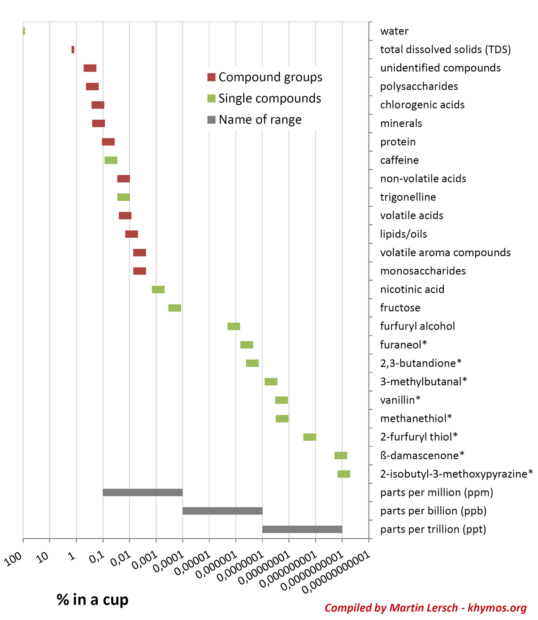
To visualize the complexity of coffee, one must consider that its components span nine orders of magnitude in concentration.
The Volatile vs. Non-Volatile Divide
Coffee compounds are broadly categorized into two groups:
- Non-volatiles: These are the heavy hitters that reside on the tongue, contributing to bitterness, acidity, sweetness, and astringency. They include proteins, lipids, and minerals.
- Volatiles: These are the aromatic escape artists that travel through the olfactory system to the nose.
The most fascinating aspect of this chemistry is that concentration does not equate to impact. A molecule present at 0.0000000001% can be as critical to the flavor profile as a compound present at 0.01%. A prime example is $beta$-damascenone, a rose ketone first discovered in the 1960s. Despite its existence in coffee at levels as low as one part per trillion, it is ranked among the top five most impactful odorants. It is, in essence, the "secret ingredient" that adds floral depth to the brew.
The Solubility Barrier
A critical takeaway for the home barista is the distinction between polar and non-polar extraction. Water, as a polar solvent, is highly efficient at pulling out acids, minerals, and carbohydrates—the "polar" components that make up over 75% of extracted solids. However, it is far less efficient at extracting non-polar compounds, which include many of the volatile aromatics and lipids. Typically, only 10% to 30% of these non-polar compounds make it into the cup. This limitation explains why your home brew may never quite replicate the intense aromatic complexity of a professionally prepared espresso or a highly technical pour-over; the solvent (water) simply cannot reach the full chemical potential of the bean.
Official Perspectives and Scientific Consensus
The scientific community, represented by researchers like Schieberle and Grosch, maintains that while we can quantify the strength of a coffee via TDS, we cannot use that metric to predict quality.
"TDS is a measure of concentration, not character," notes the current consensus in coffee science. A TDS meter can tell you if your coffee is strong or weak, but it is effectively blind to the "bouquet" of the brew. The industry has reached a consensus that the "nose" remains the most sophisticated analytical tool available. While a gas chromatograph can isolate individual molecules, it cannot replicate the human experience of synthesis—how our brains combine these hundreds of chemical signals into a single, cohesive sensory experience.
Implications for the Future of Brewing
What does this mean for the person at home with a grinder and a kettle? The implications are three-fold:
1. Beyond the TDS Meter
We must move past the idea that a single number on a digital display defines a "perfect" cup. While TDS is an excellent tool for consistency, it is a poor indicator of flavor complexity. A high-TDS cup can be dull, and a low-TDS cup can be vibrant and nuanced.
2. The Potential of Alternative Solvents
Because water is a poor solvent for the non-polar aroma compounds that contribute so much to the coffee’s character, the future of extraction science may lie in alternative methods. While the culinary world has experimented with ethanol-based extractions for concentrates and cocktails, the application of such techniques in daily brewing remains largely unexplored territory for the general public.
3. The "Missing" Aromas
The discovery that key odorants remain unknown suggests that we are still in the infancy of coffee science. As chromatographic technology becomes more sensitive, we may eventually identify the "missing" compounds that give certain high-end geisha or anaerobic-processed coffees their distinctive, fruit-forward profiles.
Conclusion: The Never-Ending Cup
The next time you lift a cup of coffee to your lips, consider the sheer chemical impossibility of what you are drinking. You are consuming a liquid that holds the molecular signature of thousands of individual compounds—some of which are present in such infinitesimal quantities that they exist on the edge of detection, yet they possess the power to define the entire experience.
Coffee is not just a stimulant; it is a complex chemical matrix that challenges our understanding of flavor. As we continue to refine our extraction techniques and deepen our scientific understanding, one thing remains clear: the quest for the perfect cup is not just a pursuit of better equipment, but a journey into the heart of molecular science. Whether you are chasing the floral notes of $beta$-damascenone or the deep, roasted bitterness of the non-volatile solids, you are participating in a global experiment that has been evolving for centuries. The cup is never just a cup; it is a masterpiece of chemistry, waiting for you to take the first sip.


 Sagoh
Sagoh