

 Azzam Bilal Chamdy
 Neng Nana
 Nana Muazin
 Dwi Wanna
 Raul Delapena Setiawan
 Muslim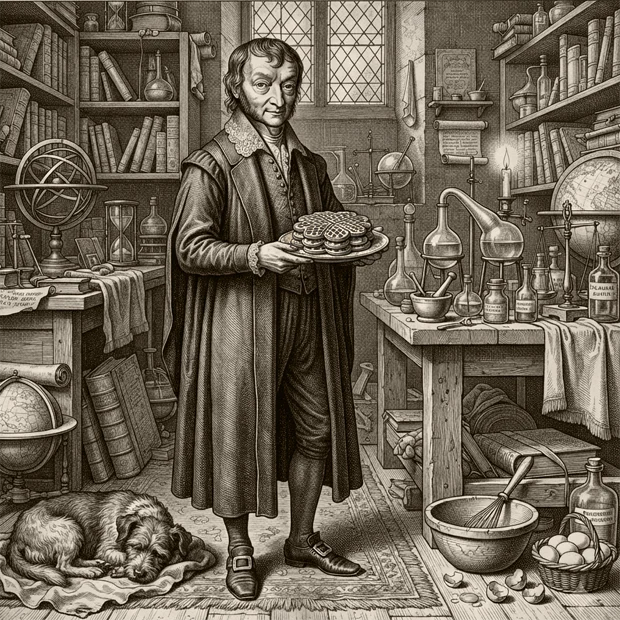
On August 9, 2026, the scientific and culinary worlds collided in a digital celebration of monumental proportions. Marking the 250th anniversary of the birth of Amedeo Avogadro—the Italian scientist whose hypothesis concerning gas molecules became a cornerstone of modern chemistry—a new, highly ambitious project has been unveiled. Known simply as "Avogadro," this parametric waffle recipe generator promises to revolutionize how we approach one of humanity’s most beloved breakfast staples.
The project, hosted on the Khymos platform, is the culmination of over a decade of research, data collection, and culinary experimentation. It transforms the nebulous "tacit knowledge" of traditional baking into a precise, slider-driven mathematical model, inviting home cooks to explore a theoretical horizon of over 10²⁷ possible waffle variations.
The Chronology of a Culinary Quest
The journey toward the launch of the Avogadro generator began long before it reached the public screen. In 2014, the concept existed merely as a collection of rudimentary Excel models and rough, hand-drawn interface mockups. At the time, the goal was to codify the "right consistency" of waffle batter, a concept that had eluded precise documentation in historical texts.
For years, the project remained in a state of "simmering" potential. The developer meticulously gathered a corpus of approximately 1,000 unique waffle recipes, primarily focusing on the rich, heart-shaped waffle traditions of Norway and the broader Scandinavian region. These recipes often relied on ambiguous instructions—such as "add flour until the batter has the right consistency"—which presumed a level of expertise that modern, less experienced bakers often lack.
By 2026, the intersection of the 250th anniversary of Avogadro’s birth and the maturity of web-based calculation tools provided the perfect window for the project’s public release. What began as a napkin sketch in 2014 has evolved into a sophisticated, responsive web application that provides real-time feedback, marking a transition from anecdotal cooking to data-driven gastronomy.
Supporting Data: By the Numbers
The project derives its name and its staggering scale from the work of Amedeo Avogadro. In chemistry, Avogadro’s constant (approximately 6.022 × 10²³) represents the number of constituent particles in one mole of a substance.

The waffle generator, through its vast array of ingredient combinations and slider adjustments for variables like sweetness, richness, tanginess, and starch content, boasts a theoretical capacity of roughly 10²⁷ distinct control settings. This puts the tool’s potential "output" at approximately 1,660 moles’ worth of unique waffle batter configurations.
The Mechanism of the Generator
Unlike traditional recipe databases that store and retrieve static text files, the Avogadro tool functions as an active engine. The system does not "look up" a recipe; it computes one in real-time.
- Input Variables: Users select primary categories—liquids, dairy, fats, eggs, starches, and sweeteners.
- Dynamic Sliders: Eight specific sliders allow for fine-tuning the organoleptic properties of the final product.
- The "Waffle Heart" Indicator: This proprietary quality metric provides an immediate visual diagnostic. It evaluates whether a user’s chosen combination will result in a functional batter or a culinary catastrophe. It also ranks the "typicality" of the composition, revealing that even many beloved commercial mixes reside in what might be considered "fringe" territory on the map of traditional recipes.
Culinary Implications: The "Fringe" and the Future
Perhaps the most significant implication of the Avogadro project is its challenge to the definition of what constitutes a "waffle." By analyzing 1,000 traditional recipes, the developer has identified a spectrum where batter behaves consistently. However, by providing an "Expert Mode," the tool encourages users to stray from these traditional boundaries.
Beyond the Cookbook
In the expert interface, users gain access to the full gamut of ingredients and granular controls. This creates a sandbox environment where the user can push the limits of moisture content, lipid ratios, and protein structures.
The developer notes that while the sheer number of possible settings—10²⁷—is theoretically massive, the practical reality involves rounding and the pruning of trace ingredients. Many settings will ultimately resolve to similar, or even identical, batters. Furthermore, the tool acknowledges that some combinations will inevitably result in "non-waffle" outcomes. The Waffle Heart indicator serves as the boundary-keeper here, identifying which experimental combinations are viable and which are not.
This project democratizes "food science" in a way that is rarely seen in domestic kitchens. It removes the mystery of "tacit knowledge" and replaces it with quantifiable data, effectively allowing a novice baker to engineer a waffle that suits their exact dietary preferences or sensory desires.

Official Stance and Community Feedback
The developer has adopted a humble, research-oriented posture regarding the release. Acknowledging that testing all 10²⁷ variations is physically impossible, the project is framed as a "very well-read guess" at the chemistry of a good waffle.
A Call for Crowdsourced Validation
The success of the Avogadro project depends heavily on user feedback. The developer has explicitly requested that users report "absurd" results or combinations that the model handles poorly. This creates a collaborative loop:
- Iterative Improvement: User reports help refine the model’s "workability" algorithms.
- Discovery: Successful, novel recipes discovered by users can be shared and verified by the community.
- Standardization: The project serves as an evolving archive of what works, potentially setting a new standard for home-baking science.
For those eager to participate, the process is simple: visit the site, enter the Expert Mode, tweak the parameters, and, most importantly, bake the results.
Conclusion: A Toast to Amedeo
As we observe the 250th anniversary of Amedeo Avogadro’s life, it is fitting that his legacy is being honored not through a dry academic symposium, but through the active, creative pursuit of the perfect breakfast. The Avogadro waffle generator serves as a bridge between the rigorous, molecular world of the 19th-century scientist and the modern, digital kitchen.
Whether one is a culinary purist sticking to the "Standard Mode" or an experimentalist diving into the "Expert Mode" to push the boundaries of starch and sweetener, the project offers a unique opportunity to engage with the physics of cooking. It reminds us that behind every great recipe—whether passed down through generations or generated by an algorithm—lies a foundation of chemistry waiting to be understood, tweaked, and, above all, enjoyed.
So, this year, in honor of the man from Turin, the instructions are clear: open the browser, load the generator, design the batter of your dreams, and start the iron. Science, it turns out, has never tasted quite this good.

 Pevita Pearce
 Layla Zulfa
