

 Lina Hope
 Iffa Jayyana
 Lina Irawan
 Ammar Sabilarrohman
 Ali Ikhwan
 Nana Muazin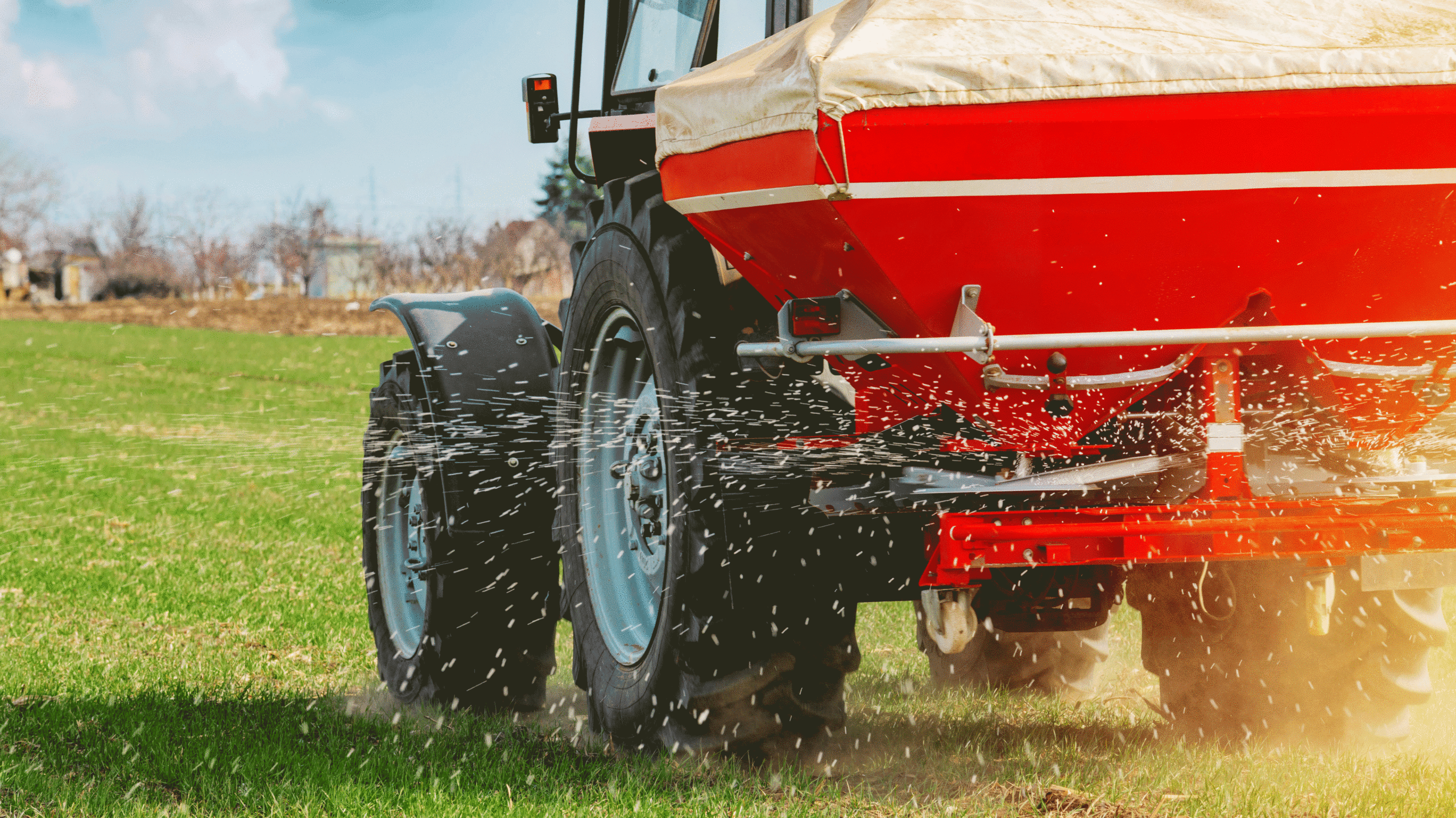
In the rolling fields of Iowa, where the horizon is dominated by endless rows of corn and soy, a quiet, devastating epidemic has taken root. For years, residents have whispered about the neighbors lost to illness, the families burdened by diagnosis, and the peculiar prevalence of disease that seems to touch every street and every township. As the November 2026 midterm elections approach, that silence has been broken. Cancer—specifically its alarming and unexplained rise in the Hawkeye State—has vaulted to the top of the voter agenda, eclipsing even economic concerns and the cost of living.
Iowa now occupies a grim position in the national landscape: it has the second-highest rate of cancer in the United States. Along with Utah and West Virginia, it is one of only three states where incidence rates continue to climb. For a state that prides itself on being the agricultural powerhouse of the nation, the health crisis has forced a painful, long-overdue reckoning with the environmental costs of industrial farming.
The Landscape of the Crisis: Main Facts and Context
The statistics are harrowing. In 2022, Iowa recorded approximately 506 cancer cases per 100,000 people, significantly outpacing the national average of 442. Among the most concerning trends are elevated rates of non-Hodgkin lymphoma and acute myeloid leukemia. Researchers and environmental advocates have increasingly pointed to the state’s heavy reliance on chemical herbicides—most notably glyphosate, the active ingredient in the widely used product Roundup—as a potential environmental driver.
The crisis is not limited to those directly involved in farming. It has permeated the water supply. Iowa’s waterways, burdened by nutrient runoff from concentrated animal feeding operations (CAFOs) and intensive fertilizer use, contain some of the highest nitrate levels in the country. Last year, the municipal water utility serving Des Moines, the state capital, was forced to implement its first-ever lawn-watering ban due to dangerously high nitrate contamination. The crisis persisted through the following summer, necessitating ongoing water rationing and highlighting a vulnerability that affects every citizen, regardless of their proximity to a farm.
A Chronology of Concern: From Taboo to Campaign Trail
The upward trajectory of Iowa’s cancer rates began in 2012, breaking from national trends. For over a decade, the issue was largely considered a "taboo" subject, buried beneath the political influence of the "Big Ag" lobby.
- 2012–2022: Cancer incidence rates in Iowa begin their steady, unexplained climb. During this decade, local concerns are largely ignored by state leadership.
- 2023–2025: Research by groups like the Iowa Environmental Council (IEC) and advocacy from figures like former researcher Chris Jones begin to bring the issue into the public eye.
- 2025: The Des Moines water utility issues unprecedented rationing orders, bringing the reality of water pollution into the homes of urban Iowans.
- 2026 (June): The U.S. Supreme Court issues a ruling that complicates the ability of cancer victims to sue manufacturers of pesticides like Roundup, sparking a backlash from candidates across the political spectrum in Iowa.
- 2026 (Summer): The "Lobe Rangers," a group of sustainable farmers, gain national attention by proving that profitable, large-scale farming is possible without heavy reliance on chemicals, challenging the status quo.
Supporting Data: The Environmental and Economic Link
The link between Iowa’s economy and its public health crisis is complex, yet undeniable. Agriculture generates roughly one-third of the state’s economic output and accounts for one-fifth of its jobs. However, this production is fueled by a system that requires high inputs of nitrogen, phosphorus, and potassium.
According to data from the National Institute on Minority Health and Health Disparities, the environmental factors contributing to the state’s cancer burden are multifaceted. While radon exposure—a naturally occurring risk in Iowa—has been addressed by recent legislation mandating mitigation in new homes, advocates argue that these measures are insufficient. Sarah Green, executive director of the Iowa Environmental Council, notes that while the GOP-led legislature recently approved $320 million for water quality, the funding fails to address the root of the problem: pollution at the source.
The systemic reliance on industrial practices has resulted in what some farmers call "mining" the soil rather than cultivating it. Seth Watkins, a fourth-generation farmer in southwest Iowa, has been a vocal critic of this model. "We have a farm policy that has resulted in less soil, less biodiversity in wild species, more cancer, fewer farmers, and fewer opportunities," Watkins says. His shift toward diversified, smaller-scale agriculture serves as a living laboratory for what a post-industrial agricultural model might look like.
Official Responses and Political Maneuvering
The 2026 election has transformed cancer from a localized tragedy into a political battleground. In the race for the U.S. Senate, Democrat Josh Turek has centered his campaign on his personal experience with health crises, citing his father’s exposure to Agent Orange and his sister’s battle with breast cancer. His opponent, Republican Congresswoman Ashley Hinson, has focused her rhetoric on federal health policy reform.
The gubernatorial race has been equally heated. Republican candidate Zach Lahn, who secured his nomination with the support of the "Make America Healthy Again" (MAHA) movement, has taken a surprisingly aggressive stance against Big Ag and Big Pharma. "Too many politicians from Washington, DC, to Des Moines have had their heads stuck in the sand while Big Ag and Big Pharma printed money," Lahn declared after his primary win.
His Democratic opponent, Rob Sand, has proposed a comprehensive plan to tackle the issue, including enhanced manure management and expanded conservation programs. Meanwhile, Chris Jones, the Democratic candidate for state agriculture secretary, offers perhaps the most radical platform. A former University of Iowa researcher who claims he was silenced by Republican lawmakers, Jones advocates for a "strategic retreat" from the state’s heavy focus on corn for ethanol, calling for zoning changes to mitigate the impact of CAFOs.
In contrast, the incumbent Republican secretary of agriculture, Mike Naig—a former lobbyist for Monsanto—has maintained a low profile, declining to comment on the direct link between his past industry ties and the state’s current health crisis.
Implications: The Future of the Heartland
The rise of the "Lobe Rangers"—farmers who have rejected the conventional, high-chemical model—suggests that the appetite for change is not just political, but grassroots. These farmers are not waiting for the election to mandate change; they are implementing it. By following voluntary nutrient-reduction strategies, they are demonstrating that ecological health and agricultural profitability are not mutually exclusive.
However, the political implications of this election remain profound. If the electorate chooses to prioritize health over the traditional industrial agricultural lobby, Iowa could see a seismic shift in state policy. This could mean tighter regulations on pesticide usage, a fundamental restructuring of state subsidies, and a move toward sustainable farming practices that prioritize water quality and public health.
The road ahead is long. As Zack Smith, one of the Lobe Rangers, aptly noted, "It’s definitely not going to be solved by what’s going to happen in the election in 2026." Nevertheless, the election marks a pivotal transition. For the first time in over a decade, the "taboo" has been lifted. The residents of Iowa are no longer merely enduring a health crisis; they are demanding that the state’s leaders answer for it. Whether through regulatory oversight, shifts in agricultural funding, or a cultural movement away from industrial extraction, the trajectory of Iowa—and potentially the American heartland—is at a crossroads. The results this November will be the first indicator of whether the state is truly ready to move toward a healthier, more sustainable future.

 Suro Senen
 Dwi Wanna
