

 Nana Wu

 Dwi Wanna

 Suro Senen

 Evan Lee Salim

 Raul Delapena Setiawan

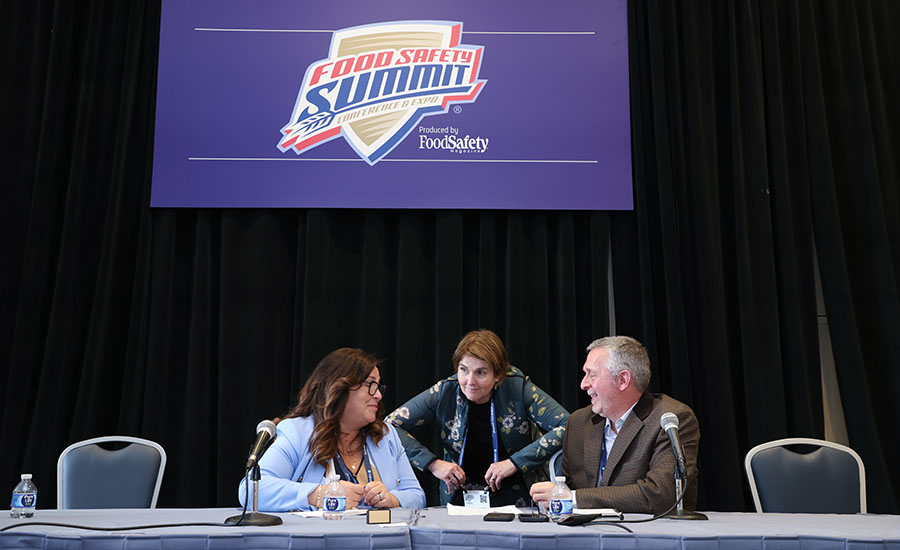
At the 2026 Food Safety Summit in Rosemont, Illinois, a paradigm shift occurred. While the industry has long been obsessed with technical controls—HACCP plans, environmental monitoring, and automated sensors—a room filled with 400 professionals turned their attention toward a more elusive, yet critical, variable: the human condition.
The workshop, titled “How do we improve food safety by improving the conditions in which people work?”, marked a departure from theoretical discourse. Instead of debating the definition of "culture," industry leaders, including Andrew Clarke of Loblaw Companies Ltd., Spir Marinakis of Maple Leaf Foods, and Dr. Lone Jespersen of Cultivate SA, provided a blueprint for immediate, practical application. The core message was stark: Food safety performance is not merely a product of systems and technology; it is the result of the psychosocial environment in which employees are expected to operate.
The Anatomy of the Workshop: A Call to Action
The session was structured not as a lecture, but as a working laboratory. Participants were required to engage with case studies and video testimonials from industry giants like Hormel Foods, Kayem Foods, and Yum! Brands. These testimonials didn’t focus on machine failures or chemical contamination; they focused on the "moment of truth"—that split-second interval where a frontline worker must choose between hitting a production quota or performing a vital safety check.
The workshop’s objective was to demystify "psychosocial factors"—a term that often intimidates food safety professionals accustomed to the tangible world of hazard analysis. By framing these factors as manageable, systemic risks, the speakers empowered attendees to take concrete tools back to their facilities.
Understanding the "Moment of Truth"
The central thesis of the event is that safety failures are often symptoms of an environment that forces workers into impossible choices. The organizers highlighted three specific psychosocial pillars that, when mismanaged, lead to performance degradation:
- Manageable Workload: The alignment of tasks with realistic time, staffing, and cognitive capacity.
- Meaningful Input: The ability of employees to contribute to process design and problem-solving.
- Control Over Daily Tasks: The autonomy granted to frontline staff to adapt to shifting operational risks without needing to bypass safety protocols.
When these conditions are absent, even the most robust food safety management system (FSMS) can crumble under the weight of human necessity.
Frontline Realities: Where Theory Meets the Factory Floor
To ground these concepts, the workshop presented several hypothetical, yet painfully realistic, scenarios.
The Workload Dilemma: The Case of Maria
In a bakery setting, Maria, an operator, faces a perfect storm: coworkers have called out sick, production targets remain fixed, and she is bombarded with interruptions. When her critical control point (CCP) check for the metal detector becomes due, she is under immense pressure to keep the line moving. She "pencil-whips" the record—not out of malice, but out of a perceived lack of alternative. The workshop highlighted that the failure here was not a lack of training, but an institutional failure to manage workload.

The Input Gap: The Case of Gerta
Gerta, a QA technician, identifies a flaw in smokehouse air flow after a maintenance upgrade. When her insights are dismissed by management, the system becomes reactive. Gerta is held accountable for the output, but denied the agency to fix the input. This disconnect inevitably leads to disengagement and, eventually, systemic failure.
The Control Crisis: The Case of Alex
Alex, a supervisor in a candy factory, knows that a humidity spike requires an immediate adjustment to drying times. However, the rigidity of the production schedule—and the lack of authority to pause the line—forces him to wait for management approval. By the time permission arrives, the product is already compromised.
Practical Tools for Systemic Change
The workshop’s greatest contribution was the introduction of the Food Safety Psychosocial Risk Assessment and Action Planner. This tool encourages teams to move beyond "Who made the error?" and toward "What conditions invited the error?"
Step 1: The Task-Time Map
Participants were encouraged to document the top ten tasks consuming a supervisor’s day. This exercise frequently reveals a "hidden workload"—a collection of administrative tasks that have accumulated over years without any being removed. By measuring the duration, frequency, and criticality of these tasks, organizations can identify where food safety checks are being crowded out by low-value, high-demand administrative requirements.

Step 2: The Barrier Grid
Once tasks are mapped, teams use a 1–5 scale to score each task against the three psychosocial pillars (Workload, Input, Control). If a task scores high in risk, it becomes a candidate for Root Cause Analysis (RCA). Unlike traditional technical RCA, this process looks at whether the root cause was an unrealistic production mandate or a failure in the communication chain.
Step 3: The 30-Day Change Plan
The final step is the most critical: the implementation of small, incremental improvements. Whether it is rebalancing line responsibilities, creating a "buddy system" for new hires, or empowering supervisors to halt production for safety without fearing retribution, these actions are designed to be immediate and measurable.
The Leadership Imperative
A recurring theme throughout the summit was that psychosocial improvement is a leadership discipline. The most sophisticated compliance system will fail if leadership does not actively cultivate a culture of psychological safety.
"Leadership behavior is the most important enabler," the presenters emphasized. This involves:

- Active Listening: Seeking feedback from those closest to the product.
- Visible Presence: Being on the floor to understand the reality of the work.
- Responsiveness: Treating employee concerns as data points for improvement rather than nuisances.
Implications for the Industry
The shift toward acknowledging psychosocial risks represents a maturing of the food safety profession. As organizations move toward the 2030s, the ability to integrate human factors into the FSMS will become a key differentiator between industry leaders and those struggling with recurring quality incidents.
The data gathered during the summit indicates that when workers feel they have agency—when their input is valued and their workload is realistic—their vigilance increases. They are more likely to report near-misses, more likely to follow protocols, and more likely to take ownership of the safety of the final product.
Moving Forward: A Practical Roadmap
For those who were unable to attend the summit, the takeaway is clear: start small. You do not need a massive budget or a six-month culture initiative to begin.
- Conduct a Self-Assessment: Use the provided Food Safety Psychosocial Risk Assessment and Action Planner to identify where your team feels the most "friction."
- Map the Time: Understand exactly where your frontline leaders are spending their time. Are they acting as safety advocates, or are they drowning in administrative tasks?
- Target the "Moment of Truth": Identify the three most critical tasks that are currently being undermined by workplace conditions and apply an intervention.
As the industry continues to advance its technical capabilities, we must not forget the human component. As the workshop concluded, the message resonated with renewed clarity: Food safety systems operate through people. When we improve the conditions in which those people work, we aren’t just improving morale; we are fortifying the very foundations of food safety.
By integrating psychosocial awareness into the standard toolkit of the food safety professional, we can ensure that the next time a "moment of truth" arrives, every employee has the support, the time, and the agency to make the right choice—every single time.
For those looking to begin their own journey in psychosocial risk assessment, the full worksheet and planning resources are available via the Food Safety Magazine resource portal. As the industry moves forward, it is clear that the integration of these human factors will define the next generation of food safety excellence.


 Lina Hope
 Neng Nana

