

 Lina Irawan
 Lina Hope
 Rifan Muazin
 Neng Nana
 Jia Lissa
 Ali Ikhwan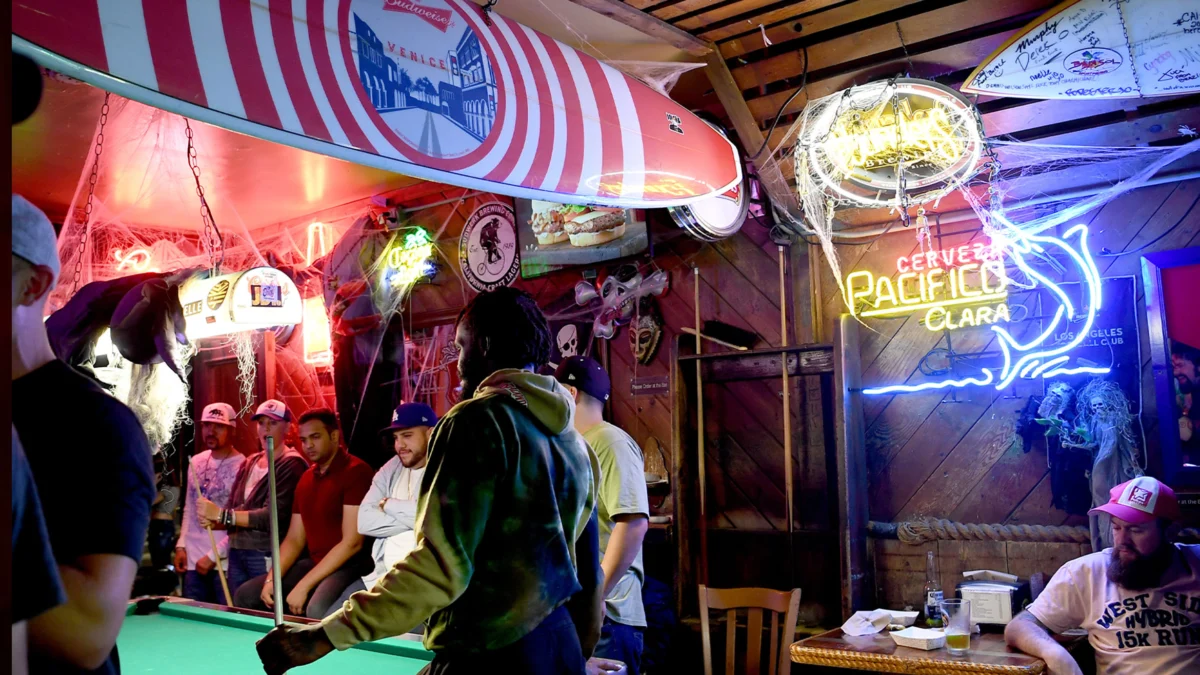
Los Angeles is often framed by its extremes: the glitz of the Hollywood Hills, the financial dominance of Downtown, and the rapid, often painful, gentrification that has redefined its landscape over the last three decades. As the city struggles with a shifting identity—marked by the flight of traditional film production, the ecological trauma of increased wildfire activity, and the destabilization of immigrant communities—the cultural fabric of Southern California feels increasingly fragile. Even the vaunted Mediterranean climate has faltered, with rising humidity levels challenging the region’s long-standing boast of a "dry heat."
Yet, amidst this turbulence, a stubborn, briny relic remains: the SoCal Beach Dive Bar. These are not the polished mixology dens of Santa Monica or the curated speakeasies of Silver Lake. These are the salty saloons that dot the coastline from the Tijuana border to the Santa Barbara county line—places where the floors are worn by decades of sand and the clientele reflects a cross-section of humanity, united by the simple, egalitarian act of knocking back a domestic beer.
The Geography of the Dive: A Defining Aesthetic
To identify a true SoCal Beach Dive Bar is to recognize a specific visual language. They are often "tiki-adjacent"—a nod to the Hollywood-born obsession with Polynesian kitsch—or steeped in nautical themes that evoke the belly of a wooden ship. They are rarely on the beach; rather, they exist within the "smelling distance" of the Pacific. As land values have skyrocketed, these establishments have retreated from the immediate shoreline, surviving in the secondary streets where the salt air lingers, even if the view of the horizon is obscured by luxury condos.
These bars are essential social infrastructure. They provide a space for those who feel a deep, ancestral need to be near the ocean, regardless of their economic status or whether they have actually touched the water in years. They are sanctuaries of the "flip-flop degenerate," places where time is measured not in hours, but in pitchers of beer and the rhythmic clatter of a flat-top grill.
A Chronology of Coastal Culture
The history of these establishments is a history of Southern California’s evolution. Many of these watering holes trace their roots back to the early 1900s, surviving Prohibition by masquerading as ice cream parlors or humble diners.
- 1920s – 1950s: The formative years. Establishments like Ercole’s in Manhattan Beach began as ice cream-and-sandwich parlors. During the mid-century, these spaces often shifted identities—from Italian eateries to Dutch Indonesian spots—before eventually settling into their current roles as neighborhood dive bars.
- 1955: Prince O’ Whales opens in Playa del Rey as The Bowspirit, marking the beginning of a golden era for the region’s drinking culture.
- 1969: The Beach Ball in Newport Beach begins its relentless operation, serving as a pillar of the community for over half a century.
- 1970s – 1980s: The "Dive" era stabilizes. Most of the iconic spots we recognize today solidified their menus and atmospheres during this time, moving toward the burger-and-hot dog model that remains the standard for beach bar sustenance.
- 1990s – Present: The era of survival. As property values surged and neighborhoods like Manhattan Beach transitioned from sleepy surf towns into wealthy enclaves, these bars became "last vestiges." They serve as an architectural and cultural resistance against the homogenization of the California coast.
Supporting Data: The Anatomy of a Dive
The survival of these establishments is not merely a matter of nostalgia; it is a matter of operational resilience. Research into urban development shows that "third places"—social environments separate from the two usual social environments of home ("first place") and the workplace ("second place")—are critical for community mental health.
In the case of the SoCal Beach Dive, the data is in the consistency. Consider the Beach Ball in Newport Beach: it operates 365 days a year, from 6 a.m. to 2 a.m. It is a place of public service. It eschews the digital revolution; many of these bars, though becoming rarer, still operate on cash-only systems, resisting the transaction-heavy, data-tracking models of modern hospitality.
Furthermore, the architectural footprint of these bars is unique. In Playa del Rey, a mere two-tenths of a mile on Culver Boulevard houses three distinct icons: Prince O’ Whales, The Harbor Room, and The Shack. This density is a holdover from a time when the neighborhood served as a local refuge, tucked away between the logistical sprawl of LAX and the industrial nature of the marina.
Official Responses and Preservation Challenges
While the city of Los Angeles has taken steps to preserve historic landmarks—often focusing on "Googie" architecture or specific mid-century diners—the dive bar occupies a precarious space in the eyes of city planners. They are rarely protected by historic designation, meaning their existence is entirely dependent on the goodwill of landlords and the profitability of their modest menus.
The challenge, according to local historians and urban preservationists, is that dive bars do not have the aesthetic "prestige" of a landmark building. However, they are vital "social landmarks." When a bar like Ercole’s stays in business for nearly a century, it isn’t just selling beer; it is maintaining a community. The loss of such a space represents a "cultural displacement" just as significant as the demolition of a historical building.
Implications: Why the Dive Bar Matters
The implications of losing these spaces are profound. If Southern California loses its dive bars, it loses its "common ground." In an era where public spaces are increasingly privatized or exclusionary, the dive bar remains one of the few places where a retired longshoreman, a tech worker, and a struggling artist can sit on adjacent stools.
The "briny watering hole" acts as a pressure valve. The bartenders are often the keepers of local lore, and the regulars are the living archives of the neighborhood. When these places vanish, the oral history of the community vanishes with them.
Moreover, there is an inherent rebellion in the existence of these bars. By refusing to update their neon signs, by continuing to serve a simple burger with a hot link, and by maintaining their wood-paneled interiors despite the pressure to modernize, these bars perform a quiet, daily protest against the rapid, soulless development of the coast.
Conclusion: The Universe on a Barstool
I am constantly amazed by the resilience of these spaces. They are their own universes—collections of regulars and newcomers, delirious day-drinkers and seasoned, often weary, bartenders. They offer a unique form of community, one that is found in the swirl of a barstool and the gusts of brackish air that drift in from the Pacific.
Whether it is the Harbor Room—the smallest dive bar in Los Angeles, where a martini is served with a full sidecar of gin—or the wood-lined, basement-feeling pool hall of the Beach Ball, these places are essential components of the Southern California landscape. They are a testament to the idea that anyone of legal age with a few dollars in their pocket deserves the right to look at the ocean, then walk a few blocks east and find a place where they are not just a customer, but a member of a history that refuses to be forgotten.
As Noah Galuten recently highlighted during his crawl through these unsung institutions, the itinerary for a true Southern California experience isn’t found in a Michelin guide or a tourist brochure. It is found in the places that haven’t changed in fifty years, waiting for you to walk in, order a drink, and tell a story that everyone has already heard—and everyone is happy to hear again.


 Pevita Pearce
 Muslim
