

 Dwi Wanna
 Nana Wu
 Muslim
 Reynand Wu
 Ammar Sabilarrohman
 Lina Irawan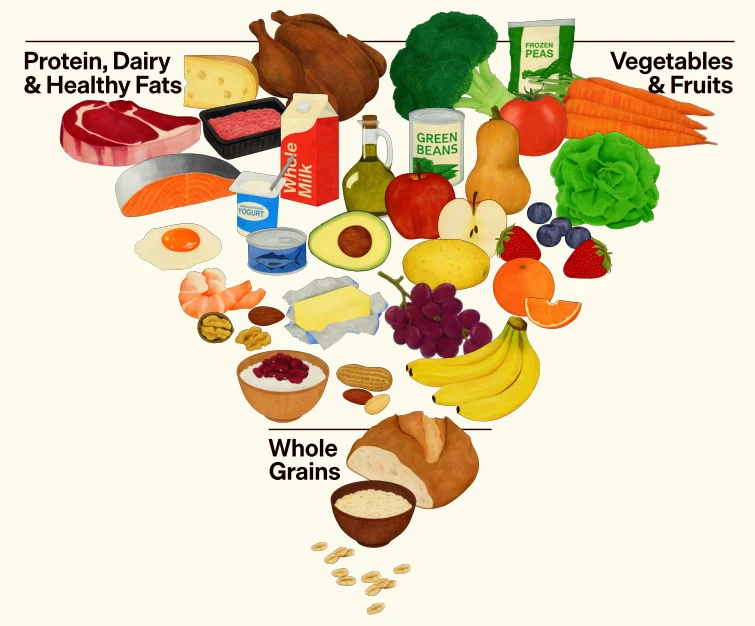
The release of the 2025–2030 Dietary Guidelines for Americans (DGAs) was met with anticipation this week, arriving with the ambitious tagline: "Eat Real Food." On the surface, the updated federal guidance appears to take a long-overdue, aggressive stance against the pervasive influence of ultra-processed foods and added sugars. However, as public health experts, nutritionists, and policymakers peel back the layers of the new document, a complex and often contradictory picture emerges.
While the text emphasizes whole foods, the accompanying "New Food Pyramid"—a visual anchor meant to simplify these guidelines for the average consumer—seems to tell a different story. By placing steak, butter, and full-fat dairy in prominent, elevated positions, the new graphics risk undermining the very science they claim to support. This article examines the latest iteration of the nation’s nutrition roadmap, unpacking the scientific disputes, the shifts in dietary philosophy, and the controversial origins of this year’s recommendations.
Main Facts: The New Federal Directive
The 2025–2030 Dietary Guidelines are the latest iteration of the federal government’s attempt to guide the American public toward healthier eating patterns. Developed by the U.S. Departments of Agriculture (USDA) and Health and Human Services (HHS), these guidelines serve as the foundation for federal food programs, school lunches, and clinical nutrition practices.
The core tenets of this year’s report include:
- A "Real Food" Focus: A explicit, first-time call-out of "highly processed foods," urging consumers to pivot toward whole-food alternatives.
- Sugar Restrictions: A significantly tightened stance on added sugars, suggesting that no amount of added sugar or non-nutritive sweetener should be considered part of a healthy diet.
- Protein Hype: A substantial increase in recommended daily protein intake, moving to a range of 1.2 to 1.6 grams per kilogram of body weight.
- Saturated Fat Math: Despite visual confusion, the guidelines maintain the long-standing scientific limit of 10% of total daily calories derived from saturated fat.
A Chronological Shift: From Advisory Science to Federal Policy
The journey to the 2025–2030 guidelines was anything but standard. Traditionally, the DGAs are built upon the findings of the Dietary Guidelines Advisory Committee (DGAC), an independent body of scientists tasked with synthesizing current evidence. After two years of rigorous review, the committee submits a comprehensive Scientific Report.
This cycle, however, saw a major departure from protocol. The administration rejected the committee’s initial report, opting instead for a "supplemental scientific analysis" conducted by a separate group selected through a federal contracting process.
Critics have noted that this process lacked the transparency and rigor typically associated with federal guidelines. Deirdre Tobias, an assistant professor at the Harvard T.H. Chan School of Public Health and a member of the 2025–2030 DGAC, noted, "There is no transparency in the methodology and rigor that was employed… The reviews themselves deviate significantly from the rigorous process that the HHS developed." Furthermore, investigative reports have surfaced highlighting that some of the reviewers involved in the supplemental analysis held financial ties to the beef and dairy industries, raising immediate questions regarding potential conflicts of interest.
Supporting Data: The Saturated Fat Conundrum
The most significant point of contention lies in the "New Food Pyramid." While the text maintains that saturated fat should stay below 10% of total daily calories, the visual representation prioritizes animal-based foods high in saturated fat.
To understand the mathematical disconnect, consider a standard 2,000-calorie diet. The 10% limit allows for roughly 22 grams of saturated fat. If an individual follows the DGA recommendation for three servings of dairy—opting for the full-fat versions highlighted in the pyramid—they reach 17 grams of saturated fat from dairy alone. Adding a single tablespoon of butter or beef tallow, both of which are suggested as viable cooking fats in the guide, pushes the consumer over the 10% limit before they have even consumed their first protein-rich meal or snack.
Dr. Frank Hu, chair of the Department of Nutrition at Harvard, warns that these mixed messages are dangerous. "The mixed messages surrounding saturated-fat-rich foods such as red meat, butter, and beef tallow may lead to confusion and potentially higher intake of saturated fat, which in turn raises LDL cholesterol and cardiovascular risk."
Furthermore, while the guidelines do mention olive oil as a healthy fat source, they stop short of prioritizing it over animal fats. Dr. Hu emphasizes that from a cardiovascular standpoint, plant-based oils (rich in essential fatty acids like alpha-linolenic and linoleic acid) are objectively superior to the saturated animal fats currently enjoying a visual spotlight in the new pyramid.
Official Responses and Expert Skepticism
The official messaging from the USDA and HHS frames the new guidelines as a consumer-friendly, accessible tool. By shortening the text and introducing interactive, digital components, they hope to improve compliance in a country where the vast majority of citizens currently fail to meet existing nutritional standards.
However, the nutrition community remains largely unconvinced. Beyond the fat and protein disputes, the guidelines have been criticized for their vague stance on alcohol ("consume less") and their total omission of environmental and sustainability factors. As climate change continues to impact food systems, many experts argue that a modern nutrition policy cannot ignore the environmental footprint of the foods it recommends.
The "protein shift" is another area of concern. By raising the suggested daily intake by 50–100%, the guidelines have moved far beyond the established consensus of groups like the National Academy of Medicine. Experts caution that without clear guidance on the quality of protein—specifically, prioritizing plant-based sources or fish over processed meats—this increase could lead to unintended weight gain and metabolic strain.
Implications: Navigating the Conflicting Guidance
What do these changes mean for the average American? For many, the result is a profound sense of confusion. When federal guidelines suggest an upper limit for saturated fat but simultaneously provide a visual aid that promotes the very foods that make that limit impossible to maintain, the consumer is left without a clear path.
The "Protein Package"
A critical takeaway from nutrition science is the concept of the "protein package." When we consume protein, we are also consuming the fiber, sodium, saturated fats, and micronutrients that come along with it. The new DGAs recommend a "variety" of proteins, but fail to differentiate between the health benefits of a lentil-based dish versus a processed meat product. This oversight is particularly concerning given that many Americans are already consuming more than enough protein, often from sources that contribute to chronic inflammation and heart disease.
The Problem of "Ultra-Processed"
While the inclusion of "highly processed foods" as a category to avoid is a step in the right direction, the definition remains nebulous. Because food processing is a spectrum, it is difficult for consumers to know where to draw the line. Does a store-bought, unsweetened yogurt count? What about whole-grain bread? By failing to provide a clear, actionable definition of what constitutes a "highly processed" food, the government leaves the door open for industry-influenced labeling that may not serve the public’s health.
Conclusion: A Need for Better Guidance
The 2025–2030 Dietary Guidelines for Americans represent a paradox: they are written with a modern, health-conscious vocabulary, yet they are anchored in visual and policy-based logic that feels decades behind.
As history has shown, Americans rarely adhere to these guidelines, a trend that is unlikely to change when the messaging is contradictory. When the science is clouded by administrative interference and the graphics conflict with the written text, the burden falls on the individual to seek out independent, evidence-based nutrition advice.
For those looking to cut through the noise, the best course of action remains unchanged: look toward established, non-partisan resources like the Harvard Healthy Eating Plate, and consult with a registered dietitian who can provide personalized guidance based on your specific health needs, rather than broad, potentially compromised, federal policies. As the nation grapples with record levels of diet-related chronic disease, the need for transparent, science-first nutrition policy has never been more urgent.


 Nila Kartika Wati
 Iffa Jayyana