

 Jia Lissa

 Raul Delapena Setiawan

 Asro
 Layla Zulfa

 Sagoh
 Dwi Wanna
The restaurant industry is currently navigating a period of profound structural transformation. As we move further into 2027, the long-standing industry standard of targeting the "average guest" is proving to be an increasingly obsolete strategy. According to the latest comprehensive research from Revenue Management Solutions (RMS), the economic landscape has created a starkly divided consumer base, defined primarily by a widening income gap that is fundamentally altering how Americans dine, spend, and perceive value.
The Death of the Average: A New Economic Reality
For decades, restaurant operators have built menus, pricing strategies, and marketing campaigns around a perceived "average" consumer. However, the current data suggests that this individual no longer exists. Instead, the market has fractured into two distinct segments: the affluent, who continue to prioritize convenience and premium experiences, and the budget-conscious, who are rapidly tightening their belts in response to macroeconomic pressures.
The numbers illustrate this divide with alarming clarity. Households earning $100,000 or more are exhibiting resilience, with 48% reporting that they are allocating a larger share of their income to restaurant dining compared to the previous year. Their appetite for convenience is growing, evidenced by a 15% year-over-year increase in takeout orders among this demographic.
Conversely, households earning under $50,000 are retreating. This cohort has cut back on casual dining and coffee runs by 10% year-over-year. Nearly half of these lower-income households report reduced visits to fast-casual, full-service, and coffee shop establishments, with 56% specifically cutting back on breakfast restaurant visits. The data paints a clear picture: the restaurant industry is no longer a monolith; it is a polarized ecosystem where success depends on identifying which side of the divide a brand’s customer base occupies.
The Macroeconomic Context: Traffic and Transaction Trends
The broader industry metrics reflect the strain of this divide. Recent reports indicate an aggregate traffic decline of 3.5%, accompanied by a 0.6% dip in net sales following a seven-month growth streak. While average prices have risen by 2.6%, this has not translated into increased volume. In fact, items per transaction are currently in negative territory, showing a 0.4% decline year-over-year.
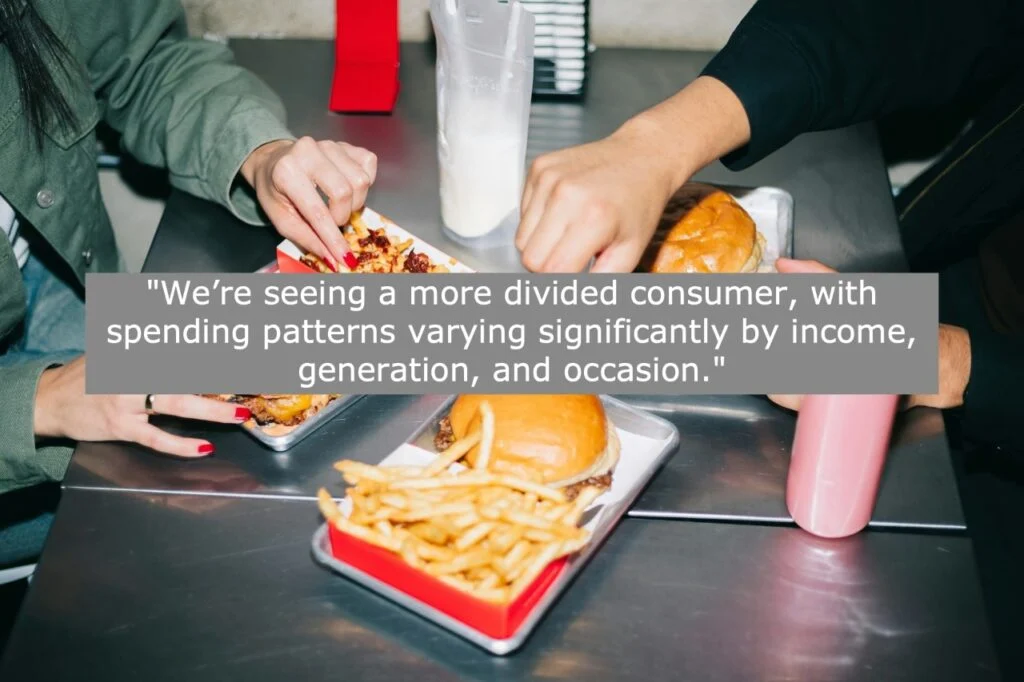
Richard Delvallée, Senior VP of Consulting at RMS, cautions against misinterpreting these numbers. "Operators should take the recent traffic decline seriously, but we don’t see the data as evidence that consumers have stopped spending at restaurants," Delvallée explains. "Instead, we’re seeing a more divided consumer, with spending patterns varying significantly by income, generation, and occasion."
The economic headwinds—including volatile gas prices and waning consumer confidence—are exacerbating this divide. In August, as gasoline prices hovered above $4 per gallon, consumer confidence hit a seven-month low. This volatility has forced consumers to become more strategic, leading to a phenomenon where patrons are "trading down." Nearly half (47%) of those spending less are choosing cheaper menu items, while 45% are opting for less expensive restaurant concepts entirely.
Generational Shifts: Gen Z vs. Boomers
The divide is not merely economic; it is generational. The demographic shift is perhaps best exemplified by the contrasting behaviors of Gen Z and the Boomer generation.
Gen Z remains a primary driver of restaurant demand. In the second quarter of 2026, 45% of Gen Z consumers reported increasing their Quick Service Restaurant (QSR) visits, and 49% noted they are spending a higher portion of their disposable income on dining out. Their comfort with digital interfaces and mobile ordering has kept them engaged with the QSR segment despite rising costs.
On the other side of the demographic spectrum, the Boomer cohort is significantly pulling back. 35% of Boomers report visiting QSRs less frequently, and 39% are spending less on restaurants overall. This trend extends to casual dining, where 43% of Boomers have indicated they plan to visit less often in the coming months. For operators, this means that legacy brands relying heavily on older, more traditional dining patterns may face a significant existential threat if they fail to adapt to the habits of younger, more mobile-first consumers.
The Strategic Imperative: Value, Bundling, and Menu Engineering
As operators look toward the remainder of 2027, the ability to adapt to this "bifurcated" consumer will be the primary determinant of success. The "one-size-fits-all" pricing and promotion strategy is failing.
"Getting consumers through the door is only part of the equation," Delvallée says. "Operators can make more informed decisions about menu placement, bundles, and add-on offerings by examining which items consumers continue to purchase and which they are dropping."
The data provides a roadmap for this "menu engineering." Among those cutting back, dessert is the most frequently sacrificed item, with 20% of diners opting to skip it. Appetizers and beverages are also high on the list of "cuttable" items, with 15% of diners removing them from their orders. Operators should focus on bundling these items into value-driven packages rather than offering them as expensive add-ons. By creating bundles that provide perceived value, operators can encourage "attachments" that might otherwise be abandoned.
Furthermore, QSRs are proving to be the most resilient segment, particularly for lower-income households. While other segments struggle, only 29% of lower-income households have decreased their QSR visits, and 21% have actually increased them. This suggests that for the budget-constrained, QSRs serve as a necessary, affordable luxury rather than a discretionary expense.
Navigating the Road Ahead: Implications for 2027
The implications for restaurant operators are twofold: they must prioritize precise segmentation and improve the overall "value" of the visit.
1. Differentiated Messaging and Pricing
Brands can no longer afford to promote to an "average guest." Instead, marketing must be segmented. Premium offerings should be marketed toward the high-income demographic that remains willing to spend, while value-based, high-utility bundles should be targeted toward price-sensitive consumers.
2. The Power of the Drive-Thru
Despite rising fuel costs, the drive-thru remains a crucial battleground. 73% of consumers report using the drive-thru at least once a week, and 15% expect to increase that usage. However, the risk is that consumers may consolidate their trips to save on transportation. Brands must ensure that the "value of the trip"—the speed, accuracy, and overall quality of the experience—is high enough to justify the drive.
3. Competing with the Home Kitchen
Grocery stores are emerging as a major competitor. With 27% of consumers buying meals from grocery stores more often, restaurants are competing for the "meal occasion" rather than just the "restaurant occasion." Hybrid workers, in particular, are leaning into QSRs, with 37% planning to increase their visits. Capturing this segment requires efficiency and seamless digital integration.
Conclusion: The Path to Resilience
The data from RMS is clear: the demand for restaurant dining has not evaporated, but the expectations surrounding those visits have shifted dramatically. As the income divide continues to widen, the middle ground is disappearing.
For the remainder of 2027, the winners will be the operators who stop looking for a mythical "average" and start catering to the specific needs of their disparate customer bases. Whether it is by offering premium, high-margin experiences for those who have the means or by providing aggressive, transparent value for those feeling the economic squeeze, the goal remains the same: making the restaurant visit feel "worthwhile" in a challenging economic climate.
"There’s little in the data to suggest that the gap is closing," Delvallée concludes. "Rather than pricing and promoting to an ‘average guest,’ operators should segment their offers and messaging based on how different consumers are spending. The demand is still there, but brands are competing harder for the visits consumers do make."
As 2027 progresses, the operators who thrive will be those who embrace this complexity, leveraging their own internal data to pivot quickly, personalize their value propositions, and meet the consumer exactly where they are—whether that is in a high-end dining room or a fast-moving drive-thru line.

 Nana Muazin
 Laily UPN