

 Dwi Wanna
 Nana Wu
 Muslim
 Reynand Wu
 Ammar Sabilarrohman
 Nana
Nana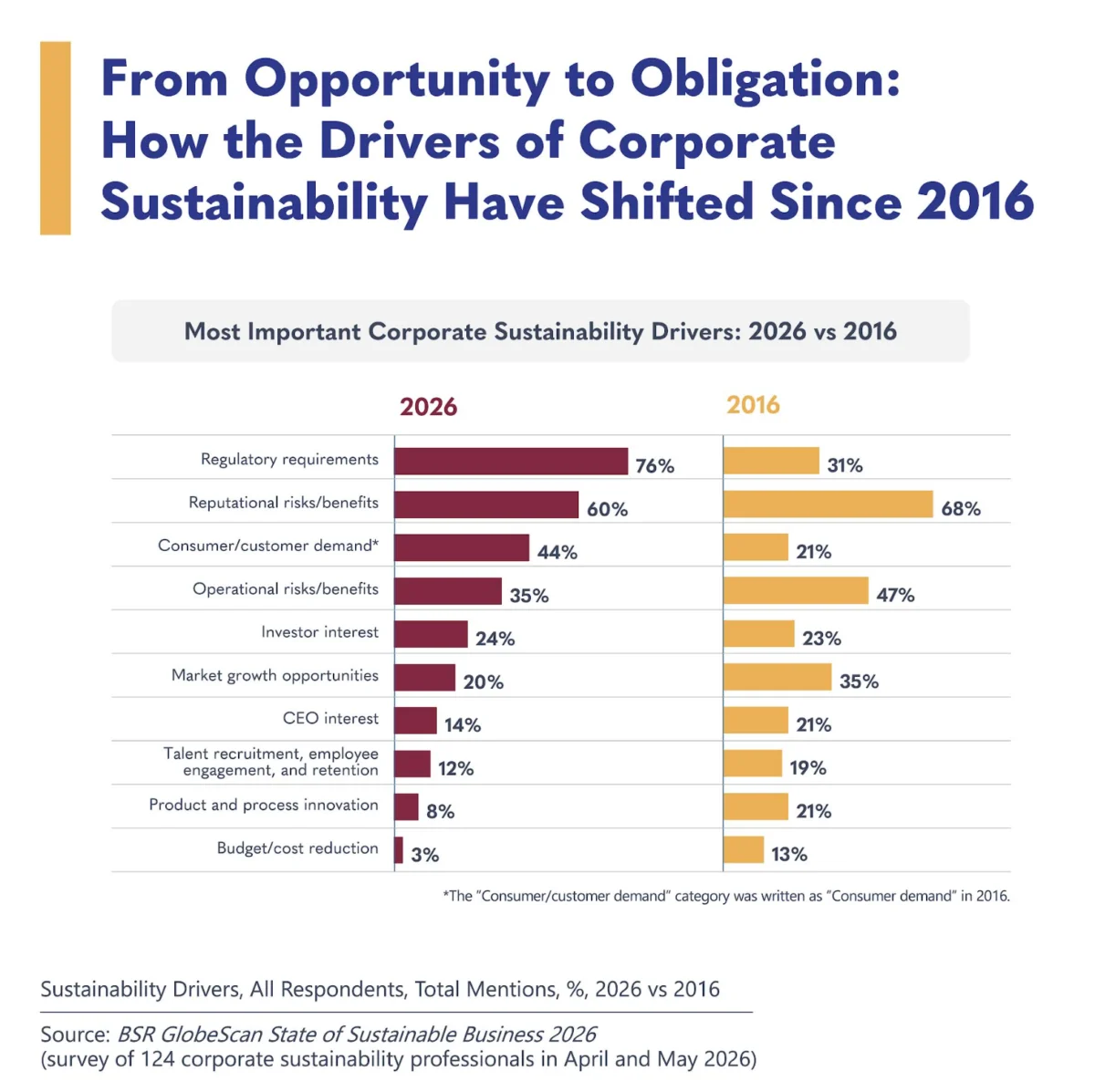
A decade of tectonic shifts in the global business landscape has culminated in a fundamental transformation of why corporations pursue sustainability. New research from BSR and GlobeScan, based on a comprehensive survey of sustainability professionals at billion-dollar enterprises, reveals that the "business case" for sustainability has undergone a profound evolution. While the boardroom narrative of the mid-2010s was defined by the promise of innovation and growth, the corporate reality of 2026 is increasingly dictated by the "stick" of regulation rather than the "carrot" of competitive advantage.
The State of Play: Main Facts and Key Findings
The study, conducted in April and May 2026, surveyed 124 sustainability leaders at global firms with annual revenues exceeding $1 billion. The results present a stark contrast between the strategic priorities of 2016 and those of today.
The most significant finding is the meteoric rise of regulatory compliance as the primary catalyst for sustainability initiatives. In 2016, regulatory requirements were a secondary concern, cited by only 31% of respondents as a key driver. Today, that figure has surged to 76%. This shift marks a transition from a voluntary, market-led model of corporate responsibility to a mandatory, state-enforced framework.
Conversely, the "value-creation" drivers that dominated the previous decade—such as operational efficiency, market growth, and product innovation—have seen a marked decline in influence. Sustainability, once pitched as a engine for internal transformation and cost savings, is now being treated increasingly as a cost of doing business—a regulatory hurdle to be cleared rather than a horizon to be reached.
A Decade of Evolution: A Chronological Look
To understand the current climate, one must look at the progression of the last ten years:
- 2016–2018: The Era of Voluntary Commitment: Following the Paris Agreement, corporations were largely motivated by reputational risk and the potential for "green growth." Sustainability was framed as a way to attract top-tier talent and differentiate products in the eyes of conscious consumers.
- 2019–2022: The ESG Integration Phase: As institutional investors began to scrutinize Environmental, Social, and Governance (ESG) metrics, companies adopted sustainability to lower their cost of capital. During this period, the internal narrative focused on long-term resilience and risk mitigation.
- 2023–2026: The Regulatory Tipping Point: The emergence of rigorous reporting standards, cross-border carbon border adjustment mechanisms (CBAM), and mandatory supply chain due diligence laws has forced a pivot. Sustainability professionals have moved from the strategy department into the legal and compliance wings of the organization.
The data suggests that while sustainability is now "mainstreamed," it has lost some of its visionary fervor in the process. The strategic ambition that once drove sustainability is being sidelined by the sheer administrative burden of reporting and the necessity of avoiding regulatory penalties.

The Data Breakdown: What the Metrics Say
The BSR and GlobeScan data visualization provides a chilling look at the shifting priorities of the modern enterprise.
In 2016, "Reputational risks and benefits" reigned supreme at 68%. Today, while reputation remains important (60%), it is eclipsed by the cold, hard requirements of regulators. The collapse of "Market growth opportunities" as a top-three driver is particularly telling. A decade ago, executives viewed sustainable product development as a way to capture new segments of the market. Today, those same executives are likely preoccupied with ensuring their current operations meet the evolving standards set by international governing bodies.
Furthermore, internal drivers like "CEO interest" and "Talent recruitment" have weakened. This suggests that sustainability has moved away from the CEO’s desk—where it was once a vision for the company’s future—and into the operational middle-management layer, where it is treated as a checklist of technical compliance.
Official Perspectives and Expert Analysis
James Morris, who leads GlobeScan’s San Francisco office and spearheaded the research, notes that this transition is a double-edged sword. "We are seeing a clear rebalancing," Morris explains. "A decade ago, sustainability was associated with forward-looking business value. Today, the emphasis has moved toward responding to external expectations."
Industry analysts argue that this shift is a natural evolution of market maturity. When a practice is new, it is driven by innovators looking for an edge. When it becomes systemic, it is inevitably codified into law. However, the concern among experts is whether this "compliance-first" mindset can sustain the level of innovation required to meet global climate goals. If the primary motivation is simply to avoid fines, firms are less likely to invest in the transformative, high-risk research and development that radical decarbonization requires.
Implications for the Future of Business
The findings of this research present three critical implications for the corporate sector:
1. The Risk of Stagnation
Compliance is a baseline, not a ceiling. If the sustainability agenda is defined solely by what is legally required, companies risk falling into a "compliance trap." In this state, the organization performs the bare minimum to satisfy auditors but fails to leverage sustainability as a source of long-term competitive advantage.
2. The Talent Gap
The study indicates a decline in sustainability as a tool for talent recruitment. For the modern workforce—particularly Gen Z and Alpha—the "purpose" of a company is a key retention factor. If companies retreat into a purely compliance-based sustainability model, they may find it harder to engage the very employees who are most passionate about corporate mission and values.
3. Re-integrating Strategic Value
The challenge for sustainability leaders in the coming decade will be to bridge the gap between compliance and strategy. The most successful organizations of the 2030s will be those that view regulation not as a burden, but as a roadmap for the future economy. They will use the structure provided by new regulations to build more resilient supply chains, drive innovation in resource efficiency, and communicate a compelling, values-driven brand story to consumers.
Conclusion: The Path Forward
The BSR and GlobeScan research serves as a wake-up call for the C-suite. While the global regulatory environment has successfully forced sustainability to the center of the corporate agenda, it has simultaneously eroded the narrative of opportunity.
To thrive, businesses must move beyond the "compliance-only" mindset. Sustainability leaders need to re-engage the board and executive leadership on how sustainability drives growth, resilience, and competitiveness. The regulatory floor has been set; it is now up to the private sector to determine how high they want to build the ceiling.
As we look toward the remainder of the decade, the question is no longer whether sustainability is part of the business model—the regulators have ensured that it is. The real question is whether companies can rediscover the spirit of innovation that once defined the movement, or if they will remain satisfied with merely checking boxes to keep the regulators at bay. The companies that choose the former will define the next decade of global commerce; those that choose the latter may find themselves obsolete in a world that demands more than just adherence to the status quo.


 Azzam Bilal Chamdy
 Ali Ikhwan