

 Nana Wu

 Dwi Wanna

 Suro Senen

 Evan Lee Salim

 Sagoh
Introduction: A Strategic Milestone in Global Health
On March 4, 2025, the World Health Organization (WHO) and the Swiss Confederation officially formalized a renewed commitment to their collaborative framework, launching the WHO–Switzerland Country Cooperation Strategy (CCS) for 2024–2028. Signed at the WHO Regional Office for Europe in Copenhagen, Denmark, this agreement solidifies a long-standing partnership that has consistently positioned Switzerland as a linchpin in global health governance.
The renewal of this strategy is not merely a bureaucratic formality; it represents a deliberate synchronization of national Swiss health priorities with the WHO’s overarching global health objectives. By aligning their resources, technical expertise, and diplomatic influence, the two entities aim to address the systemic challenges posed by the post-pandemic landscape, including climate-related health risks, digital health integration, and the urgent need for equitable access to medical countermeasures.
The Chronology of Collaboration: A Legacy of Innovation
The relationship between Switzerland and the WHO is unique, defined by Switzerland’s role as both a host nation and a proactive member state.
The 2013 Pilot: Setting the Precedent
In 2013, Switzerland broke new ground by becoming the first high-income country in the WHO European Region to adopt a formal Country Cooperation Strategy. Historically, such strategies were reserved for developing nations seeking assistance in capacity building. By choosing to pilot this framework, Switzerland signaled its intent to view the WHO not just as an external regulator, but as an essential partner in optimizing its own domestic public health systems while leveraging its domestic success to influence global policy.
The 2022 Mandate for Renewal
Following the global disruption caused by the COVID-19 pandemic, both parties recognized that the 2013 framework required a comprehensive overhaul. In 2022, high-level officials from the Swiss Federal Office of Public Health and the WHO began a series of consultations to modernize the agreement. The focus shifted from basic cooperation to high-level strategic alignment on global health security, sustainable financing for the WHO, and the advancement of digital health technologies.
The March 2025 Formalization
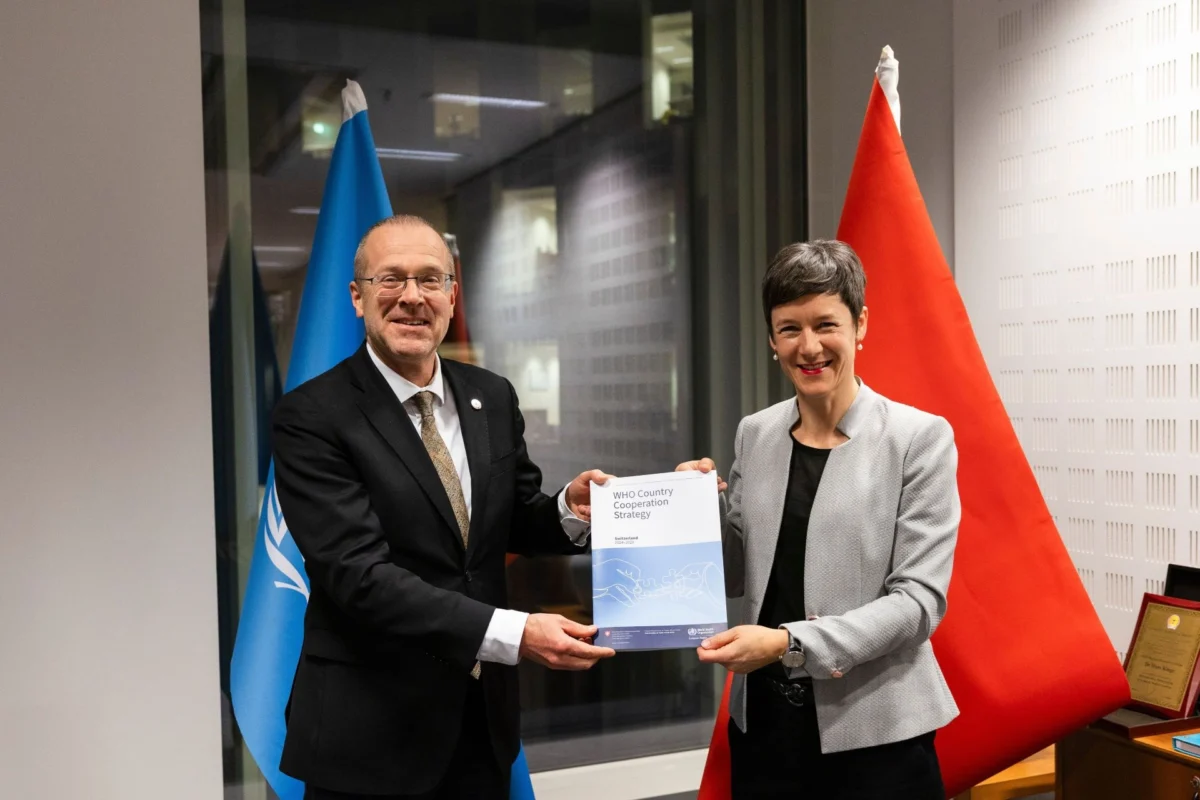
The signing ceremony in Copenhagen—attended by Dr. Hans Henri P. Kluge, WHO Regional Director for Europe, and Barbara Schedler, Ambassador for Global Health at the Swiss Federal Office of Public Health—marked the culmination of this two-year development process. The 2024–2028 strategy now serves as the blueprint for Switzerland’s engagement with the WHO, ensuring that Swiss technical expertise is effectively integrated into the WHO’s European and global programs.
Supporting Data: Why This Partnership Matters
The partnership between the WHO and Switzerland is underpinned by significant data points that demonstrate the necessity of this alliance.
Switzerland’s Contribution to Global Stability
Switzerland consistently ranks among the top contributors to the WHO’s voluntary funding mechanisms. This financial support is crucial for the WHO’s "General Programme of Work," which aims to provide universal health coverage to one billion more people, ensure one billion more people are better protected from health emergencies, and promote better health and well-being for another billion.
The Global BioHub System
One of the most vital components of the recent cooperation is the Global BioHub system. In a world where pathogens evolve rapidly, the ability to share biological materials for research, diagnostics, and vaccine development is paramount. Switzerland’s commitment to hosting and supporting the infrastructure for the BioHub provides a secure, transparent, and internationalized environment for data and sample sharing. This facility has been instrumental in the rapid analysis of emerging infectious diseases, serving as a pillar for the "One Health" approach.
Digital Health and Innovation
The new strategy places an unprecedented emphasis on "Digital Health." Switzerland, home to one of the world’s most sophisticated health-tech sectors, is collaborating with the WHO to establish international standards for digital health records and telehealth infrastructure. This is critical for preventing the "digital divide" in medicine, ensuring that innovations in AI and telemedicine are accessible to lower-income nations, thus fostering global equity.
Official Perspectives: Aligning Visions
The partnership is defined by a shared belief in multilateralism.

The WHO Perspective: Dr. Hans Henri P. Kluge
During the signing, Dr. Kluge underscored that the agreement is about more than logistics; it is about "intellectual and practical synergy." He noted that Switzerland’s ability to act as a neutral ground for health diplomacy allows the WHO to navigate complex geopolitical tensions. For the WHO, the Swiss partnership acts as a laboratory for policy testing—if a health initiative can be successfully implemented within the Swiss context, it provides a validated model for other high-income nations to emulate.
The Swiss Perspective: Ambassador Barbara Schedler
Ambassador Schedler emphasized that Switzerland’s health policy is inseparable from its foreign policy. By integrating the CCS into the national agenda, Switzerland ensures that its domestic health experts—including those from the Swiss Federal Office of Public Health and academic institutions—are directly involved in WHO policy-making. This, she argued, creates a "virtuous circle" where Swiss expertise strengthens global health, and global health lessons learned through the WHO improve the lives of Swiss citizens.
Implications for the Future: 2024–2028
The implementation of the 2024–2028 strategy carries profound implications for the global health landscape.
1. Strengthening Pandemic Preparedness
The strategy explicitly prioritizes the finalization and implementation of the "Pandemic Treaty." Both Switzerland and the WHO have been vocal proponents of a legally binding agreement to ensure that the mistakes of the COVID-19 pandemic—specifically the hoarding of medical supplies and the lack of transparent data sharing—are not repeated.
2. Addressing the Climate-Health Nexus
Climate change is increasingly recognized as the greatest health threat of the 21st century. The 2024–2028 roadmap commits both parties to research and infrastructure projects aimed at mitigating the health impacts of climate change, such as the spread of vector-borne diseases in Europe and the strain on health systems during extreme heatwaves.
3. Sustainable Financing for WHO
A key goal of the partnership is to transition the WHO toward a more sustainable and predictable funding model. By advocating for "flexible" voluntary contributions, Switzerland is leading by example, encouraging other member states to reduce the number of "earmarked" funds that often constrain the WHO’s ability to respond to sudden, unforeseen health emergencies.
4. Health Equity and Universal Coverage
The strategy reinforces the commitment to "Universal Health Coverage" (UHC). By leveraging Swiss expertise in social insurance systems and private-public health partnerships, the WHO hopes to assist other member states in developing sustainable, equitable healthcare funding models. This is particularly relevant for middle-income countries that are currently in the process of scaling up their own national health services.
Conclusion: A Model for Multilateral Cooperation
The renewal of the WHO–Switzerland Cooperation Strategy is a testament to the enduring value of multilateralism. In an era often characterized by national isolationism, the decision by a high-income nation to formalize such an intimate partnership with a global health body serves as a beacon of progress.
As the world faces the multifaceted challenges of an aging population, the threat of future pandemics, and the rapid evolution of medical technology, the collaboration between the WHO and Switzerland provides more than just a framework—it provides a pathway forward. By bridging the gap between domestic policy and global health security, Switzerland and the WHO are ensuring that they are not merely reacting to the next crisis, but actively building the infrastructure required to prevent it.
The 2024–2028 period will be critical in determining the resilience of the global health architecture. With this strategy now firmly in place, the path forward is marked by shared responsibility, scientific integrity, and an unwavering commitment to the fundamental right to health for all. As the implementation phase begins, the international community will look to this partnership as a standard-bearer for how nations and global organizations can effectively collaborate for the betterment of humanity.
For further details on the technical specifications of the 2024–2028 strategy, readers are encouraged to consult the official documentation published by the WHO Regional Office for Europe. The full text of the agreement provides a granular look at the performance indicators and accountability mechanisms that will govern this partnership over the next four years.


