
 Lina Hope

 Jia Lissa

 Pevita Pearce

 Ammar Sabilarrohman

 Reynand Wu
In the heart of Milan, a city synonymous with the evolution of design, a new auditory and aesthetic landmark has emerged. Bar Bardo, a compact 55-square-metre listening bar, has become the latest project from the rising star of Italian architecture, studio NM3. By blending the stark, modernist precision that has defined their meteoric rise with a newfound warmth and sensory depth, NM3 has crafted a space that is as much an architectural statement as it is a cultural destination. Drawing inspiration from the hallowed halls of 20th-century Viennese modernism while maintaining a strictly contemporary Milanese sensibility, the project serves as a sophisticated bridge between the history of European cafe culture and the modern listening bar movement.
Main Facts: A Study in Crimson and Steel
Bar Bardo is located in a vibrant corner of Milan, directly across from the legendary Bar Basso—an institution that has long served as the spiritual home of the city’s design elite. Occupying a modest, single-room footprint, the bar utilizes its limited spatial parameters to create an atmosphere of intense intimacy.
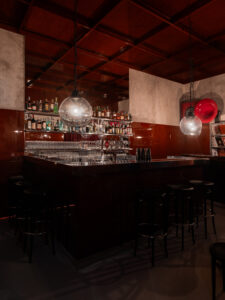
The interior is defined by a rigorous material palette. NM3 has clad the walls and ceiling in polished rosewood panels, providing a rich, dark acoustic backdrop that softens the resonance of the room—a functional necessity for a space designed specifically for high-fidelity music playback. This warmth is punctuated by the studio’s signature application of stainless steel, a material that has become a visual shorthand for NM3’s work since their founding in 2020.
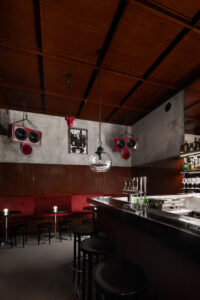
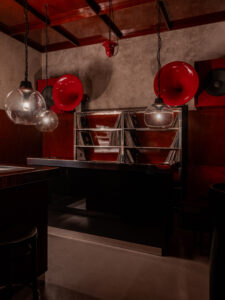
A central stainless steel bar serves as the room’s anchor, its reflective surfaces interacting with the ambient glow of 1950s globular pendant lights designed by the legendary Italian architect Luigi Caccia Dominioni. These vintage pieces, modified by the studio with custom black chains, represent the only historical artifacts in the space, grounding the modern interior in Milanese design heritage. The perimeter is lined with plush, red velvet banquettes, which harmonize with matching crimson curtains and a series of vibrant red speakers, creating a monochromatic, immersive experience that feels both high-fashion and subterranean.
A Chronology of Concept and Execution
The development of Bar Bardo did not happen in a vacuum. It is the culmination of a deliberate shift in the studio’s trajectory.
- 2020: The inception of NM3. The studio quickly gains notoriety for its "raw" approach to furniture and spatial design, characterized by heavy, industrial-grade stainless steel.
- 2025 (June/September): The studio completes two major projects: the interior of Galleria Montegani and the Miss Sixty flagship store. Both projects reinforce the studio’s reputation for monochromatic, metal-heavy aesthetics.
- 2026 (Early): Design development for Bar Bardo begins. Unlike previous projects that focused on "cold" utility, the partners at NM3 seek a balance between the industrial and the domestic.
- 2026 (Mid-Year): The construction phase. The studio sources specific rosewood and custom-fits the acoustic paneling, while simultaneously finalizing the stainless steel DJ booth and record shelving.
- 2026 (October): The grand opening of Bar Bardo, marking a critical pivot in the studio’s portfolio toward a "softer" modernist approach.
Supporting Data: Spatial Geometry and Flexibility
The brilliance of Bar Bardo lies in its inherent adaptability. In a city where real estate is at a premium, NM3 has engineered a layout that serves dual purposes without requiring structural renovation.
The bar is designed with a "loose" configuration. With the exception of the central bar structure and the perimeter banquettes, every element of the interior—from the DJ console to the vinyl shelving—is mobile. This allows the owners to shift the room’s energy from a cocktail-focused listening lounge to a high-energy club environment by simply clearing the floor.
Technical Specifications:
- Footprint: 55 square metres (excluding bathroom).
- Key Materials: Rosewood (acoustic paneling), Stainless Steel (furniture, fixtures, DJ booth), Red Velvet (seating and textiles).
- Lighting: 1950s Luigi Caccia Dominioni pendants (restored with custom black hardware).
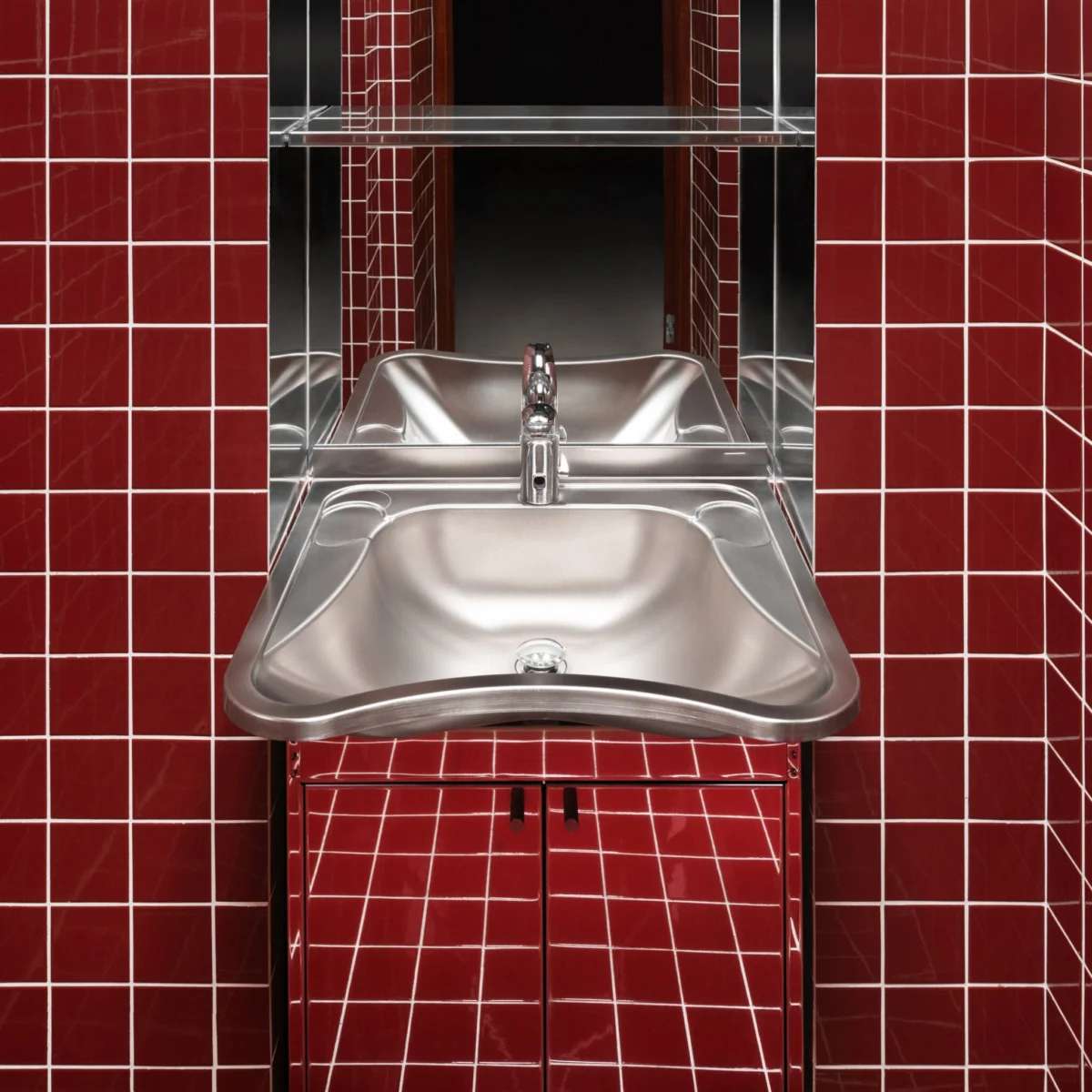
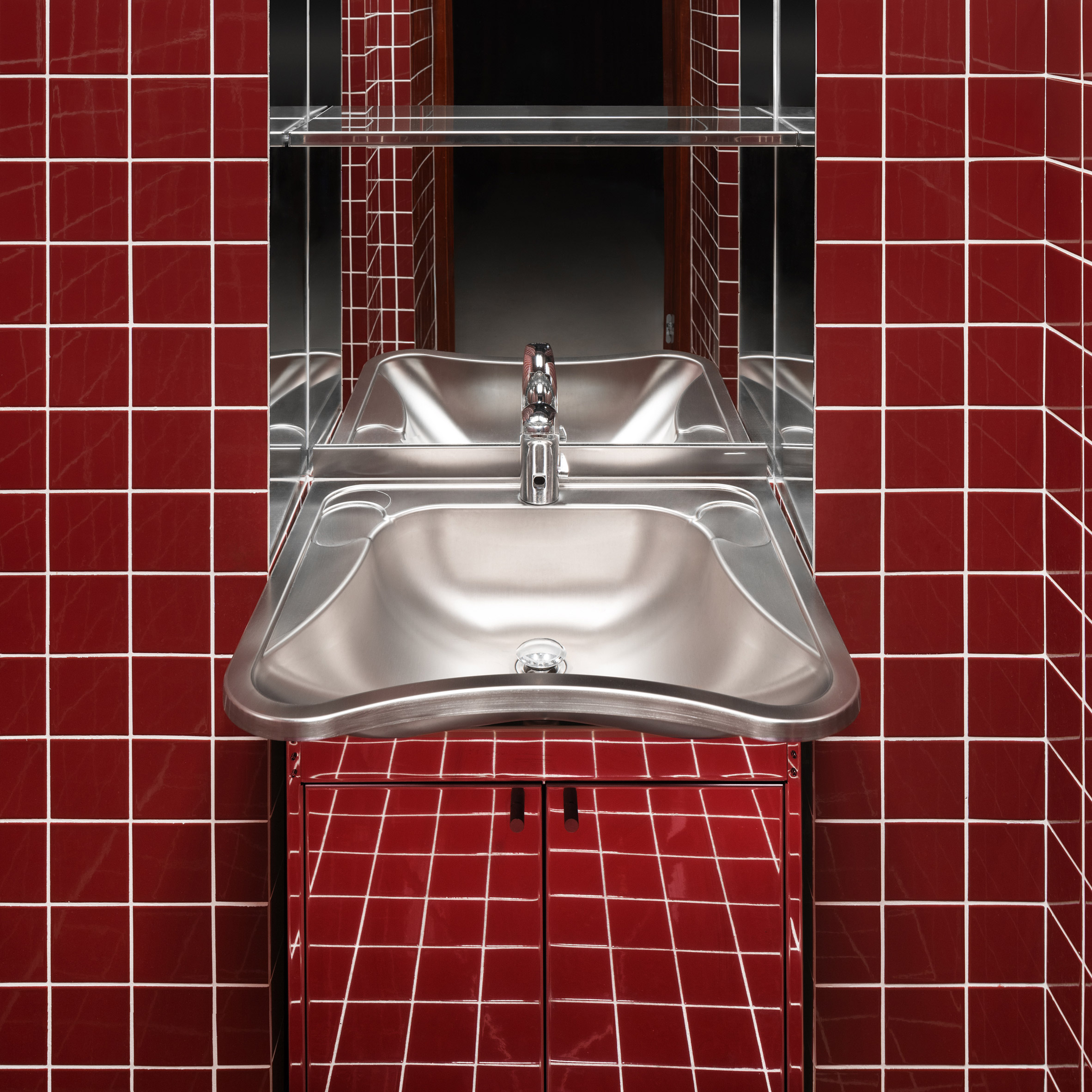
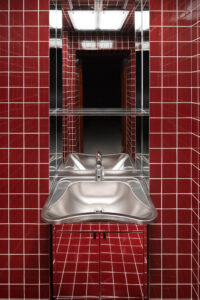
- Sanitary Design: 10cm x 10cm bright red ceramic tiling, floor-to-ceiling, combined with utilitarian stainless steel fixtures.
The bathroom, often an afterthought in small commercial spaces, is treated as a high-concept "red room," utilizing intense, saturated color to provide a dramatic transition from the rosewood-heavy main floor.
Official Responses and Design Philosophy
Francesco Zorzi, co-founder of NM3, has been vocal about the influences that guided the design, carefully distinguishing between "copying" and "honoring" the past. While critics have immediately drawn parallels to Adolf Loos’s 1908 American Bar in Vienna, Zorzi suggests the link is more philosophical than formal.
"The American Bar was more of an aspiration than a direct formal reference," Zorzi told Dezeen during the launch. "The ambition was never to recreate Loos’s bar, nor Robert and Trix Haussmann’s Kronenhalle in Zurich, which was another important reference for the project. Rather, we wanted to create a truly classic bar for Milan, with a very specific spatial and architectural character."
Zorzi emphasizes that the "flexibility of the space is achieved through a simple architectural arrangement rather than complex spatial interventions." By adhering to this principle, the studio has managed to avoid the trap of "over-designing," ensuring that the music and the patrons remain the primary focus of the room. This restraint marks a maturation for the studio; having mastered the "raw" aesthetic in previous projects, they are now demonstrating an ability to work with texture, light, and historical resonance.
Implications: The Future of Milanese Hospitality
The success of Bar Bardo carries significant weight for the Milanese design scene. It highlights a growing trend among young studios to move away from the "maximalist" or "Instagram-first" design philosophy that dominated the early 2020s.
1. The Return of Tactility
The use of rosewood and velvet signals a departure from the sterile, all-white or all-metal interiors that have plagued commercial hospitality spaces. Designers are increasingly recognizing that for a "listening bar" to succeed, the environment must possess a "warmth" that physically vibrates with the sound system.
2. The Evolution of the "Listening Bar"
Listening bars—a concept popularized in Japan—are becoming a staple of European nightlife. Bar Bardo proves that these spaces do not need to be massive to be impactful. By utilizing specific architectural cues (acoustic wood panels, dedicated vinyl shelving, and high-end speaker integration), NM3 has created a blueprint for how small, urban spaces can be converted into high-fidelity cultural hubs.
3. The NM3 Trajectory
NM3 is currently in a "transitional" phase. As they move from being a "young studio" to a pillar of the Milanese design community, their ability to balance their signature steel-heavy industrialism with warmer, more traditional materials is crucial. If Bar Bardo is any indication, the studio is moving toward a more sophisticated, nuanced language that prioritizes human comfort as much as it does avant-garde geometry.
Conclusion
Bar Bardo is more than just a place to drink or listen to music; it is a laboratory for modern hospitality design. By distilling the essence of Adolf Loos’s classic modernism and filtering it through a contemporary, flexible, and distinctly Milanese lens, NM3 has solidified their position as one of the most important creative forces in Italy today. In a world where trends move at the speed of a digital swipe, the studio has created something that feels designed to endure—a classic in the making, defined by the red glow of its speakers and the cool, unwavering reflection of its steel.


 Nana Wu

 Dwi Wanna