 Laily UPN

 Suro Senen

 Muslim

 Raul Delapena Setiawan
 Layla Zulfa
 Jia Lissa
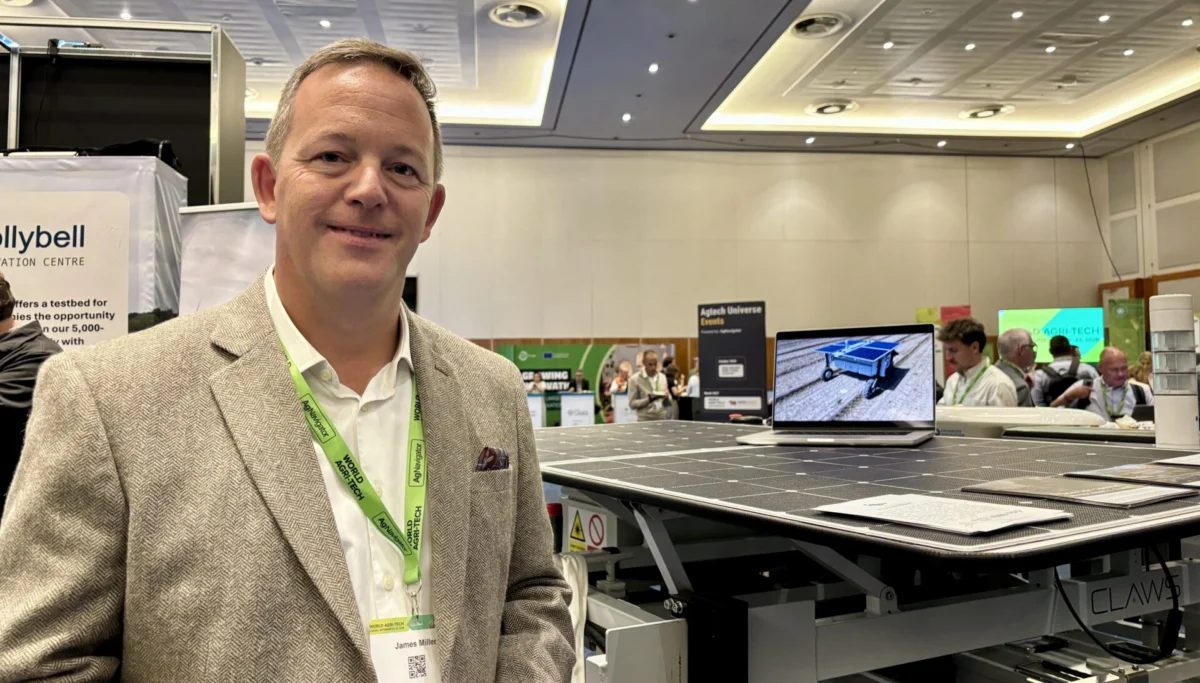
The landscape of modern agriculture is undergoing a radical technological transformation. As labor shortages intensify and the efficacy of traditional chemical herbicides wanes due to mounting weed resistance, farmers are increasingly looking toward robotics to secure their harvests. While the industry has seen a surge in mechanical hoes, precision sprayers, and even high-powered laser systems, UK-based startup Earth Rover is carving out a unique niche with a technology that feels straight out of science fiction: concentrated light.
At the heart of their innovation is the CLAWS robot (Concentrated Light Autonomous Weeding and Scouting). By harnessing the power of targeted light pulses to eliminate weeds at the meristem, Earth Rover is positioning itself as a sustainable, energy-efficient, and highly precise alternative to both chemical dependence and intensive manual labor.
The Core Technology: Concentrated Light vs. Traditional Methods
Unlike competitors that rely on high-energy, collimated laser beams—which require massive power draws and heavy cooling systems—Earth Rover’s CLAWS unit utilizes a proprietary method of converging light.
"The clue is in the title," explains James Miller, CEO of Earth Rover. "We converge the light, much like a schoolboy would with a magnifying glass making mischief. After that convergence point, it diverges. This makes the system inherently safer for the operator and surrounding environment, while significantly reducing our energy footprint."
This lower energy demand is a pivotal differentiator. Because the system is less power-hungry, the CLAWS robot can operate on a combination of solar and battery power for up to 16 hours on a single charge. During the most recent summer testing cycle, the units operated through entire workdays without requiring a battery swap. This autonomy, paired with the ability to function in adverse weather conditions—where herbicide spraying would be ineffective due to drift or moisture—positions the robot as a highly reliable tool for specialty crop growers.
Chronology of Development: From Concept to Commercialization
The journey to the field has been a methodical, iterative process. Founded in 2017, Earth Rover spent its initial years in a research-heavy phase, balancing technological development with practical field testing.
- 2017–2020: Foundational Research. The company focused on the core physics of the weeding technology and the development of the autonomous platform, securing early backing through a combination of equity and targeted grants from Innovate UK and the Forestry Commission.
- 2021–2023: The Alpha and Beta Phase. Earth Rover moved from controlled environments to live, commercial fields. During this time, the team refined the scouting software, allowing the robot to identify, monitor, and map crop health alongside its primary weeding task.
- 2024–Present: The Pilot Commercialization. With the product now in a "pilot production" phase, Earth Rover has successfully sold its first 10 units. An additional 15 units are currently under construction as the company prepares to scale operations.
The company is now eyeing a Series A funding round in 2025 to fuel its expansion beyond vegetable and salad crops into the massive, high-stakes market of broadacre cropping systems.
Supporting Data and Economic Realities
The business case for CLAWS is built on the stark reality of modern farming economics. For organic farmers, the options have historically been binary: back-breaking manual labor or mechanical weeding that requires dry, stable ground. Earth Rover’s platform removes these constraints.
ROI and Cost Structure
With a price point around £150,000, the investment is substantial, yet Miller points to a payback period of one to three years, depending on the specific farm’s scale and existing weed management costs. Unlike many "robotics-as-a-service" models currently trending in Silicon Valley, Earth Rover has found that its core customer base prefers to own the asset outright.
"All farmers want to weed when they want to weed," Miller notes. "They don’t want to rely on a third-party service provider who might be busy elsewhere when the rain stops and the field is ready."
Precision Metrics
The system operates with millimeter-level precision. Through advanced computer vision and machine learning algorithms, the robot can differentiate between delicate vegetable sprouts—such as young onions—and the weeds surrounding them. This precision prevents crop damage and ensures that every pulse of light is utilized for maximum efficacy, targeting only the unwanted vegetation.
Official Perspectives: The Human Element of Robotics
One of the most striking aspects of the Earth Rover philosophy is its commitment to "repairability." While the technology inside is cutting-edge, the physical structure of the robot is built for the harsh reality of the farm.
"Our chairman is a fifth-generation farmer," Miller shares. "From day one, we designed this to be repairable with nothing more than baler twine, a can of WD-40, and a hammer." This acknowledgment of the realities of remote, high-pressure agricultural environments has been a significant selling point for early adopters who are wary of "black box" technology that cannot be fixed without a specialized technician from the manufacturer.
The company’s modular design also allows for high levels of customization. Because the weeding modules are independent, they can be configured to fit various bed widths (1.5 to 2 meters) and accommodate different ridge heights, making the platform adaptable to almost any specialty crop operation.
Implications: A New Era for Global Agriculture
The implications of Earth Rover’s success extend far beyond individual farms. As the "chemical toolbox" for farmers continues to shrink due to stricter environmental regulations and the rise of herbicide-resistant superweeds, the industry is at a crossroads.
The Shift from Chemicals to Data
The CLAWS robot does more than just weed; it scouts. By equipping the front and back of the robot with high-definition cameras, the platform provides farmers with a wealth of per-plant data. This includes NDVI (Normalized Difference Vegetation Index) readings, precise crop counting, and early detection of disease or nutrient deficiencies. By turning a weeding tool into a data-gathering mobile hub, Earth Rover is helping farmers move toward "precision farming," where inputs are applied only where they are strictly necessary, further reducing waste and environmental impact.
Market Readiness and Investor Appetite
Investors are increasingly viewing agricultural robotics as a high-growth sector. Unlike the speculative bubbles seen in other tech verticals, ag-tech is now being judged on real-world utility: Can the machine run for 16 hours? Does it reduce the need for manual labor? Does it pay for itself within three seasons?
Earth Rover’s transition from a grant-funded startup to a company with 25 units in the field—and a clear roadmap for Series A funding—suggests that the market is finally ready for the transition. The shift from "experimental" to "essential" is happening as the industry faces a perfect storm of rising labor costs, labor shortages, and regulatory pressure.
Scaling the Future
The challenge for Earth Rover in the coming years will be one of production speed. While the design is modular and relies on off-the-shelf components to simplify maintenance, assembling these robots at scale to meet global demand is a significant hurdle. However, by leveraging standard agricultural manufacturing techniques for the chassis and focusing its R&D on the software and light-delivery systems, the company is well-positioned to scale alongside the growth of the broader autonomous agricultural market.
Conclusion
Earth Rover is a prime example of how the next generation of agricultural technology is moving toward a more sustainable, data-driven, and autonomous future. By focusing on the physics of light, the realities of farm maintenance, and the economic pain points of the modern grower, they are not just creating a piece of equipment; they are creating a new methodology for crop production. As they look toward the 2025 season, the company is proof that the future of farming will be written in pulses of light, one weed at a time.



 Reynand Wu