

 Nana Wu

 Dwi Wanna

 Suro Senen

 Evan Lee Salim
 Pevita Pearce
In the complex and often turbulent landscape of the 2026 global fine wine market, a clear trend has emerged: while speculative fervor for recent releases has cooled, the demand for mature, drinkable Bordeaux has proven remarkably durable. As collectors and investors navigate a period of economic uncertainty, the secondary market is increasingly pivoting away from the "new and shiny" toward the "proven and poured."
Bordeaux’s historic ability to produce substantial volumes of high-quality, long-lived wines has long been a pillar of market liquidity. Today, that liquidity is being tested and reaffirmed by a shift in consumer behavior. As older, prestigious vintages enter their prime drinking windows, they are being consumed at a rate that is quietly, but steadily, tightening supply.
The Core Market Dynamics: A Shift Toward Consumption
The current fine wine climate is characterized by a "price correction" phase. According to data from the Liv-ex fine wine exchange, overall prices have touched 10-year lows in real terms. For the savvy buyer, this represents a rare window of opportunity.
Geraint Carter of Bordeaux Index and the LiveTrade platform notes that the market downturn—which saw prices fall by 20% or more across several categories—has acted as a reset button. "There is some evidence of stretched liquidity beginning to emerge now," Carter explains. "With the caveat that you have to be buying at the right price, mature Bordeaux looks like one of the safest segments of the market."
The "safe haven" status of these wines is not born of speculative hype, but of the fundamental reality that they are being opened and enjoyed. For decades, the market was fueled by a cycle of investment and resale. Today, the driving force is consumption. This is particularly evident in the dwindling availability of legendary vintages. First-growth Bordeaux from 1982 and 1986, which were once considered staples of the secondary market, now appear only sporadically. When they do surface, it is rarely in more than a case or two, signaling a "draining of the pool" that has been decades in the making.
Chronology of a Market Shift
To understand the current state of the market, one must look at the timeline of the last two years:
- 2024–2025: The post-pandemic "softening" of prices begins. While this hit younger vintages of Bordeaux and other regions hard, mature back-vintages remained resilient.
- Summer 2026: A critical inflection point. The bid-to-offer ratio on the Liv-ex marketplace for Bordeaux First Growths from the 2000–2005 vintages climbs above 2.0. By contrast, post-2020 vintages languish with a ratio of 0.7, indicating a clear preference for wines with age.
- September 2026: A wave of "La Place de Bordeaux" releases, including Opus One, Masseto, and Solaia, enters the market. While technically impressive, the reception is lukewarm, highlighting the disconnect between high-quality new releases and a market that is currently prioritizing value and maturity over contemporary acquisition.
- October 2026: A pivot toward high-end auctions, such as the upcoming Christie’s New York sale, which focuses on cellar-aged treasures like 1961 Château Latour and historic Penfolds Grange vintages, reflecting a collector appetite for provenance and age.
Supporting Data: The Case for 2000 and Beyond
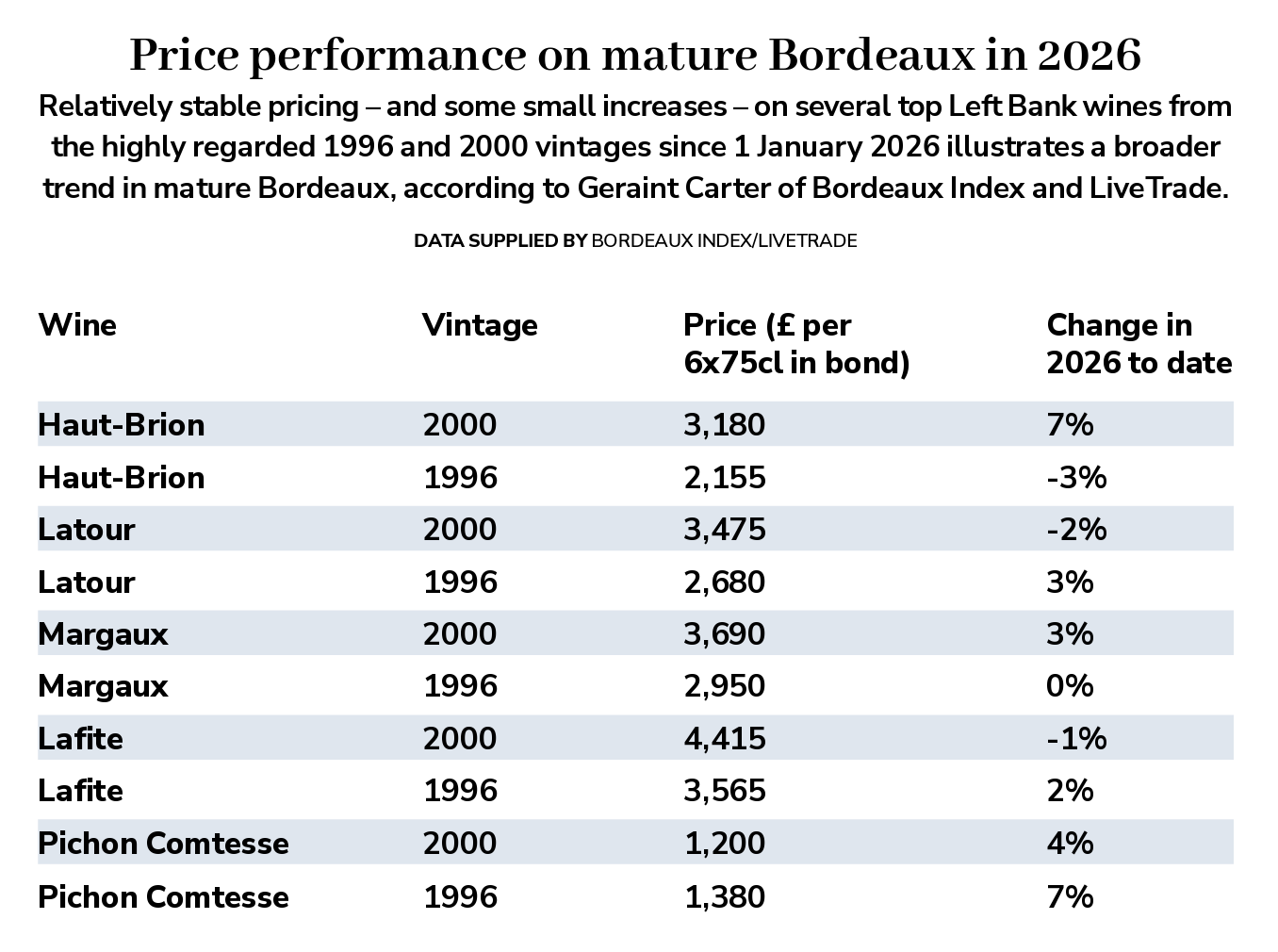
The data confirms that the "price floor" for many iconic wines has been hit. Liv-ex reports that the 2000 vintage—a landmark year for Bordeaux—is now trading at levels that present an 18-year value proposition. Specifically, Lafite 2000 has fallen below 2008 price levels, while legendary names like Château Latour, Haut-Brion, and Margaux are trading at or near 2015 lows.
This creates a fascinating paradox. While the critics and châteaux argue that the 2019, 2022, and 2023 vintages are among the finest ever produced, the market is not yet prepared to absorb them at premium prices. Investors are essentially saying: "Why pay a premium for a wine that needs 20 years in the cellar when I can buy a 2000 that is ready to drink today at a historic discount?"
Official Perspectives and Expert Analysis
Industry leaders are unanimous in their assessment of the current landscape. Tim Triptree MW, International Director of Wines and Spirits at Christie’s, points to a changing demographic. "We are seeing a growing demographic of younger wine drinkers at auction," Triptree says. "These individuals are not looking for assets to sit in a warehouse; they are looking for mature Bordeaux that is ready to drink. They are interested in the experience, and the price correction has made that experience more accessible."
The sentiment is echoed by Giles Burke-Gaffney of Justerini & Brooks. He notes that while the market is still interested in labels, the reception to new releases has been "lukewarm." The market is saturated with high-quality, young wine, and buyers are becoming increasingly selective, focusing their capital on wines that have already proven their longevity and quality through the passage of time.
Broader Implications: What Does This Mean for the Future?
The trend toward mature, drinkable wine has several long-term implications for the fine wine trade:
1. The Death of Speculative Hoarding
The era of buying young Bordeaux solely as a hedge against inflation is facing a structural challenge. As holding costs rise and interest rates remain a factor in the broader economy, the "buy-to-hold" model is being challenged by a "buy-to-drink" reality. This could lead to a more sustainable, if slower, growth model for the market.
2. The Rise of "Franc de Pied" and Rarity
Niche markets, such as the upcoming auction of Liber Pater—a wine made from ungrafted, franc de pied vines—suggest that collectors are moving toward extreme rarity when they do engage with new releases. The market is polarizing: either you buy a reliable, mature, liquid asset like a 2000 First Growth, or you hunt for hyper-rare, artisanal projects that offer a unique story.
3. A Philanthropic and Cultural Pivot
The Naples Winter Wine Festival and similar events signal that the future of high-end wine is increasingly linked to philanthropy and experiential luxury. As the "double magnum" packages and gala events continue to sell, the industry is finding that collectors are willing to spend significant sums when the purchase is tied to a cause or a high-level social experience, rather than just an entry on a ledger.
4. The "La Place" Dilemma
The muted reaction to the September 2026 La Place releases suggests that the traditional model of releasing new vintages globally through a network of merchants is in need of an update. When a 2023 release is offered at a price point that makes it the "least expensive vintage on the market" compared to older, better-regarded years, it creates a downward pressure on pricing that is difficult to reverse.
Conclusion
The fine wine market of 2026 is one of caution, reflection, and, most importantly, enjoyment. While the "young claret" market struggles with the weight of its own recent success, the mature sector is thriving on a wave of genuine consumption. For the collector, the message is clear: the best value in the market today is not found in the latest score, but in the bottle that has already stood the test of time.
As we look toward 2027, the industry must adapt to a consumer who is less interested in "wine as a stock" and more interested in "wine as a reward." The liquidity that Bordeaux provides is no longer just a financial metric; it is a cultural one, defined by the clink of glasses and the opening of cellars that have been sealed for far too long.
Disclaimer: Decanter’s Market Watch pages are published for informational purposes only and do not constitute investment advice. Wine prices may fluctuate, and the market for fine wine remains largely unregulated in many jurisdictions, including the UK. Prospective buyers are encouraged to seek independent financial advice before making significant capital commitments.

 Basiran