

 Nana Wu

 Dwi Wanna

 Suro Senen

 Evan Lee Salim

 Lina Irawan
The agricultural marketing landscape is undergoing a structural transformation. For years, the industry operated under a predictable paradigm: maximize reach, optimize for clicks, and rely on broad third-party data segments to fill the funnel. However, as 2026 unfolds, a confluence of economic pressure, shifting privacy regulations, and the rapid, often indiscriminate adoption of artificial intelligence has rendered these legacy tactics increasingly obsolete.
Today, marketing leaders in the ag sector are facing a "signal crisis." With U.S. farm sector debt projected to hit a staggering $624.7 billion by the end of 2026 and commodity prices remaining volatile, the margin for error has evaporated. Finance teams are no longer satisfied with vanity metrics; they are demanding direct evidence of pipeline contribution and revenue impact. To survive this new era, marketers must stop chasing broad reach and start prioritizing the quality of the signals that drive every campaign decision.
The Market Reality: Why the Old Playbook Is Failing
Several converging forces have fundamentally altered the terrain for agricultural marketers. The most immediate is the tightening of farm-gate budgets. As input costs remain high and commodity prices stay soft, every dollar spent across the value chain—from seed and chemical manufacturers to machinery OEMs—is under intense fiscal scrutiny.
Simultaneously, the digital infrastructure that powered the last decade of ag marketing is fracturing. The deprecation of third-party cookies, while punctuated by Google’s recent shift toward "user privacy controls" rather than an outright phase-out, has not lessened the pressure. The "direction of travel" remains clear: audience tracking is becoming more difficult, and reliance on rented, third-party data sets is becoming a liability.
Industry data suggests a massive pivot is underway. Nearly 90% of marketers have migrated toward first-party and zero-party data strategies, recognizing that third-party cookies were never a sustainable foundation. Yet, even with this shift, the measurement bar has risen. According to Nielsen, while 85% of marketers claim confidence in their ROI measurements, only 32% possess the capability to track spend holistically across channels. This gap between perceived confidence and operational reality is where campaign budgets are being squandered.
The AI Paradox: Scaling the Wrong Signals
Artificial Intelligence has been hailed as the great equalizer, yet in the current ag marketing environment, it is often acting as a force multiplier for inefficiency.
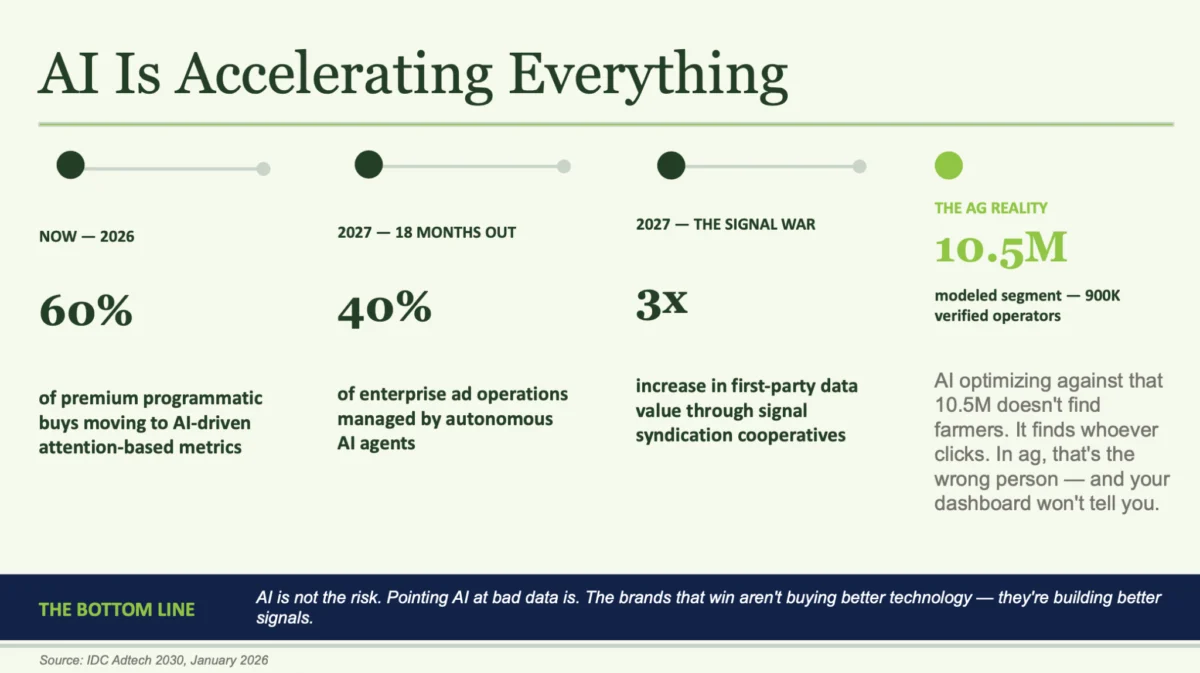
AI does not possess inherent wisdom; it possesses speed. When a marketer feeds an AI engine data based on weak audience segments or misleading KPIs, the AI does not fix those problems—it accelerates them. If a campaign is optimized for click-through rate (CTR), the AI will relentlessly hunt for "clickers"—individuals who may have no intention of purchasing a $500,000 tractor or thousands of acres’ worth of crop protection products.
The brands seeing the strongest performance in this cycle are not those with the most advanced AI algorithms, but those with the highest-fidelity data signals. They have recognized that AI is only as effective as the underlying data inputs, and they are prioritizing verified operator data over the nebulous, modeled segments that have historically plagued the industry.

The Data Chasm: Verified vs. Modeled Audiences
The most jarring realization for many in the industry is the massive discrepancy between "modeled" audience sizes and "verified" operator populations.
In a recent analysis conducted by Farm Journal, the results were sobering. When comparing a modeled third-party crop producer audience to a verified operator audience, the third-party segment claimed a reach of approximately 12.6 million individuals. In reality, the verified operator pool consisted of roughly 983,000 active individuals.
This is not necessarily a failure of vendor intent, but a systemic failure of data architecture. The discrepancy is often even more radical. In another instance, a third-party agriculture segment containing 10.5 million IDs shared absolutely zero overlap with a verified audience of 592,000 in-market machinery buyers.
This creates a dangerous illusion of scale. Marketers who rely on these massive, unverified segments are effectively casting a net into a dry pond, celebrating the size of the net while failing to notice the absence of fish.
The KPI Trap: Why Clicks Are a "Vanity" Metric
The reliance on CTR as a primary performance indicator is perhaps the most significant structural weakness in modern ag marketing. It is a metric of convenience, not of business intent.
Nielsen research has repeatedly demonstrated that CTR shows less than a 1% correlation with actual purchase intent, brand awareness, or ad recall in the agricultural sector. Because ag buying cycles are long, complex, and involve multiple decision-makers, a single click is rarely a proxy for a sale.
When marketers optimize for clicks, they inadvertently favor "dashboard behavior"—the tendency for an audience to engage with an ad for superficial reasons—rather than "buyer behavior." For high-value agricultural products, success must be measured by engagement depth, site behavior, and, ultimately, conversion.
Four Questions to Audit Your Campaign Strategy
To navigate this shift, marketing teams must adopt a more skeptical, data-driven framework. Before launching a campaign, leaders should apply the "Four-Question Audit" to their data strategy:

- Is the audience verified or modeled? Modeled data relies on probabilistic inferences, whereas verified data relies on observable, confirmed behavior. In a high-stakes market, knowing the difference is the difference between revenue and wasted spend.
- When was the data refreshed? Agriculture is a seasonal, fast-moving industry. Data that is 18 months old is functionally useless. It fails to account for operation transitions, shifting commodity markets, and changing equipment needs.
- Does the creative match the audience? The most accurate audience data in the world will fail if the message is misaligned. Messaging must be tailored to the specific operation type, the specific pain point, and the specific stage of the buying journey.
- Are we measuring buyer behavior or dashboard behavior? Move beyond the click. Track view-through activity, audience movement, and long-term engagement patterns that correlate with actual sales.
The Path Forward: Evidence-Based Marketing
The proof that this shift is necessary is visible in recent head-to-head campaign tests. When keeping creative and spend constant, changing only the audience quality yields dramatic results.
In one such test, two campaigns were deployed. Both received the same number of clicks. However, the campaign built on a verified audience generated 106% more unique users and 341% more total site visits than the campaign built on traditional, broad-reach third-party data. Had the marketers involved only measured CTR, they would have concluded the campaigns were identical. Instead, they discovered that one was four times more effective at driving actual traffic to the brand.
Furthermore, context matters. Contextual targeting—placing ads within relevant agricultural content rather than "run-of-network" placements—consistently drives a 79% higher CTR. When combined with action-triggered emails to verified operators, which can achieve open rates as high as 35.65%, the strategy becomes clear.
Implications for the Future of Ag Marketing
The era of "easy" digital marketing is over. As we look toward 2027 and beyond, the competitive advantage will belong to the marketers who treat data as a strategic asset rather than a commodity.
This requires a change in culture. It means moving away from the comfort of vanity dashboards and toward the rigor of incrementality and pipeline contribution. It means investing in first-party data infrastructure and cultivating deeper relationships with verified audiences.
The market has shifted, and the demands of the farm economy are clearer than ever. Budgets will continue to be tight, and the pressure for performance will only mount. Those who choose to ignore these realities will continue to see their budgets diluted by poor signals and ineffective metrics. Those who embrace this shift—by asking harder questions, demanding better data, and focusing on measurable business outcomes—will not only survive the current market volatility but will lead the industry into a new, more efficient, and more profitable era of agricultural commerce.
Better signals lead to better decisions, and in the high-stakes world of modern agriculture, better decisions are the only path to sustainable growth.

 Nila Kartika Wati

 Layla Zulfa

