

 Jia Lissa

 Raul Delapena Setiawan

 Asro

 Layla Zulfa

 Sagoh
 Muslim
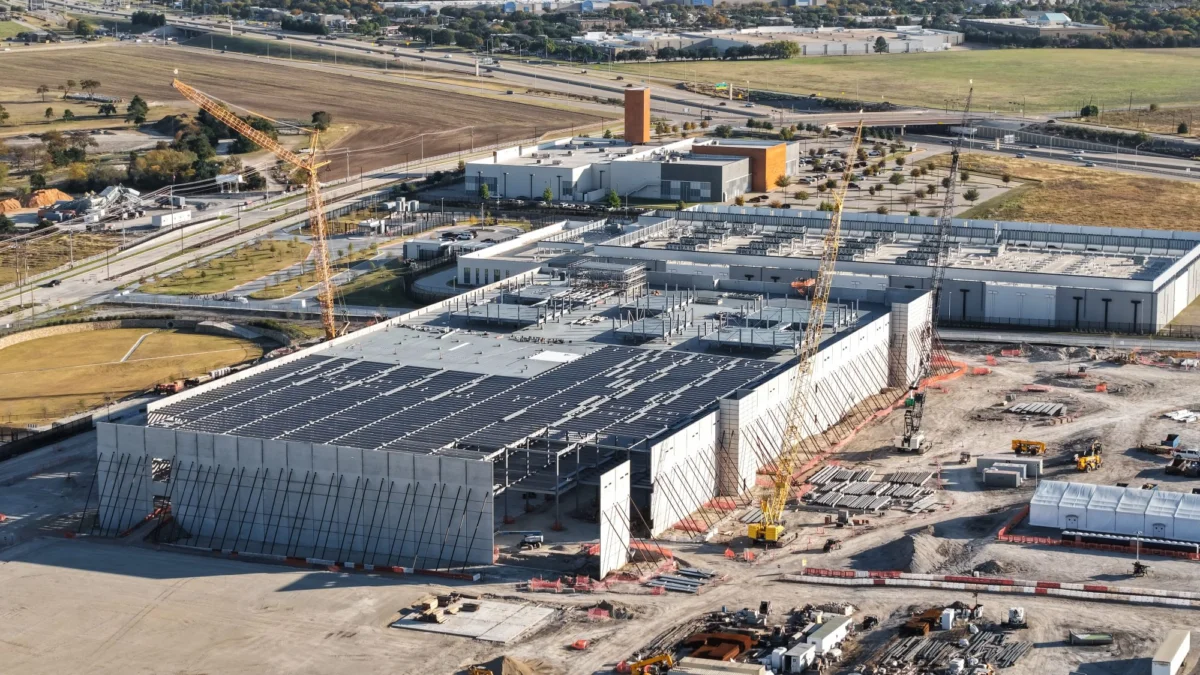
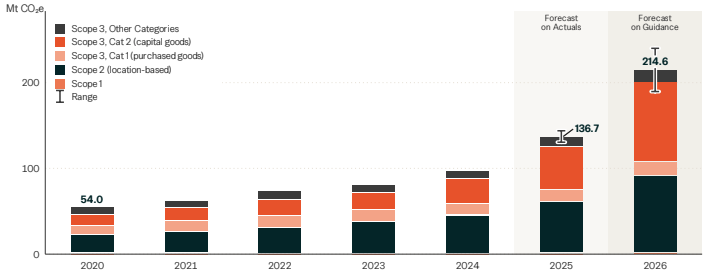
The global race to dominate artificial intelligence is no longer just a contest of computational power and market capitalization; it has become a profound environmental challenge. According to a pioneering forecasting model released this week by the Bricola Group, the carbon emissions of the world’s five largest hyperscalers—Alphabet, Amazon Web Services (AWS), Meta, Microsoft, and Oracle—are on track to skyrocket by nearly 60 percent this calendar year.
This dramatic increase underscores the inherent tension between the tech industry’s relentless pursuit of generative AI and its stated commitments to carbon neutrality. As these corporations pour unprecedented capital into the physical infrastructure required to power the next generation of computing, the environmental consequences are becoming impossible to ignore.
The Magnitude of the Footprint: A Corporate Nation-State
The forecast predicts that by 2026, the combined emissions of the “Hyper 5” will reach an staggering 215 million metric tons of carbon dioxide equivalent (tCO2e). To put this figure into perspective, it exceeds the annual national carbon footprint of a large majority of countries worldwide. Even after accounting for renewable energy certificates (RECs) and other carbon-offsetting instruments, the net total remains a daunting 140 million tCO2e—a significant leap from the 87 million tCO2e recorded in 2025.
The primary culprit behind this surge is the massive expansion of physical data center capacity. Building, equipping, and powering the server farms necessary to train and deploy Large Language Models (LLMs) is an energy-intensive endeavor. With these five companies collectively projected to spend over $1 trillion in capital expenditures (capex) across 2025 and 2026, the infrastructure build-out is accelerating at a pace that is rapidly outstripping decarbonization efforts.
Chronology of a Crisis: From Ambition to Acceleration
The trajectory of hyperscaler emissions can be traced back to the onset of the current AI boom. In the early 2020s, many of these companies set ambitious "net-zero" or "carbon-negative" goals, believing that their transition to renewable energy procurement would decouple their growth from their environmental impact.
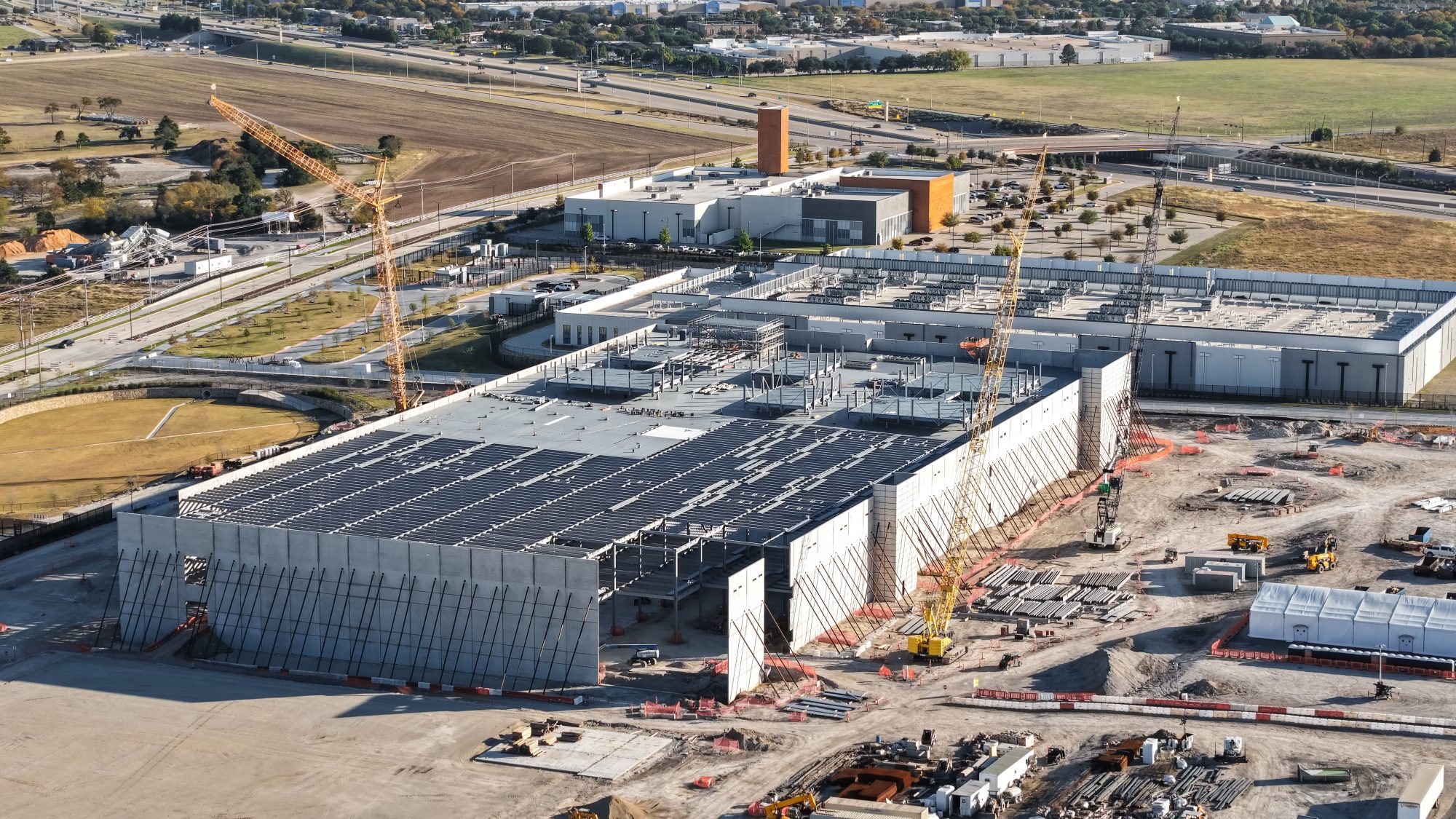
However, the rapid arrival of generative AI in 2022 and 2023 shifted the goalposts. The high-performance computing clusters required for AI have a power density far exceeding traditional cloud workloads. As the companies raced to secure GPU supply chains, the demand for power led to an unprecedented strain on regional grids.
By late 2024 and throughout 2025, companies like Microsoft and Alphabet began to publicly acknowledge that their climate progress was stalling. Their annual sustainability reports—often published with a lag of several months—began to show the first cracks in the armor. Now, in late 2026, the Bricola Group’s model confirms that the "AI surge" is not a temporary anomaly but a fundamental, structural change in the carbon profile of Big Tech.
Unveiling the Bricola Model: A New Lens on Corporate Responsibility
The methodology behind these startling figures was developed by Jimmy Gillan, a former Amazon economist who recognized a critical flaw in the current system of environmental disclosure: the "reporting lag."
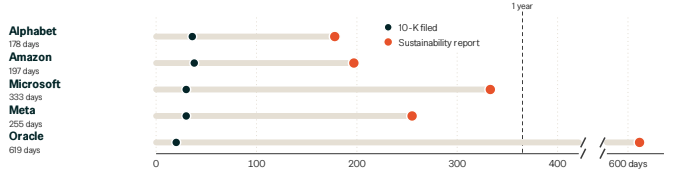
Under existing corporate norms, emissions data is typically buried in sustainability reports that emerge five to nine months after a company publishes its annual 10-K financial results. This means that by the time investors and environmental advocates see the data, the decision-making cycle that led to those emissions is already long in the past.
Gillan’s model bridges this gap by using historical correlations between capital expenditure and carbon emissions. Because data center construction and hardware procurement are highly correlated with carbon output, Gillan can estimate a company’s footprint as soon as its financial capex data becomes available.
"My hope is to accelerate what we think is going to come out of the disclosure process so that we can identify the areas where decarbonization is most needed," Gillan explained. By providing this real-time visibility, the model enables stakeholders to push for cleaner energy solutions while the capital is still being deployed, rather than waiting for the "autopsy" of a sustainability report.
Supporting Data: The Concentration of Emissions
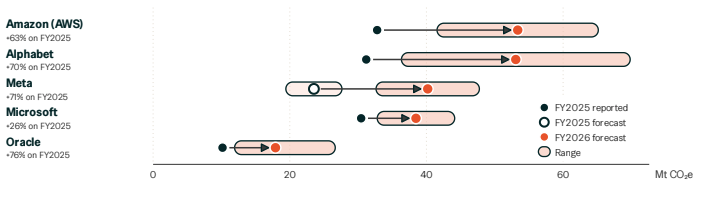
The Bricola forecast reveals a stark concentration of emissions among the leaders of the sector. AWS and Alphabet are projected to be the largest emitters in 2026, with their individual footprints each totaling just over 53 million tCO2e.
The divergence in these numbers is partly due to differences in fiscal reporting cycles. For instance, Microsoft and Oracle, which operate on fiscal years ending in June and May respectively, provide a clearer look at confirmed capex. For companies like Amazon and Alphabet, whose fiscal years align with the calendar year, the model relies on recent financial guidance. Regardless of the nuance in reporting, the trend line is uniform: the bigger the investment in AI, the higher the emissions.
The data also reveals the limitations of the current reliance on market-based mechanisms. When companies purchase renewable energy certificates to "zero out" their footprint, they are often papering over a much larger, fossil-fuel-dependent reality. The difference between the 215 million tCO2e gross footprint and the 140 million tCO2e adjusted footprint highlights how heavily these companies depend on financial instruments rather than actual, grid-wide decarbonization.
Official Responses and Industry Silences
To date, the response from the major tech giants has been one of cautious recalibration. Companies like Microsoft have begun adjusting their climate agendas, admitting that their previous targets were set before the full scale of the AI energy demand was understood. Alphabet has similarly acknowledged that its AI expansion is weighing heavily on its sustainability goals, though both companies continue to maintain that they remain committed to long-term carbon neutrality.
Critics argue that these adjustments are insufficient. There is a growing call for tech companies to invest not just in renewable energy credits, but in the actual capacity of local grids—funding transmission upgrades, storage solutions, and firm, carbon-free energy sources like geothermal or advanced nuclear.
So far, none of the companies have signaled a willingness to throttle back their AI infrastructure spending to meet climate targets. Instead, the strategy appears to be one of "growth first, cleanup later," a stance that environmental NGOs describe as increasingly untenable.
Implications: The Road Ahead
The implications of this 60 percent surge are multifaceted, affecting everything from global energy policy to investor sentiment.
1. The Energy Grid Challenge
As hyperscalers continue to snap up power capacity, they are effectively competing with municipalities and traditional industries for energy. This is forcing grid operators to keep aging fossil-fuel plants online longer than planned to ensure stability, a phenomenon that is directly undermining the national energy transition goals of many countries.
2. Investor Scrutiny
Investors are increasingly viewing climate risk as financial risk. With the Bricola model now providing a transparent, predictive look at the "carbon liability" of these tech giants, ESG-focused funds may begin to factor these emissions forecasts into their valuation models. If a company’s AI strategy is fundamentally incompatible with its carbon goals, shareholders may begin to demand a clearer pathway to decoupling revenue growth from carbon output.
3. Policy and Regulation
The surge in emissions will likely invite greater regulatory scrutiny. Governments in the EU and North America are beginning to look at the energy consumption of data centers as a matter of national security and public infrastructure. We may see a push for more stringent "efficiency mandates" or higher taxes on the energy used by large-scale AI training runs.
4. A Call for Innovation
Perhaps the most positive outcome of this realization is the shift in focus toward efficiency. If these companies cannot meet their targets through offsets, they will be forced to innovate at the hardware and software levels. This includes developing more energy-efficient AI chips, optimizing algorithms to require less compute, and pioneering new cooling technologies for data centers.
Conclusion: A Turning Point for Tech
The findings from the Bricola Group represent a watershed moment. The "Hyper 5" are at a crossroads: they can continue to pursue an aggressive, carbon-heavy expansion that ignores the planetary boundaries of their infrastructure, or they can use the current data to force a radical change in how they source, use, and manage energy.
As Jim Giles, Editor-at-Large at Trellis Group, notes, the goal of these new forecasting models is to prevent teams from "waiting for a number to come in." By forcing these emissions into the light now, rather than years down the road, the industry is being given an opportunity to course-correct. Whether they take that opportunity, or continue to treat the climate as an externality of the digital age, will define the legacy of the AI revolution.
For now, the math is clear: the cost of artificial intelligence is rising, and it is a cost that the environment can ill afford to pay.


 Nila Kartika Wati

 Dwi Wanna