

 Nana Wu

 Dwi Wanna

 Suro Senen

 Evan Lee Salim

 Siti Muinah
Listen to This Article:
For those yet to embark on this unique gastronomic adventure, envision a meal where each arrival at your table is a carefully orchestrated surprise. One moment, a delicate, bright amuse-bouche awakens the palate; the next, a deeply savory, richly textured course captivates the senses. Each plate, meticulously crafted and presented, unveils another chapter in the chef’s culinary narrative for the evening. This is the essence of a tasting menu: a chef-curated odyssey designed to transport diners on a multi-sensory journey, one exquisite, small course at a time.
Yet, this distinctive dining format often prompts a flurry of practical inquiries, particularly for first-timers. How many courses constitute a "tasting"? What duration should one allocate for such an experience? Are wine pairings an obligatory accompaniment? And to what extent can one influence the culinary procession that graces the table?
Ahead, we delve into the intricate mechanics of tasting menus, illuminating what discerning guests can anticipate from this immersive experience and exploring the profound creative allure it holds for the world’s most innovative chefs.
The Art of the Narrative: Decoding the Tasting Menu
At its core, a tasting menu is a fixed, multi-course meal where the chef assumes the role of conductor, meticulously selecting each dish and dictating its sequence. This stands in stark contrast to the conventional à la carte model, where diners assemble their meal from a menu of individual offerings. Instead of choosing a separate appetizer, entrée, and dessert based on personal preference, guests are presented with a harmonious succession of smaller plates, each designed to complement the others, often bound by an overarching theme, seasonal inspiration, or a singular culinary philosophy.
The origins of this refined dining tradition can be traced back to the venerable French practice of menu dégustation—literally, "tasting menu." This concept emerged as a sophisticated vehicle for chefs to demonstrate the breadth of their technical prowess and the versatility of premium ingredients within a single sitting, liberating guests from the constraints of selecting merely one or two main dishes. It was an invitation to experience the full spectrum of a chef’s artistry.
This esteemed tradition has since transcended its French genesis, blossoming into a global phenomenon. Restaurants worldwide now build entire concepts around the tasting menu, transforming it into a canvas for diverse culinary expressions. From Dominique Crenn’s poetically inspired menu at Atelier Crenn in San Francisco, where each course is accompanied by a poem, to Fernando Olea’s nine-course Sazón menu in Santa Fe, which vibrantly celebrates the authentic flavors of Mexico, the format allows for boundless creativity.
The sheer volume of courses can vary dramatically, reflecting the restaurant’s ethos and ambition. A vibrant neighborhood bistro might offer a concise five or six courses, concluding within two hours, while a world-renowned destination dining room could orchestrate an elaborate fifteen to twenty-course spectacle that gracefully unfolds over an entire evening. These variations underscore the adaptability of the tasting menu, proving it can be both an accessible introduction to fine dining and an extensive, deeply contemplative culinary journey.
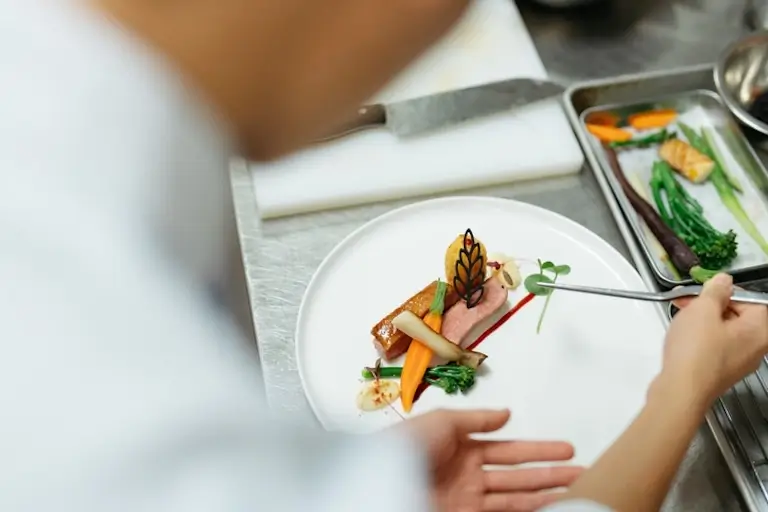
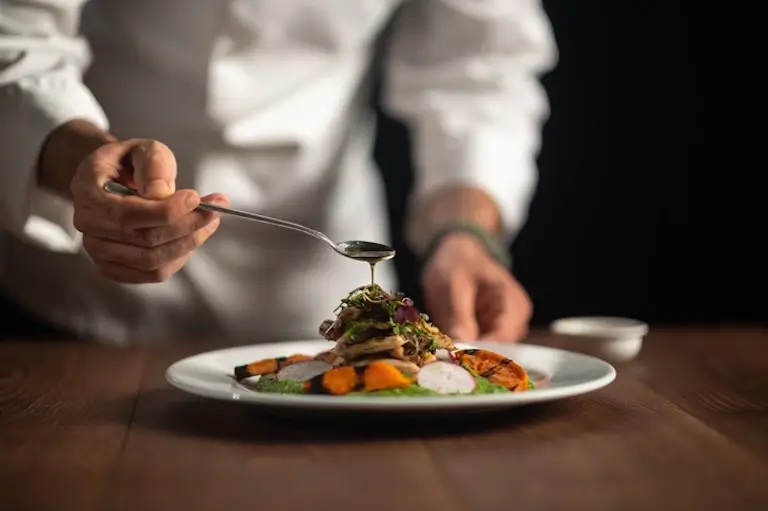
A critical aspect of the tasting menu’s appeal for chefs lies in its capacity to focus intensely on composition, balance, and aesthetic presentation, ensuring that each course is a visual and gastronomic masterpiece in its own right, while also contributing to the meal’s overall flow.
A Curated Journey vs. Personal Preference: Tasting Menu Explained
To fully grasp the essence of a tasting menu, it’s instructive to juxtapose it with the more ubiquitous à la carte dining experience. À la carte empowers the diner: you dictate your courses, control your pacing, and determine the scope of your order. A tasting menu, conversely, shifts this locus of control to the kitchen, trading individual flexibility for a meticulously curated, guided gastronomic adventure.
| Feature | Tasting Menu | À La Carte |
|---|---|---|
| Course Selection | Chosen entirely by the chef, with minimal or no substitutions. | Selected by the diner from a comprehensive menu. |
| Pacing | Deliberately set by the kitchen, typically slower and more contemplative. | Determined by the diner, allowing for faster or slower meals. |
| Price Structure | Fixed price per person, often with an optional add-on for beverage pairings. | Priced per individual dish; total cost fluctuates with order. |
| Flexibility | Limited; dietary needs and allergies usually require advance notice. | High; diners can order as much or as little as desired. |
| Best For | An immersive, guided experience centered on the chef’s artistic vision. | A quicker meal, greater control over choices, or specific cravings. |
Furthermore, a tasting menu distinguishes itself subtly from a prix fixe menu. While both are offered at a set price, prix fixe menus typically present diners with a limited choice within a smaller number of courses (e.g., a selection of three appetizers, three entrées, and three desserts). A tasting menu, however, invariably features a greater number of courses, each integral to a precisely planned progression conceived by the chef. Every dish must not only stand as a triumph on its own but also resonate harmoniously with the courses that precede and follow it, contributing to a cohesive, evolving narrative.
The Rhythmic Unfolding: Structure and Pacing of a Tasting Menu
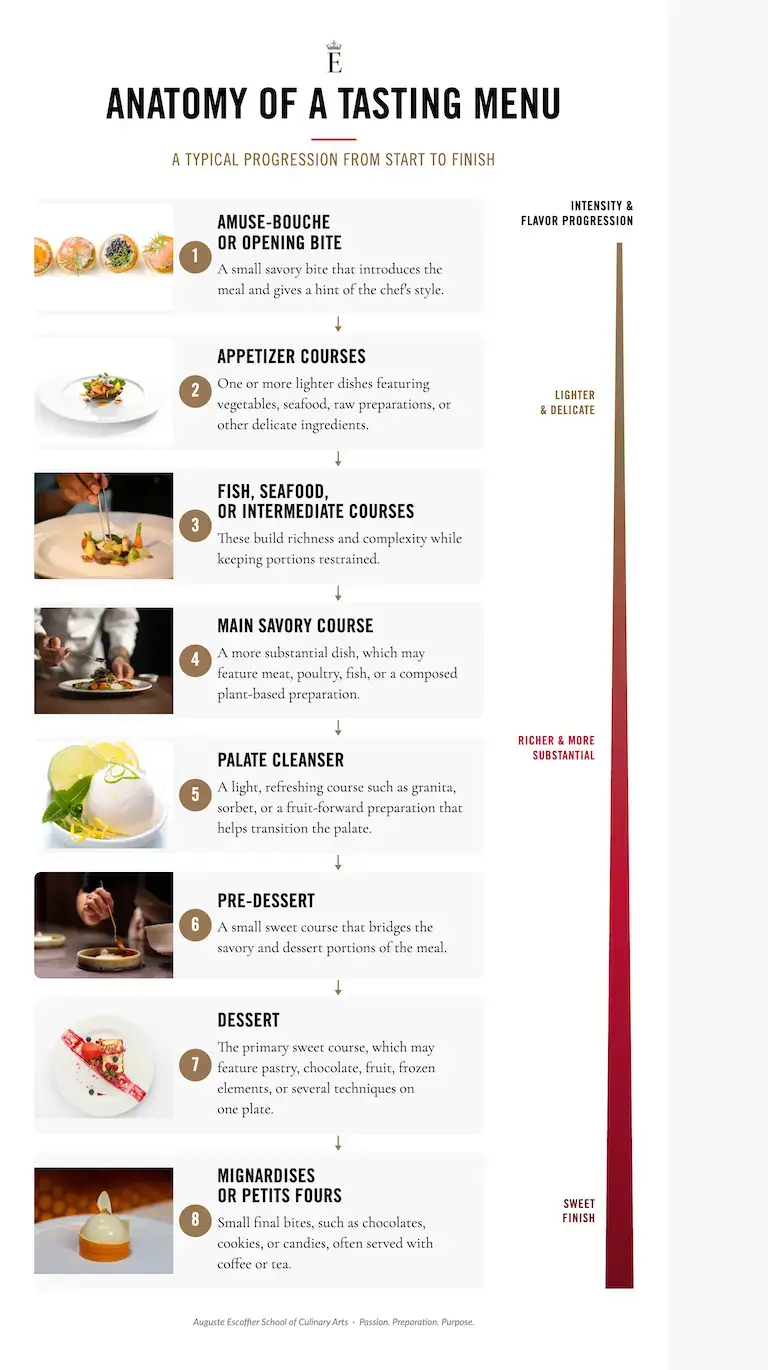
While no rigid formula governs the construction of a tasting menu, a common architectural principle dictates a gradual progression. Meals often commence with lighter, more delicate preparations, slowly building in intensity and richness towards more substantial, savory courses, culminating in a series of artful desserts. The precise sequence, however, remains fluid, adapting to the specific cuisine, seasonal availability, and the chef’s distinctive style.
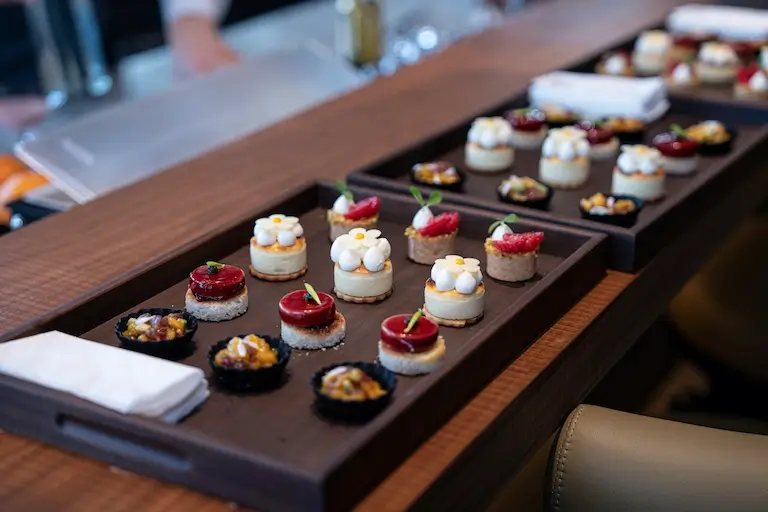
A typical tasting menu often begins with an amuse-bouche—a tiny, complimentary bite designed to tantalize the palate and signal the commencement of the culinary journey. This might be followed by a delicate seafood course, perhaps a crudo or a light scallop preparation, then a vegetable-centric dish showcasing seasonal produce. The progression might lead to a pasta or grain course, followed by a lighter protein such as poultry, before culminating in a more robust main course, often red meat or game. An intermezzo or palate cleanser might appear before dessert, followed by a main dessert and then petit fours or mignardises to offer a sweet conclusion.
Many contemporary menus boldly deviate from this traditional structure, particularly when centered around a specific ingredient, a distinct culinary region, or an innovative conceptual framework. For instance, at Blue Hill at Stone Barns in New York’s Hudson Valley, Chef Dan Barber’s team crafts their menu entirely around the produce harvested from their working farm, ensuring that the dishes are in constant flux, evolving with the seasons and reflecting the immediate bounty of the land. This approach transforms each visit into a unique, ephemeral experience.
Given the intricate preparation and sequential service required for numerous individual dishes, tasting menus inherently unfold at a more leisurely pace than a typical restaurant meal. A comprehensive experience can easily span two to four hours, a duration contingent on the number of courses and the overall style of service.
This deliberate pacing is crucial. It affords the kitchen the necessary time to perfect each dish at its optimal moment of readiness, while simultaneously allowing diners to fully appreciate one creation before transitioning to the next. It also empowers chefs to meticulously manage the meal’s overarching arc, carefully balancing richness, portion sizes, temperatures, and flavor intensities to ensure the menu builds gracefully without ever becoming overwhelming.
The seamless execution of this pacing is often a testament to the highly skilled front-of-house team. An astute server will attentively monitor the table, discerning subtle cues—the fullness of a glass, the placement of cutlery, the ebb and flow of conversation—to intuitively judge the opportune moment for the next course. The floor manager, in constant communication with the kitchen, directs the "firing" or holding of dishes, ensuring that the kitchen’s rhythm harmonizes perfectly with the diners’ experience, rather than adhering to a rigid, predetermined schedule. As a general benchmark, many kitchens aim for an interval of fifteen to twenty-five minutes between courses, though this window remains flexible and responsive to the dynamics of each table. This precise choreography ensures a relaxed, enjoyable progression for the guests.
Enhancing the Experience: The Role of Beverage Pairings
Many tasting menus offer an optional beverage pairing, designed to elevate the culinary journey. This typically involves a different pour selected for each course, rather than a single bottle for the entire table. The philosophy mirrors that of the food menu: guests entrust the restaurant’s sommelier with the selection, who meticulously chooses beverages intended to complement the specific flavors, acidity, and weight of each dish as it arrives.
These pairings usually represent an additional cost layered onto the tasting menu price. Portions are intentionally smaller than standard glasses—often just a few ounces per course—encouraging a nuanced tasting experience rather than a full drink with each dish. Some establishments offer tiered pairing options, such as a "standard" selection alongside a "reserve" or "premium" option featuring rarer or more exclusive bottles.
Wine, while traditional, is not the sole avenue for pairing. Some innovative restaurants craft pairings around different spirits, thoughtfully chosen to align with the cuisine or regional influences. At Sazón in Santa Fe, Chef Fernando Olea’s Mexican-inspired degustación menu can be accompanied by an optional tequila, mezcal, and wine pairing, authentically reflecting the menu’s cultural roots rather than defaulting to a solely European wine list.
Other establishments might offer sake pairings alongside Japanese-influenced menus, or, in a nod to evolving preferences, curate sophisticated non-alcoholic pairing menus. These often feature house-made sodas, artisanal teas, shrubs, and freshly pressed juices, providing an equally intricate and delightful experience for guests who prefer to abstain from alcohol.
It is crucial to note that beverage pairings are almost invariably optional. Guests who prefer to order wine by the glass, select from non-alcoholic beverages, or forgo drinks altogether will find most restaurants readily accommodating. The ultimate goal is to enhance, not dictate, the dining experience.
Navigating the Nuances: What to Know Before Your First Tasting Menu
Approaching a tasting menu experience with confidence largely hinges on effective communication and thoughtful timing. Far from being intimidating, a little foresight can transform the evening into a seamless and deeply enjoyable affair.
Reservations are almost always a prerequisite, and many high-end restaurants will request a deposit or even charge the full menu price upfront. This practice allows the kitchen to precisely plan its purchasing and preparation around a fixed guest count, minimizing waste and ensuring optimal freshness. Consequently, cancellation policies tend to be more stringent than at typical restaurants, making it prudent to review them carefully at the time of booking.
Addressing dietary restrictions and allergies as early as possible—ideally when making the reservation, rather than upon arrival—is paramount. Given the fixed and sequential nature of the menu, last-minute alterations pose significant challenges for the kitchen, far more so than in an à la carte setting.
Some forward-thinking restaurants integrate flexibility directly into their format. Eleven Madison Park in New York, for instance, allows guests to choose between a fully plant-based tasting menu or one that incorporates select animal proteins, making dietary preference an inherent part of the reservation process rather than an afterthought. A brief, clear note during booking can spare both you and the restaurant considerable inconvenience.
Once seated, a few informal norms generally prevail across most tasting menu establishments:
- Embrace the Pacing: Allow the service team to guide the meal’s rhythm. Resist the urge to rush or demand faster service. The deliberate pace is integral to the experience.
- Trust the Chef’s Vision: The menu is a curated journey. Unless you have a severe allergy, try to approach each dish with an open mind and a willingness to explore new flavors and textures.
- Limit Distractions: While conversation is encouraged, try to minimize cell phone use or other distractions that might disrupt the flow of service or your appreciation of the meal.
- Engage with the Staff: Feel free to ask questions about the ingredients, techniques, or inspiration behind a dish. The servers are often highly knowledgeable and eager to share insights.
- No Substitutions at the Table (Generally): As reiterated, the menu is fixed. Last-minute requests for changes or substitutions are rarely accommodated, save for severe, pre-notified allergies.
In essence, the golden rule is simple: provide the restaurant with all necessary information in advance, then relax and allow the kitchen and service team to orchestrate a memorable evening. This level of trust and cooperation is precisely what a tasting menu asks of its guests.
The Value Proposition: Why a Tasting Menu Can Be Worth It
While tasting menus can represent a significant financial investment, they offer an unparalleled window into a chef’s complete culinary philosophy. They provide an opportunity to observe firsthand how flavors, textures, temperatures, and portion sizes are meticulously balanced and transitioned from one course to the next, revealing the intricate artistry behind a cohesive meal.
For aspiring culinary students and passionate home cooks, this experience is particularly illuminating. Attending to the pacing, the artful presentation, and the thoughtful progression of the menu can ignite new ideas and provide invaluable insights into constructing meals with greater intention and sophistication. It’s a masterclass in menu development played out on your plate.
The Chef’s Canvas: Why Tasting Menus Are Beloved by Culinary Innovators
Superficially, a fixed menu might appear to restrict creative freedom. There are no spontaneous substitutions, no bespoke dishes crafted to individual guest whims, and essentially the same sequence of courses is served to almost every table on a given night. Yet, for many chefs, this very structure is the source of its profound appeal.
The discipline of preparing and serving the same dish, night after night, offers chefs an extraordinary opportunity for refinement that an à la carte menu rarely permits. A single dish may be executed dozens, even hundreds of times, over the course of its run. Each service becomes a chance to meticulously perfect every element—the precise seasoning, the elegant plating, the nuanced application of a technique—until it reaches an almost ideal state of perfection. This iterative process allows for continuous learning and elevation of the craft.
Beyond artistic refinement, the format grants chefs significant control over the operational intricacies of running a high-caliber kitchen. When a table books a tasting menu, the kitchen possesses a precise understanding of what will be ordered. This predictability streamlines purchasing, preparatory tasks (mise en place), and portioning, making inventory management far more efficient than the myriad combinations possible with an à la carte menu. This operational efficiency directly translates into reduced food waste and more consistent cost control, contributing to a more sustainable and economically viable operation.
Furthermore, smaller, more controlled "covers"—meaning fewer tables seated simultaneously—allow the kitchen to dedicate its focused attention to fewer, often more complex, plates rather than managing a high volume of disparate orders concurrently. This concentrated effort is a key reason why the pacing experienced at the table feels so deliberate and refined. It’s a testament to a kitchen operating with precision and artistry, rather than merely efficiency.
From Tasting to Creating: Forging Your Own Culinary Path
A tasting menu offers a compelling demonstration of the immense thought and skill invested in every facet of a meal, from the exquisite balance of a single dish to the synergistic interplay of multiple courses. Developing the ability to make such sophisticated culinary decisions yourself demands rigorous practice in flavor development, mastery of diverse cooking techniques, meticulous mise en place, artful plating, impeccable timing, and strategic menu development.
Students enrolled in Escoffier’s Culinary Arts programs are afforded the unique opportunity to cultivate these foundational skills while gaining an intimate understanding of how professional chefs approach the demanding yet rewarding environment of a fine dining kitchen. If you are driven by a passion to articulate your own distinct culinary point of view and aspire to a deeper comprehension of how truly memorable meals are conceived and brought to fruition, we invite you to contact us. Discover more about Escoffier’s comprehensive Culinary Arts programs and take the first step towards realizing your culinary ambitions.
FAQs
How much does a tasting menu typically cost?
Pricing for a tasting menu is highly variable, influenced by the restaurant’s prestige, location, and the number of courses. A tasting menu at a Michelin-starred restaurant, for instance, averages around $165 for the food alone, with destination establishments featuring longer menus or premium ingredients often commanding significantly higher prices. It’s important to note that beverage pairings are almost always priced separately.
What is the primary appeal of a tasting menu?
A tasting menu empowers a chef to curate an entire meal, guiding diners through a progression of flavors, textures, and pacing across multiple courses. For guests, it represents an unparalleled opportunity to experience a restaurant’s full creative range and unique culinary perspective in a single sitting, often encountering dishes and flavor combinations they might not have otherwise chosen.
How long does a typical tasting menu last?
Most tasting menus generally span two to three hours. However, a more concise menu can conclude in under two hours, while an extensive experience featuring ten or more courses can gracefully stretch to approximately four hours, allowing for a truly immersive journey.
What is the usual number of courses in a tasting menu?
Course counts typically range from six to twelve. However, some minimalist menus may offer as few as five courses, while ambitious, fine dining experiences can extend to twenty or more. The sweet spot for many acclaimed restaurants tends to be around eight to ten courses, striking a balance between variety and manageable portion sizes.
Can dietary restrictions or preferences be accommodated?
Allergies and serious dietary restrictions can often be accommodated, provided they are flagged well in advance, ideally at the time of reservation. General preferences (e.g., "I don’t like mushrooms") are typically harder to accommodate, as tasting menus are designed as a fixed, cohesive narrative, not for course-by-course customization or substitution.
Is gratuity included in the tasting menu price?
Not usually. Standard tipping practices generally apply at most tasting menu restaurants. However, some establishments do incorporate gratuity into the fixed price. It is always advisable to check your bill or inquire with the restaurant to confirm their specific policy before adding an additional tip.
What is the appropriate dress code for a tasting menu experience?
Dress codes for tasting menu restaurants vary widely, ranging from strictly formal attire to smart casual. The simplest way to determine what to wear is to consult the restaurant’s website or inquire when making your reservation. When in doubt, it is generally safer to err on the side of smart casual or semi-formal.

 Lina Irawan

 Lina Hope

