 Laily UPN
 Suro Senen

 Muslim

 Raul Delapena Setiawan
 Layla Zulfa
 Siti Muinah
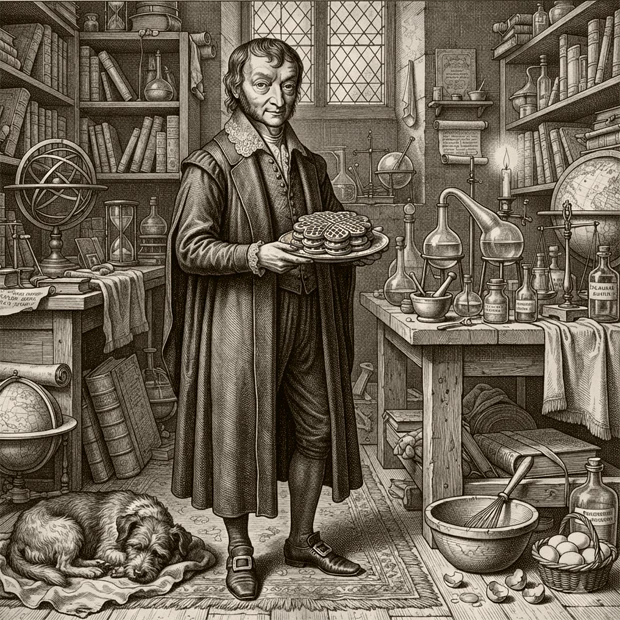
On August 9, 1776, Amedeo Avogadro was born in Turin, Italy. Two and a half centuries later, his legacy as the father of molecular theory—the man who bridged the gap between the macroscopic world and the microscopic realm of atoms—is being celebrated in the most unexpected of laboratories: the kitchen.
In a project over a decade in the making, the culinary science platform Khymos has officially launched "Avogadro," a sophisticated, parametric waffle recipe generator. This tool marks a departure from traditional cookbooks, moving away from static, handwritten instructions toward a dynamic, data-driven approach to baking. By leveraging the same principles of proportionality and composition that defined Avogadro’s work, this project invites home cooks to explore the vast, untapped chemical landscape of the humble waffle.
Main Facts: A Digital Gastronomy Engine
The Avogadro project is not a recipe database in the conventional sense. Users will find no pre-stored list of grandma’s favorite waffles. Instead, it is a generative engine that calculates batter composition on the fly. By selecting core ingredient categories—liquid, dairy, fat, egg, starch, and sweeteners—and manipulating a series of intuitive sliders (governing properties such as richness, tanginess, and sweetness), users can engineer their own unique culinary output.
The system provides immediate feedback through a "waffle heart quality indicator." This diagnostic tool serves two functions: it confirms if the chosen ratios will yield a physically functional batter and evaluates how the recipe aligns with historical norms. It is a bold experiment in "culinary cartography," designed to help users navigate the boundaries of what constitutes a waffle. As the developers note, "fringe doesn’t mean bad"—some of the most successful commercial mixes on the market sit well outside the conventional cluster of traditional recipes, proving that there is still much to discover in the realm of batter dynamics.
Chronology: From 2014 Sketches to a 2026 Reality
The journey of the Avogadro project reflects the slow-simmering nature of scientific inquiry. The concept was first conceived in 2014, when the initial sketches were drafted alongside a rudimentary, unrefined Excel model. At that stage, the project remained a theoretical curiosity, a "what if" scenario trapped in a spreadsheet.
For twelve years, the idea sat dormant, an artifact of design thinking that lacked the computational infrastructure to become truly interactive. The project was eventually revitalized by the confluence of modern web development and a desire to honor the 250th anniversary of Amedeo Avogadro’s birth. By setting the launch for August 9, 2026, the creators aligned the digital tool with the historical significance of its namesake, effectively turning a birthday celebration into a launchpad for a new way of conceptualizing food chemistry. The progression from crude 2014 mockups to the polished, responsive web interface seen today illustrates the evolution of digital tools from static representations to generative, real-time engines.

Supporting Data: 10²⁷ Combinations of Batter
The sheer scale of the Avogadro generator is staggering. By combining the vast array of ingredient selections with the nuanced positioning of the control sliders, the generator spans approximately 10²⁷ distinct control settings. To put this into perspective, Avogadro’s constant—the number of constituent particles in a mole—is roughly 6.022 × 10²³.
The tool covers a theoretical space equivalent to approximately 1,660 moles of waffle batter. While the developers provide a necessary caveat—that 10²⁷ control settings do not necessarily equate to 10²⁷ unique culinary experiences due to rounding and physical limitations of the ingredients—the potential for exploration is virtually infinite. Many of these settings will fall outside the realm of "workable" batter, but the existence of this mathematical space suggests that there are millions of viable, delicious, and entirely novel recipes that have yet to be discovered.
This is the central question the project seeks to answer: What defines a waffle batter, and at what point does it cease to be one? By analyzing a corpus of over 1,000 historical Norwegian and Scandinavian recipes, the project attempts to quantify the "tacit knowledge" that chefs have historically relied upon—those vague instructions to "add flour until the consistency is right"—and transform them into concrete, reproducible data.
Official Perspectives: The Expert and Standard Modes
The interface has been thoughtfully designed to accommodate both the casual baker and the serious food scientist. The Standard Mode offers a curated, user-friendly experience with fewer variables, ensuring that any combination selected will result in a successful, predictable waffle. This is the entry point for most users, providing a safety net that guarantees structural integrity.
However, for the adventurous, the Expert Mode removes the guardrails. It grants full access to the entire list of ingredients, all eight control sliders, and a variety of advanced presets. This mode is explicitly designed to take the user "where no cookbook has ever gone before," encouraging the kind of experimentation that leads to genuine culinary innovation.
The developers emphasize that the project is an iterative, community-driven effort. They have not tested all 10²⁷ combinations, and they openly admit that the model is a "well-read guess" at what constitutes the perfect batter. They are actively soliciting feedback, viewing the user base as a global cohort of testers. If a user encounters an "absurd" result or a combination that the model fails to resolve correctly, that data point is considered highly valuable. The goal is to refine the "consistency" algorithms through real-world application, essentially crowdsourcing the perfection of the model.

Implications: The Future of Home Baking
The implications of the Avogadro project extend beyond the kitchen. It represents a shift in how we think about recipes. For centuries, recipes have been treated as immutable, handed-down texts. Digital tools like Avogadro treat recipes as systems.
This project suggests a future where home cooking is as much about parameter tuning as it is about following instructions. By defining the "physics" of a waffle—the interaction between fats, proteins, and starches—the project provides a framework for understanding why certain recipes work and others fail. It democratizes the process of recipe development, allowing individuals to tailor their food to their specific equipment, local ingredients, and personal tastes, rather than relying on standardized, one-size-fits-all instructions.
Moreover, the project acts as a bridge between the arts and the sciences. By celebrating the history of chemistry through the lens of baking, it encourages a more analytical approach to food preparation. It asks the home cook to think like a chemist: to observe variables, measure outcomes, and iterate based on data.
As we look toward the future, the Avogadro generator serves as a reminder that science is not confined to the laboratory. It is in our pantries, our mixing bowls, and our waffle irons. Whether you are a professional chef or a Sunday morning breakfast enthusiast, the invitation is clear: pick your ingredients, adjust your sliders, and participate in the creation of a recipe that has never existed before. In doing so, you are not just making a meal; you are contributing to a vast, ongoing experiment in the chemistry of the everyday.
To celebrate Amedeo Avogadro’s 250th birthday, there is perhaps no more fitting tribute than to engage with the science of breakfast—designing the batter of your dreams and witnessing, firsthand, the intersection of stoichiometry and syrup.

 Ali Ikhwan

 Lina Hope