
 Muslim
 Raul Delapena Setiawan

 Layla Zulfa
 Laily UPN
 Asro
To the casual observer, a cup of coffee is a simple morning ritual—a dark, invigorating liquid extracted from roasted beans and hot water. Yet, to the chemist, that same cup represents one of the most complex culinary matrices in the human diet. While we often obsess over brewing ratios, grind sizes, and water temperature, the true mystery lies within the liquid itself. Beyond the 98.5% water content, the remaining 1.5% of total dissolved solids (TDS) creates a chemical symphony of hundreds, potentially thousands, of individual molecules.
The Invisible Architecture: What’s Really in Your Coffee?
When we discuss the "strength" of coffee, we often rely on the TDS measurement. In a standard brew, roughly 12 to 15 grams of solids are extracted from 60 grams of coffee grounds per liter of water. While this metric is useful for baristas to ensure consistency, it is a blunt instrument. It tells us the concentration of extracted matter, but it remains largely blind to the specific chemical compounds that dictate the actual sensory experience.
The composition of these solids is a sprawling landscape of carbohydrates, organic acids, lipids, proteins, minerals, and volatile aroma compounds. Many of these substances remain shrouded in mystery. Analytical techniques like chromatography have identified many, yet a significant portion remains uncharacterized. Research from as far back as 2002 using Aroma Extract Dilution Analysis (AEDA) highlighted that even among the key odorants—the molecules responsible for coffee’s signature scent—several remain unidentified.
The challenge in isolating these compounds is two-fold: many exist in concentrations so minute that obtaining a sample large enough for structural analysis is nearly impossible, and others are molecules of such high complexity that their precise architecture eludes our current diagnostic tools.
Chronology of a Chemical Discovery: From Rose Petals to the Coffee Mug
The history of coffee chemistry is marked by incremental breakthroughs in our understanding of volatile compounds. In 1996, a landmark study attempted to synthesize "model" coffees using only 22 key volatile compounds. While the resulting brews were described by sensory panels as "clearly coffee-like," they lacked the depth and soul of a naturally brewed cup. This failure serves as a vital lesson: the essence of coffee is not a singular flavor, but a high-dimensional puzzle.
The narrative took an unexpected turn with the study of $beta$-damascenone. Originally discovered in the 1960s within rose oil—the same compound that helped define the olfactory profile of Dior’s iconic Poison perfume—it was later identified as a cornerstone of coffee’s aroma.
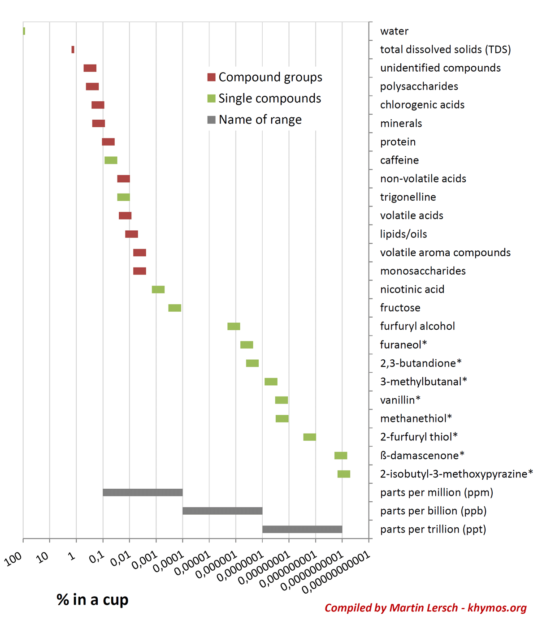
The fascinating aspect of $beta$-damascenone is its concentration. While most flavor compounds require higher concentrations to be detected by the human nose, $beta$-damascenone is active at concentrations as low as parts per trillion (ppt). This defies the conventional intuition that "more means better." In the world of coffee, a compound present at 0.0000000001% can exert a more profound influence on the final cup than a compound present at 0.01%.
Supporting Data: The Logarithmic Scale of Sensory Impact
To visualize the sheer scale of the chemistry involved, researchers have plotted the concentration ranges of coffee compounds across a logarithmic scale, spanning more than nine orders of magnitude. This visualization is essential for understanding why TDS is an insufficient metric.
The Polar vs. Non-Polar Divide
The behavior of these compounds during the brewing process is dictated by their polarity:
- Polar Compounds: These include acids, minerals, proteins, and carbohydrates. Because water is a polar solvent, it is remarkably efficient at extracting these elements, capturing over 75% of them during the brewing process.
- Non-Polar Compounds: This group includes the vital lipids and volatile aroma compounds that give coffee its top notes and mouthfeel. Water struggles to dissolve these, typically extracting only 10% to 30%.
This discrepancy suggests that our current brewing methods are essentially "polar-heavy." If one were to explore the frontiers of coffee extraction, one might look toward alternative solvents—such as ethanol—to unlock the non-polar compounds that are currently left behind in the spent grounds.
The Odor Activity Value (OAV)
The key to understanding why some compounds matter more than others lies in the Odor Activity Value (OAV), defined as the concentration of a compound divided by its odor threshold. Because the human nose possesses unique sensitivities for every molecule, we cannot rank the importance of a compound based on its weight or volume. We must instead look at its "potency."
Official Perspectives and Expert Consensus
The scientific community, through bodies such as the Journal of Agricultural and Food Chemistry, has long pushed for a move away from "bulk" measurements like TDS. Experts argue that while TDS is an excellent tool for quality control in a café setting, it is a poor predictor of "aroma and flavor."
The consensus is clear: our nose remains the most sensitive analytical instrument available. While researchers continue to map the "unknown" compounds that contribute to bitterness and color, the average consumer—and even the seasoned professional—must rely on an experimental, sensory-led approach to truly appreciate the nuances of a specific roast or origin.
Implications: The Future of the "Perfect" Cup
What does this mean for the future of coffee? As we gain a deeper understanding of the molecular makeup of our favorite morning beverage, several implications emerge for both the industry and the home enthusiast:
1. Beyond the Strength Metric
We are approaching a limit where TDS measurements will no longer suffice for high-end specialty coffee. Future brewing technology may focus on controlling the extraction of non-polar compounds, perhaps through pressure manipulation or the use of non-aqueous solvents in industrial flavor creation.
2. The Rise of Synthetic Complexity
While the 1996 "model coffee" experiment was a humble beginning, the march of synthetic chemistry suggests that we may one day be able to "engineer" specific flavor profiles. By adding back the missing, minute-concentration volatiles that are typically lost in the roasting or brewing process, we could see the rise of "designer" coffees that possess a consistency and aromatic intensity that nature, left to its own devices, cannot always provide.
3. The Preservation of the Unknown
Despite our technological advancements, the fact that we still haven’t characterized all the compounds in a humble cup of coffee is a testament to the drink’s complexity. There is a inherent value in the "unknown"—the subtle, unidentified compounds that provide the bitterness, the body, and the "x-factor" that makes one origin distinct from another.
4. A Call for Sensory Literacy
For the consumer, the implications are empowering. Understanding that aroma is determined by parts-per-trillion concentrations should encourage a more mindful approach to coffee consumption. It suggests that the "best" coffee isn’t necessarily the one with the highest extraction yield or the highest TDS, but the one that triggers the most complex olfactory response.
Conclusion
The next time you lift a cup of coffee to your lips, consider the invisible, microscopic landscape you are about to experience. You are not just drinking hot water and caffeine; you are consuming a volatile, high-dimensional chemical extract containing compounds born from the same floral oils that define high-end perfumery.
The journey from the coffee cherry to the cup is a process of extreme chemical refinement. While science has allowed us to pull back the curtain on the role of $beta$-damascenone and the polar-non-polar divide, the vast majority of what makes coffee a masterpiece remains a mystery. We are, in essence, all amateur chemists, using our own sensory systems to explore a landscape that science is only just beginning to map. Whether you are a professional barista or a home enthusiast, the lesson remains the same: stop looking only at the numbers, and start listening to the coffee.


 Ali Ikhwan

 Lina Hope

