

 Ammar Sabilarrohman
 Ali Ikhwan
 Dwi Wanna
 Neng Nana
 Siti Muinah
 Lina Hope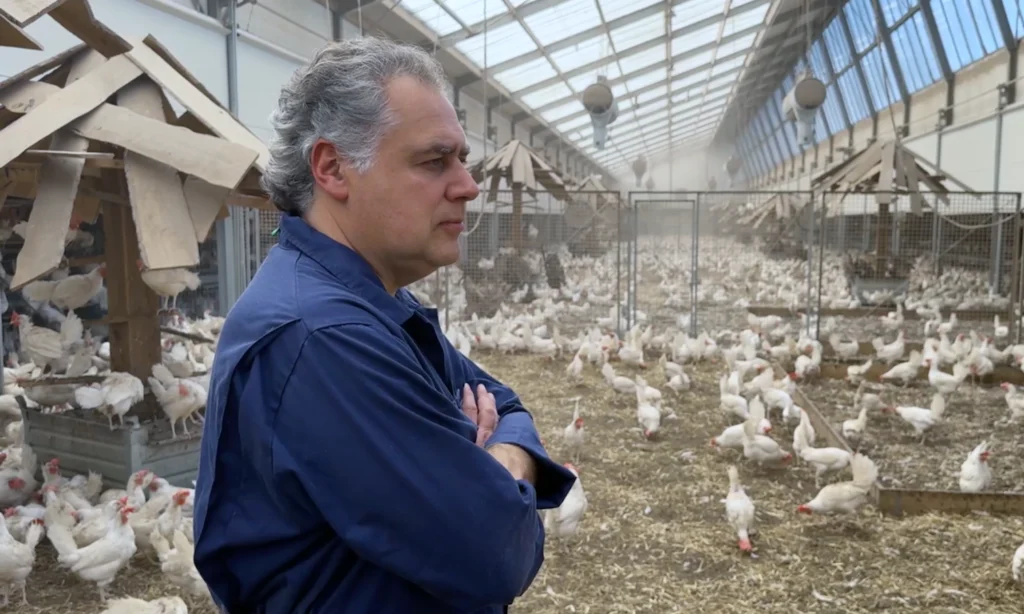
In the quiet, rural landscapes of the Netherlands, a singular experiment is unfolding—one that challenges the fundamental ethics of our global food supply. Ruud Zanders, a veteran of the poultry industry, finds himself at the center of an ideological and professional maelstrom. As the founder of Kipster, a poultry farm that has gained international acclaim for its radical approach to animal welfare and sustainability, Zanders is simultaneously a producer of animal products and a firm believer in a vegan future.
This internal conflict is the driving force behind The Vegan Poultry Farmer, a poignant new documentary by filmmaker Kadir van Lohuizen. The film follows Zanders as he travels the globe, consulting with scientists, activists, and industry experts to address a singular, haunting question: Is an animal-free food system truly possible, and if so, what is the role of the farmer in that transition?
The Genesis of a Disruptive Model
To understand the weight of Zanders’ mission, one must look at his past. Before the inception of Kipster in 2017, Zanders operated within the traditional, large-scale industrial poultry sector. When his business went bankrupt, he was forced to reckon with the machinery of modern agriculture. He witnessed firsthand how the pursuit of efficiency and low-cost protein came at a steep, often hidden, price.
"Something else is paying the price: biodiversity, the climate, the animal itself," Zanders reflects in the film. This realization became the blueprint for Kipster. Unlike conventional facilities that may house up to 350,000 birds in a single barn, Kipster limits its population to 24,000.
Core Pillars of the Kipster Philosophy
Zanders’ model is built on three pillars that remain largely absent from the industrial status quo:
- Animal Welfare: By providing indoor and outdoor access, sunlight, and complex enrichment environments, the birds are permitted to express natural behaviors often suppressed in factory farming.
- Sustainability: The farm operates on a circular economic principle, utilizing solar energy and waste streams—such as stale pastries and food-grade leftovers—as feed, effectively decoupling livestock from the need to clear land for corn and soy.
- Transparency: Through the use of live-streaming cameras, the farm invites the public to view their operations 24/7, stripping away the traditional opacity of the animal agriculture industry.
Chronology: From Industrial Standard to Circular Innovation
The evolution of Zanders’ thinking did not happen overnight. It was a gradual stripping away of industrial dogma.
- Pre-2017: Zanders operates within the conventional framework of intensive animal agriculture, eventually witnessing its total collapse.
- 2017: The first Kipster farm opens in the Netherlands, signaling a shift toward a "least bad" version of animal farming.
- Post-2017 to Present: The farm garners global attention for its low-carbon footprint—reporting emissions 23% lower than conventional farms—and its innovative use of circular waste-to-feed technology.
- The Documentary Journey: Zanders embarks on a global tour, meeting with figures like Imke de Boer of Wageningen University and activist George Monbiot, to test the viability of a post-livestock world.
Supporting Data: The Environmental Cost of Eggs
The urgency behind Zanders’ search is backed by sobering data. According to the U.S. Department of Agriculture’s Animal and Plant Health Inspection Service (APHIS), the industrial scale of poultry farming creates an immense logistical and environmental footprint.
Kipster’s primary innovation—the use of secondary food streams—addresses a critical failure in the modern food system: the competition for land. By feeding chickens food that humans no longer eat, Zanders argues that we can decrease the agricultural land footprint required for protein, allowing more space for global ecosystem restoration.
However, the documentary does not shy away from the harsh realities of the industry. Even within the "high-welfare" context of Kipster, the film exposes the raw truth: the transport of animals to slaughter, the sight of limp carcasses, and the blood-spattered reality of processing. These scenes serve as a visceral reminder that regardless of the improvements made to the animal’s life, the end result remains a systemic reliance on the death of sentient creatures.
Official Responses and Expert Critiques
The film serves as a stage for a dialogue between various stakeholders, each offering a distinct perspective on the morality of Zanders’ work.
The Sanctuary Perspective
Melanie Jaecques, a co-owner of a Belgian animal sanctuary, provides one of the most challenging critiques in the documentary. Having spent years rehabilitating birds rescued from the egg industry, Jaecques views the scale of any commercial operation with deep skepticism. To her, the existence of 24,000 birds in a single barn is "terribly wrong." Her view is that while Kipster may be an improvement over the status quo, it remains a system built on commodification rather than genuine flourishing. For Jaecques, it is "not a good system, but the least bad."
The Scientific Consensus
Zanders’ quest for an animal-free future led him to visit diverse global innovators:
- The Circularity Expert: Imke de Boer has long argued that livestock should only be used to cycle nutrients from biomass that humans cannot digest. Zanders’ model aligns with this, yet he pushes further, questioning if even this "efficient" use of animals is ultimately necessary.
- The Environmental Activist: George Monbiot provides a stark warning, noting that livestock farming represents one of the most destructive human activities on the planet. This conversation weighs heavily on Zanders, who admits that hearing such truths from his own mentors intensifies his internal conflict.
- The Global Perspective: By visiting a human-waste-to-fertilizer project in Ghana, Zanders explores the logistical hurdles of a world without animal manure. He finds that the obstacles are not technological, but cultural and systemic.
Implications: The Moral Dilemma of the Transition
The ultimate implication of The Vegan Poultry Farmer is that the current food system is in a state of terminal transition. Zanders does not claim to have the perfect answer; he claims to be a man living in the "in-between."
Can We Go Animal-Free?
Zanders concludes that an animal-free food system is not only possible but likely necessary for the survival of the planet. Yet, he recognizes the inertia of global demand. As long as the world continues to consume eggs, Zanders argues that there is a moral imperative to do so in a way that minimizes suffering and environmental degradation.
"We have to do our utmost best to give them a life worth living," he says. This is his justification for continuing to farm: a harm-reduction strategy in a world that is not yet ready to embrace a fully vegan paradigm.
The Farmer’s Future
The film leaves the viewer with a lingering question about the role of the farmer. If the future is plant-based, what happens to the knowledge and land of those currently managing livestock? Zanders represents a rare breed of producer—one who is actively working to make his own business model obsolete.
His journey from a conventional farmer to an ethical questioner highlights a broader cultural shift. We are moving toward a period where "sustainability" is no longer a buzzword but a mathematical requirement. As Zanders continues to bridge the gap between his personal convictions and the demands of the market, his work stands as a mirror to the consumer. Every purchase, every meal, and every policy decision we make participates in the system he is trying to dismantle.
Whether Kipster is a temporary bridge or a permanent fixture in the agricultural landscape remains to be seen. What is certain, however, is that the moral status of our food system is no longer hidden behind the closed doors of industrial barns. The "vegan poultry farmer" has opened those doors, and the world is now forced to watch.

 Laily UPN
